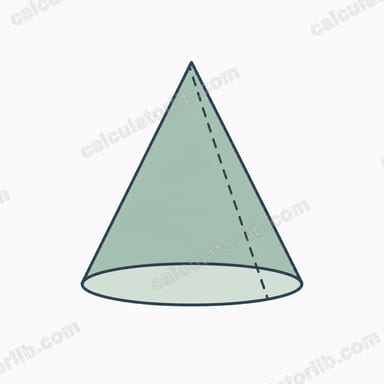

What Is the Lateral Surface of a Cylinder?
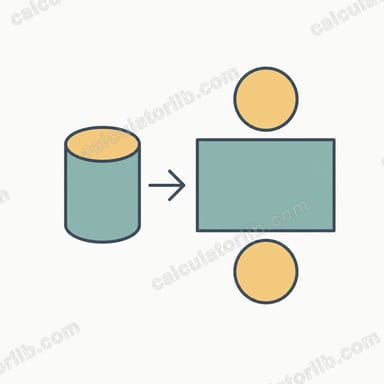
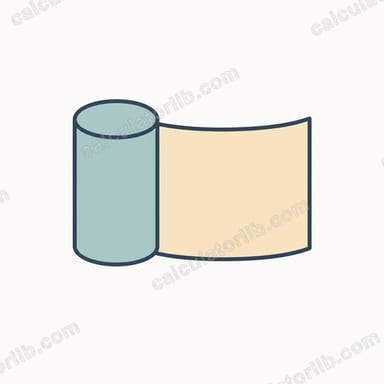
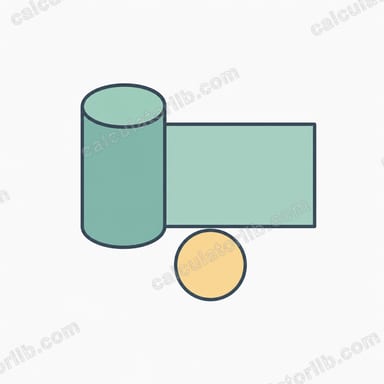
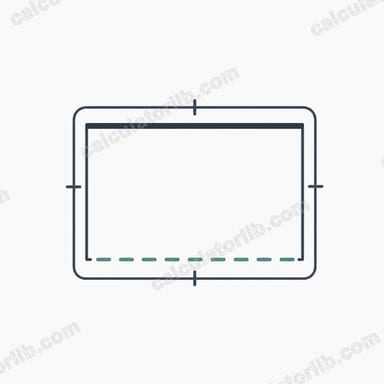
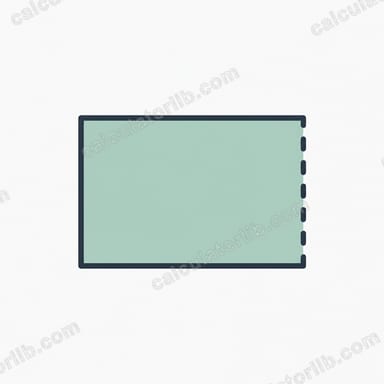
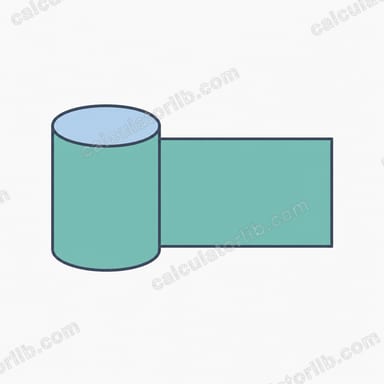
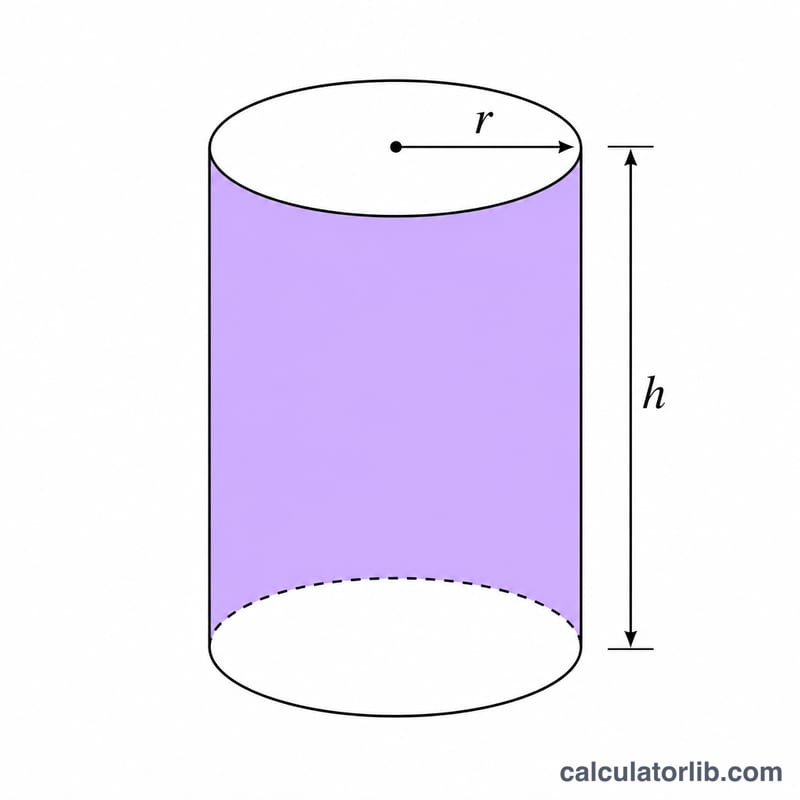
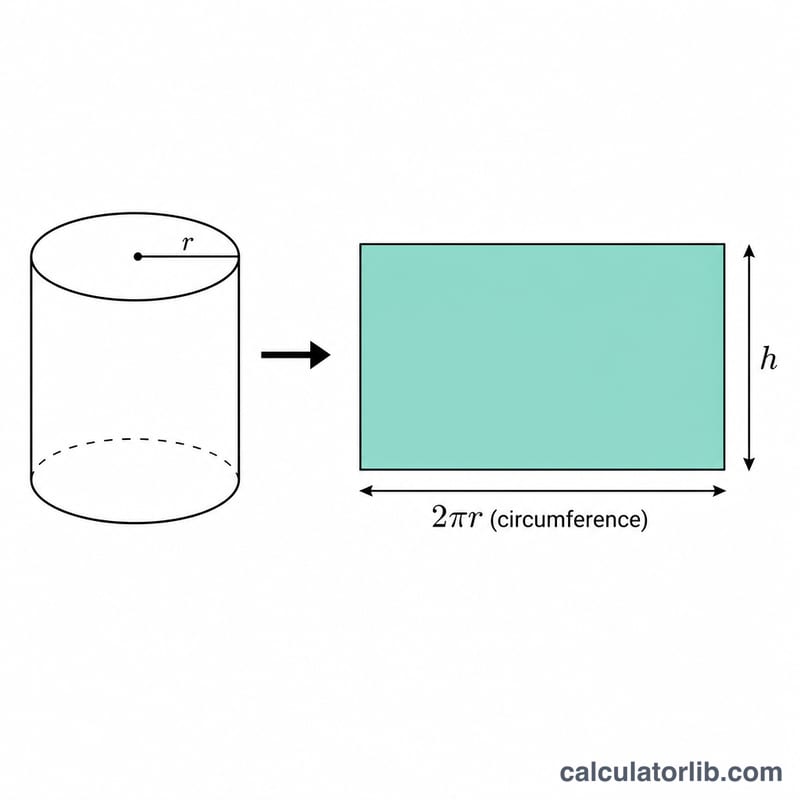
The lateral surface area (LSA) of a cylinder is the area of its curved side only — it excludes the top and bottom circular caps. If you unroll the side of a cylinder, you get a rectangle whose width is the base circumference (\(2\pi r\)) and whose height is the cylinder height (\(h\)). Multiplying these gives the simple formula $$\text{LSA} = 2\pi r h.$$
How to Use This Calculator
Enter the radius (\(r\)) of the circular base and the height (\(h\)) of the cylinder in the same unit (e.g., both in centimetres). The calculator instantly returns the lateral surface area in square units, along with the base circumference. This is universal geometry — it works for any unit system as long as \(r\) and \(h\) share the same unit.
The Formula Explained
The constant \(2\pi\) converts the radius into the circumference of the base circle, \(C = 2\pi r\). Because the side of a cylinder is essentially that circle "extended" upward by the height \(h\), the lateral area is just the circumference times the height: $$\text{LSA} = 2\pi r \times h = 2\pi r h.$$ Note this differs from the total surface area, which adds the two circular ends: $$\text{TSA} = 2\pi r h + 2\pi r^2.$$
Worked Example
Suppose a can has radius \(r = 5\) and height \(h = 10\). Then $$\text{LSA} = 2 \times \pi \times 5 \times 10 = 100\pi \approx 314.16 \text{ square units}.$$ The base circumference is \(2\pi \times 5 = 10\pi \approx 31.42\) units, confirming the unrolled rectangle is about 31.42 wide and 10 tall (\(31.42 \times 10 \approx 314.16\)).
FAQ
Does lateral surface area include the top and bottom? No. Lateral area is only the curved side. Add \(2\pi r^2\) to include both circular caps for total surface area.
What units does the result use? Square units of whatever length unit you enter — if \(r\) and \(h\) are in metres, the result is in square metres.
Can I use diameter instead of radius? Yes, but first divide the diameter by 2 to get the radius before entering it.