
What is a hollow cylinder?
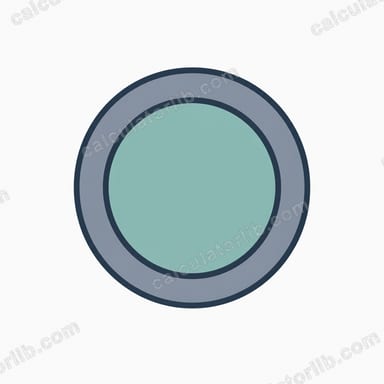
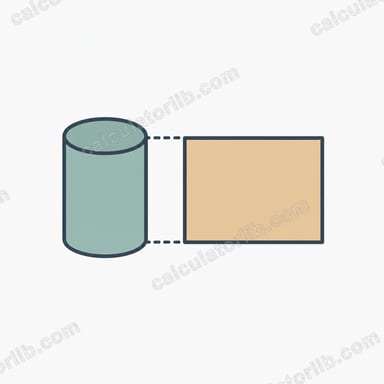
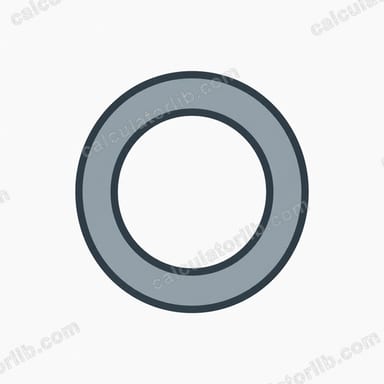
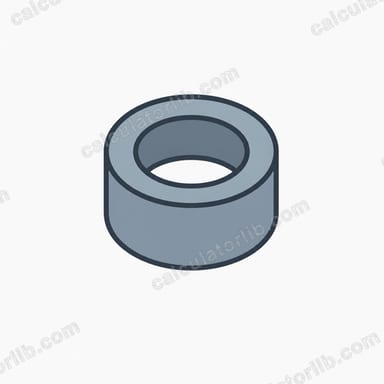
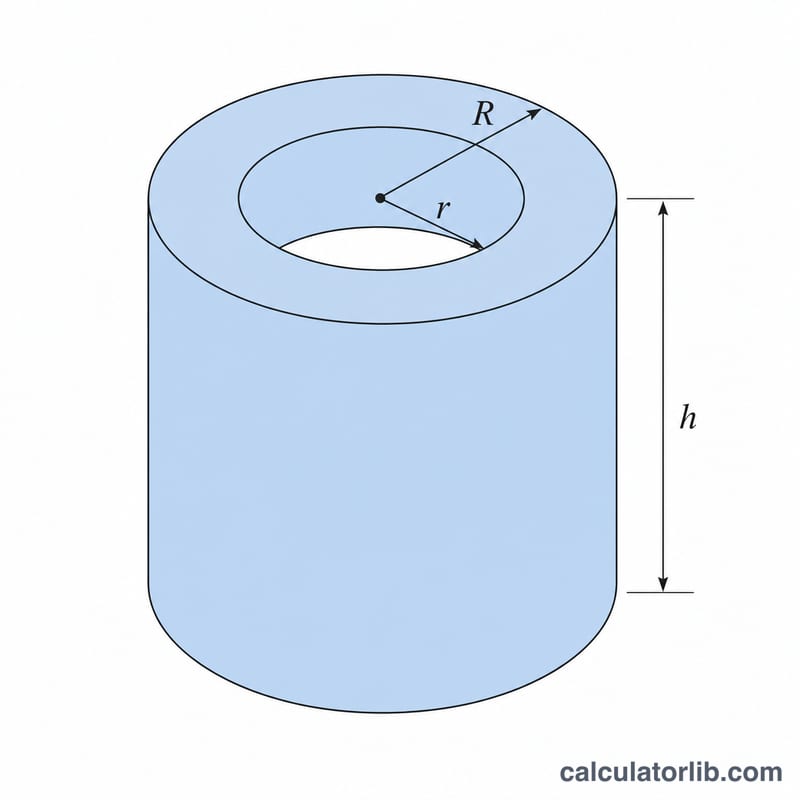
A hollow cylinder — also called a cylindrical tube, pipe, or annular cylinder — is a cylinder of outer radius \(R\) with a concentric cylindrical hole of inner radius \(r\) bored straight through it, with height (length) \(h\). Its two end faces are flat ring shapes called annuli (washers). This calculator returns the volume, the lateral (side) surface area, and the total surface area.
How to use it
Enter the outer radius \(R\), the inner radius \(r\), and the height \(h\). All three values must be expressed in the same length unit (all mm, all cm, all inches, etc.). The volume is then reported in that unit cubed and the areas in that unit squared. The tool requires \(R > r \ge 0\) and \(h > 0\); if \(r = 0\) the shape is simply a solid cylinder and the formulas still apply.
The formulas explained
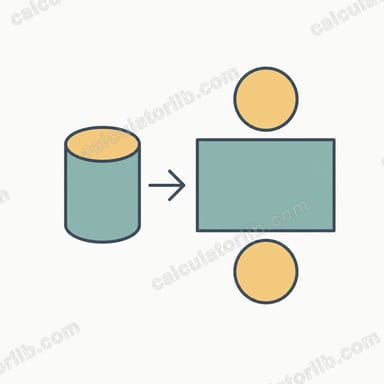
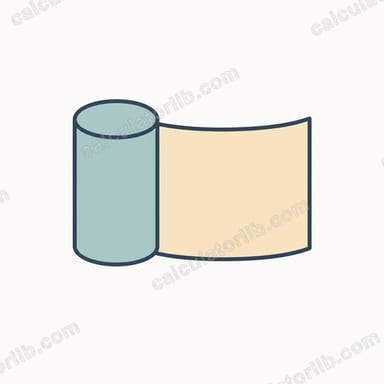
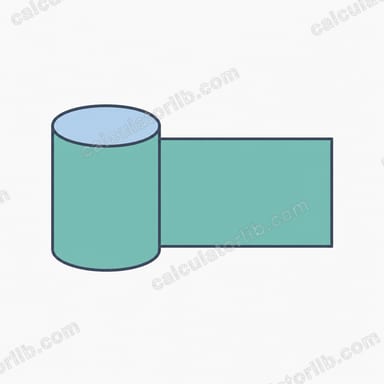
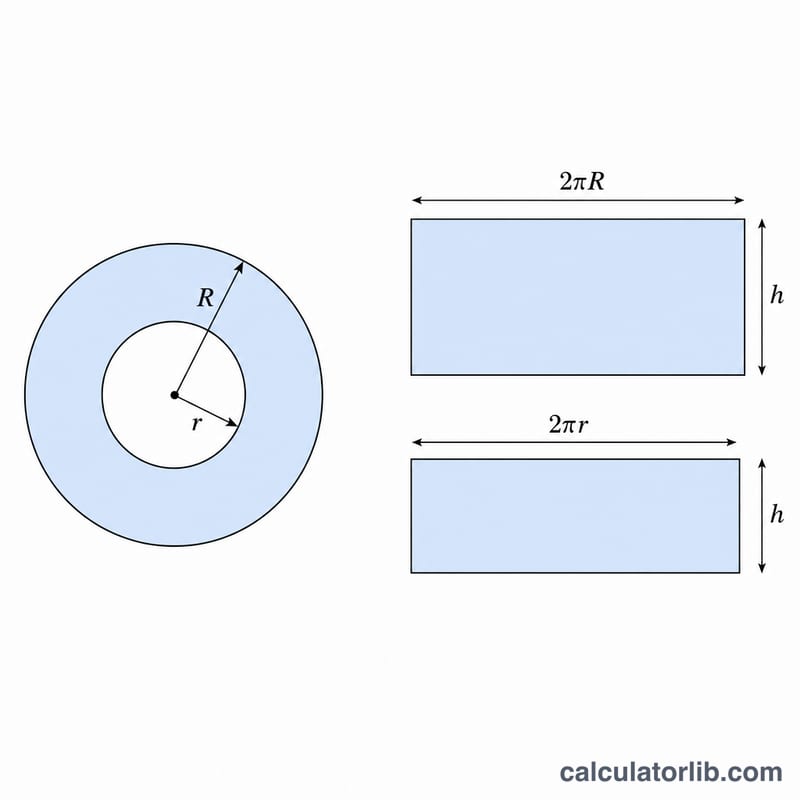
The cross-section is a ring of area \(\pi(R^{2} - r^{2})\), so the volume is $$V = \pi \left( R^{2} - r^{2} \right) h.$$ The lateral surface area counts both cylindrical walls: the outer wall \(2\pi R h\) plus the inner wall \(2\pi r h\), giving $$S_{\text{lat}} = 2\pi h \left( R + r \right).$$ The total surface area adds the two flat ring end faces, each of area \(\pi(R^{2} - r^{2})\): $$S_{\text{tot}} = 2\pi h \left( R + r \right) + 2\pi \left( R^{2} - r^{2} \right).$$
Worked example
With \(R = 5\), \(r = 3\), \(h = 10\): \(R^{2} - r^{2} = 25 - 9 = 16\). Volume \(= \pi \times 16 \times 10 = 160\pi \approx 502.65\). Lateral area \(= 2\pi \times 10 \times 8 = 160\pi \approx 502.65\). The two end rings \(= 2\pi \times 16 = 32\pi \approx 100.53\). Total surface area \(= 160\pi + 32\pi = 192\pi \approx 603.19\).
FAQ
What if the inner radius is zero? Then there is no hole and the figure becomes a solid cylinder: \(V = \pi R^{2} h\), \(S_{\text{lat}} = 2\pi R h\), \(S_{\text{tot}} = 2\pi R h + 2\pi R^{2}\). The general formulas reduce to exactly these.
Why must outer radius exceed inner radius? If \(R \le r\) the wall has no thickness or negative thickness, which is not a physical tube, so the input is rejected.
What units do I get? Whatever length unit you input. If you enter centimeters, volume is in cm³ and areas in cm². Keep all three inputs in one unit.