
What is the String Girdling Earth puzzle?
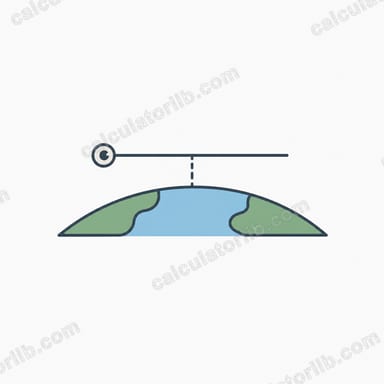
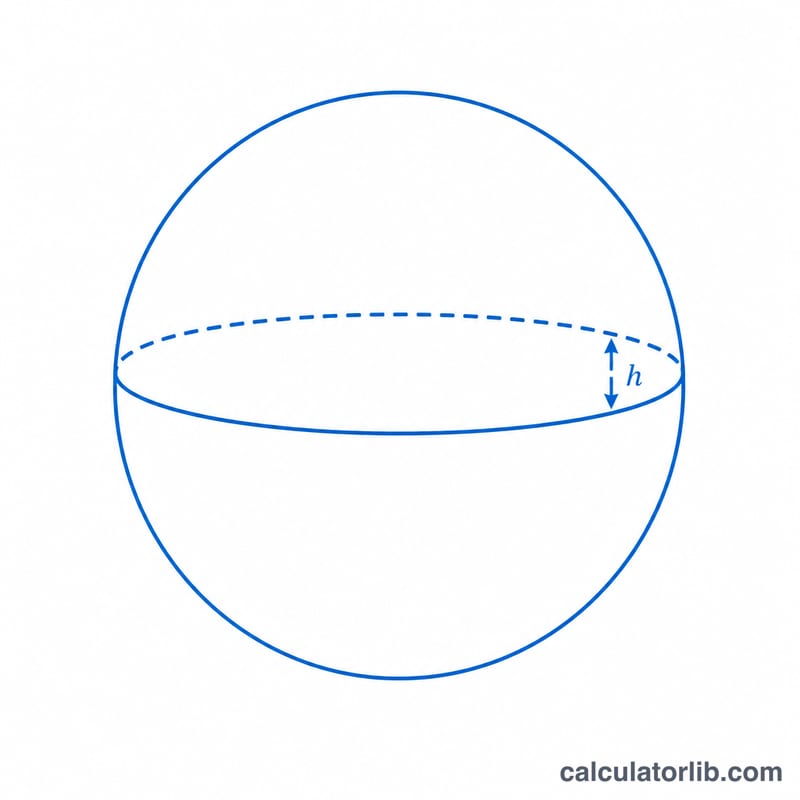
Imagine a string wrapped tightly around the Earth's equator. If you add just one extra meter to its length and lift it so it floats uniformly above the surface everywhere, how big is the resulting gap? The surprising answer is about 16 centimeters — and it does not depend on the size of the Earth at all. The same one-meter addition would lift a string around a basketball or around Jupiter by exactly the same 16 cm.
The formula explained
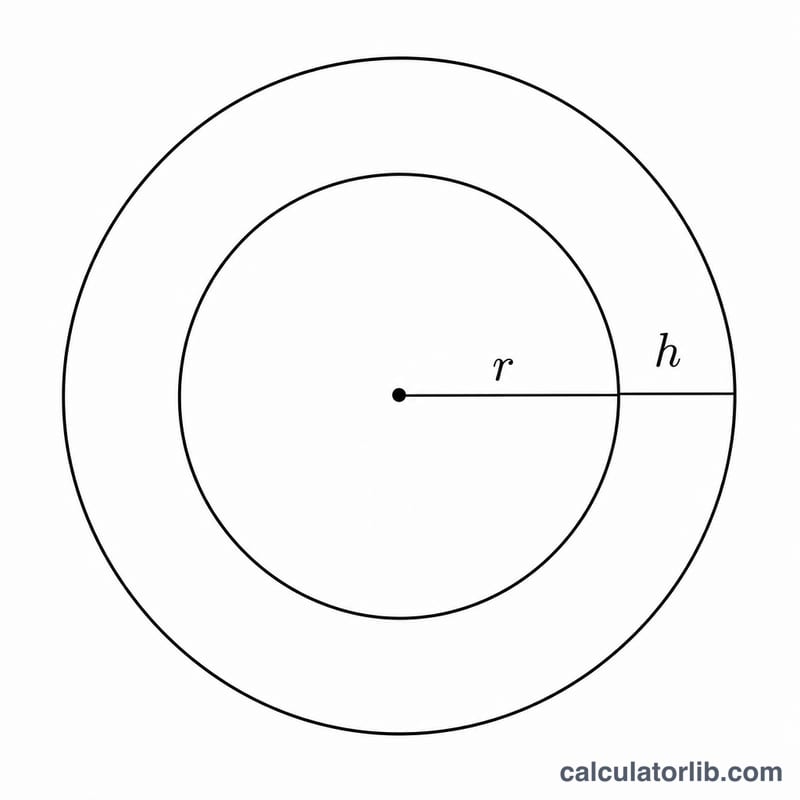
A circle of circumference \(C\) has radius \(r = C/(2\pi)\). If you add length \(\Delta C\), the new radius is \((C + \Delta C)/(2\pi)\). The gap is the difference in radii:
$$h = \frac{C + \Delta C}{2\pi} - \frac{C}{2\pi} = \frac{\Delta C}{2\pi}$$
The original radius cancels completely, which is why the result is independent of the sphere's size. Only the amount of string you add matters.
How to use this calculator
Enter the radius of your sphere (the default is Earth's mean radius, ~6,371,000 m) and the extra length you want to add to the string. The calculator returns the gap height in meters and centimeters, plus the original and new circumferences for reference.
Worked example
Add \(\Delta C = 1\) m of string. Then $$h = \frac{1}{2\pi} = \frac{1}{6.2832} \approx 0.15915 \text{ m} \approx 15.92 \text{ cm}$$ — enough room to slide your hand under, all the way around the planet.
FAQ
Why doesn't Earth's size matter? Because the radius term cancels in the subtraction; the gap depends only on the added length divided by \(2\pi\).
Does the string have to be lifted evenly? Yes — this puzzle assumes the gap is uniform all the way around. Lifting at a single point gives a much larger local gap.
What if I remove length instead? Enter a negative added length and the gap becomes negative, meaning the string would have to dig below the surface to fit.