
What this calculator does
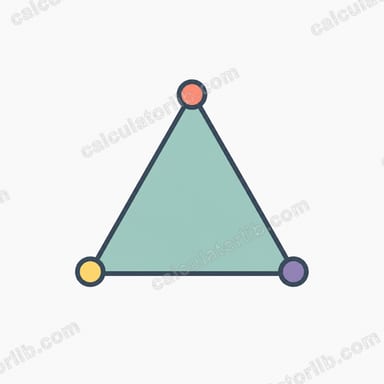
This tool finds the area of any triangle when you know the coordinates of its three corners (vertices) on a 2D plane. Instead of measuring base and height, it uses the shoelace formula, also called the coordinate or determinant method, which works for any triangle regardless of orientation.
How to use it
Enter the x and y values for each of the three vertices: \((x_1, y_1)\), \((x_2, y_2)\), and \((x_3, y_3)\). The order does not matter for the area — the absolute value guarantees a positive result. Click calculate to see the area in square units, plus the signed area which tells you whether the points were listed clockwise (negative) or counter-clockwise (positive).
The formula explained
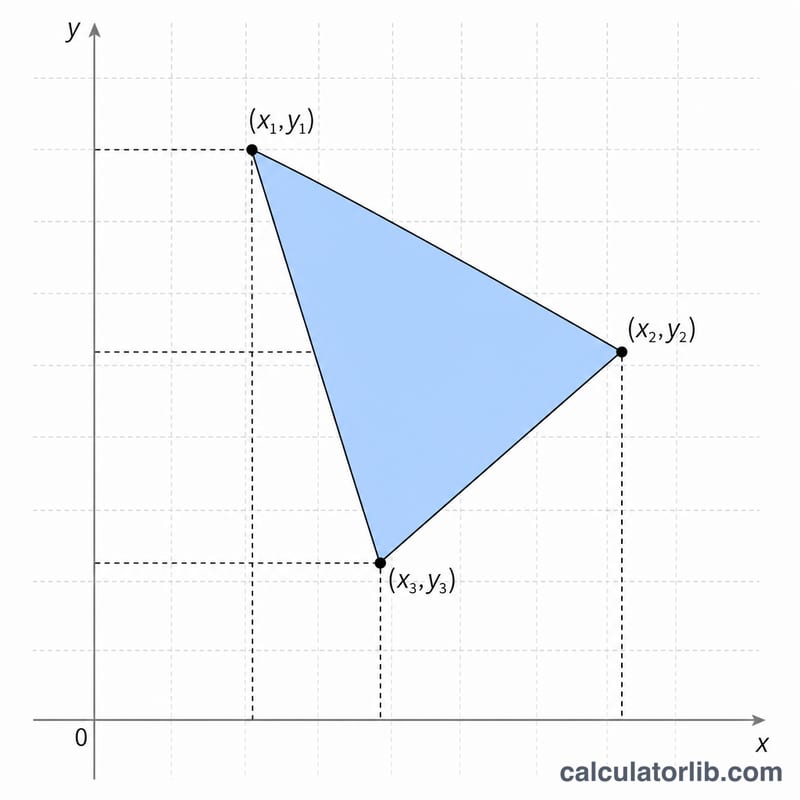
The area is half the absolute value of a cross-product-style expression:
$$\text{Area} = \frac{1}{2}\left|\, \text{x}_1\left(\text{y}_2 - \text{y}_3\right) + \text{x}_2\left(\text{y}_3 - \text{y}_1\right) + \text{x}_3\left(\text{y}_1 - \text{y}_2\right) \,\right|$$Each term pairs one x-coordinate with the difference of the other two y-coordinates. The sum equals twice the signed area of the triangle; halving and taking the absolute value gives the true area. If the result is zero, the three points are collinear and do not form a triangle.
Worked example
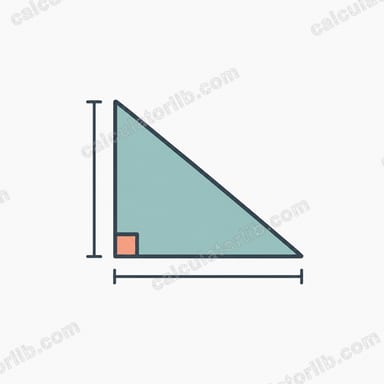
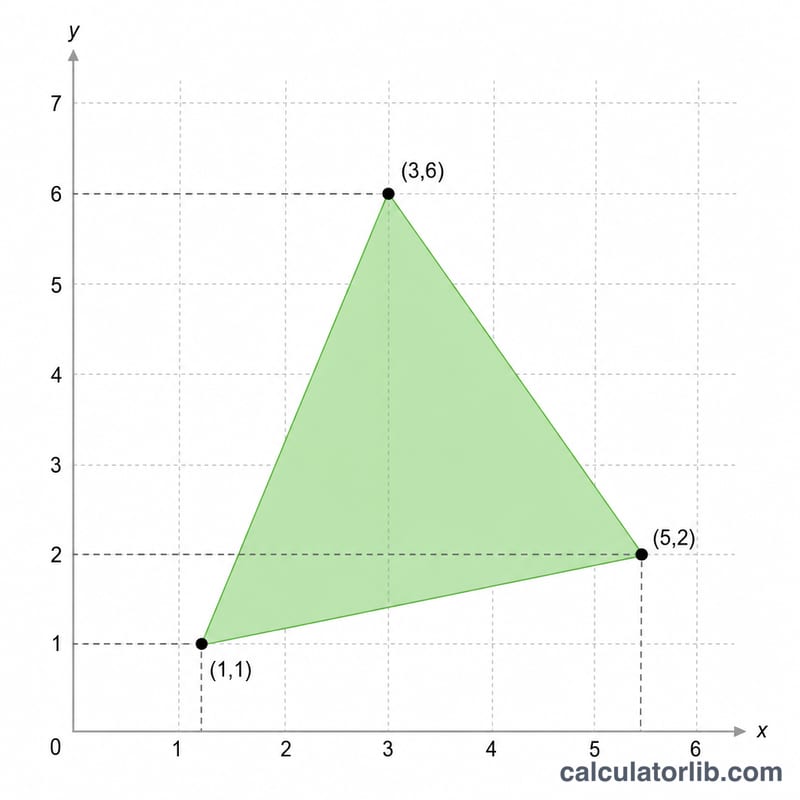
Take the vertices \((0, 0)\), \((4, 0)\), and \((0, 3)\). Plugging in: $$0(0 - 3) + 4(3 - 0) + 0(0 - 0) = 0 + 12 + 0 = 12.$$ Half of \(|12| = \) 6 square units. This matches the simple base × height ÷ 2 check: \(\frac{1}{2} \cdot 4 \cdot 3 = 6\).
FAQ
Does the order of points matter? No. Because we take the absolute value, any vertex order returns the same area. Only the signed area changes sign.
What if I get an area of 0? The three points lie on a straight line (collinear), so there is no triangle.
Can I use negative coordinates? Yes. The formula works for any real coordinates, including negatives and decimals.