What is a 45-45-90 triangle?
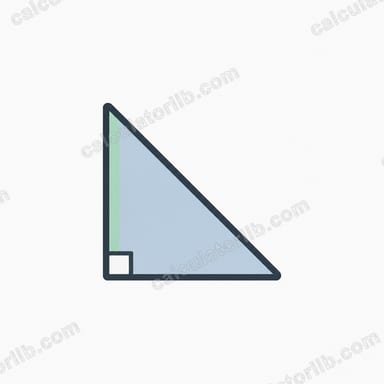
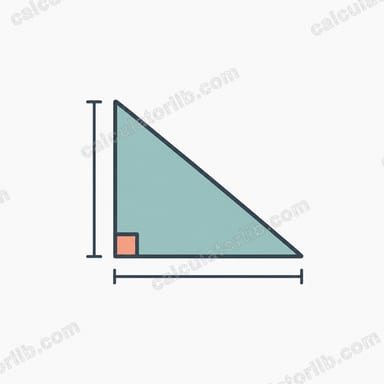
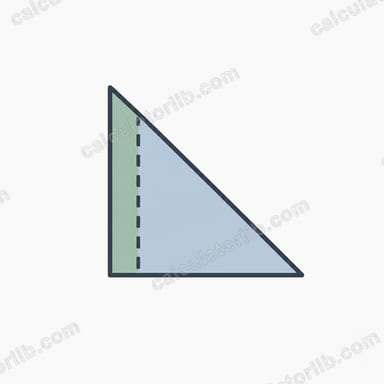
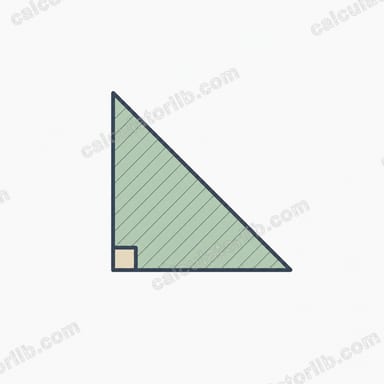
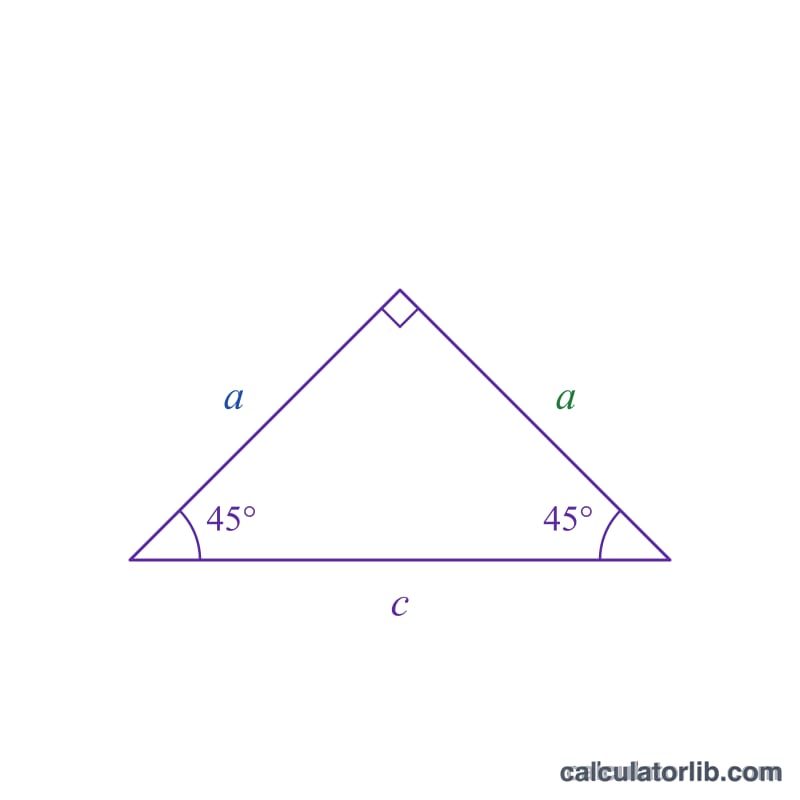
A 45-45-90 triangle is a right isosceles triangle: it has one 90° angle and two equal 45° angles. Because the two acute angles are equal, the two legs (the sides next to the right angle) are also equal. The hypotenuse is always the leg length multiplied by the square root of 2. This fixed shape makes its area especially easy to compute from a single measurement.
How to use this calculator
Choose whether you know a leg or the hypotenuse, then enter that side length and read off the area. The tool also reports the other side and the full perimeter so you can check your work. All values are in the same unit you enter, with area expressed in square units.
The formula explained
For a 45-45-90 triangle the two legs are equal, so the standard triangle area ½ × base × height becomes ½ × leg × leg, giving \(A = \dfrac{\text{leg}^2}{2}\). If you only know the hypotenuse, note that hypotenuse = leg·√2, so \(\text{leg}^2 = \dfrac{\text{hypotenuse}^2}{2}\). Substituting gives \(A = \dfrac{\text{hypotenuse}^2}{4}\).
$$A = \frac{\text{leg}^2}{2} = \frac{\text{hypotenuse}^2}{4}$$
Worked example
Suppose each leg is 10 units. Then $$A = \frac{10^2}{2} = \frac{100}{2} = 50 \text{ square units}.$$ The hypotenuse is \(10\cdot\sqrt{2} \approx 14.142\), and the perimeter is \(10 + 10 + 14.142 \approx 34.142\) units. If instead you knew the hypotenuse was 14.142, $$A = \frac{14.142^2}{4} \approx \frac{200}{4} = 50,$$ the same answer.
Quick Reference: Common 45-45-90 Triangle Sizes
A 45-45-90 triangle is a right triangle whose two legs are the same length. Once you know one leg \(a\), you can work out everything else:
$$c = a\sqrt{2}, \qquad A = \frac{a^{2}}{2}, \qquad P = 2a + a\sqrt{2}$$In the table, the hypotenuse and perimeter are rounded to 3 decimal places, using \(\sqrt{2} \approx 1.41421356\). The areas are exact. Leg, hypotenuse and perimeter are all in the same length unit (cm, m, in, ft, etc.), and area is in square units of that unit. For example, a leg in cm gives an area in cm².
| Leg | Hypotenuse (leg·√2) | Area (leg²/2) | Perimeter (2·leg + leg·√2) |
|---|---|---|---|
| 0.707 (hypotenuse = 1) | 1.000 | 0.25 | 2.414 |
| 1 | 1.414 | 0.5 | 3.414 |
| 2 | 2.828 | 2 | 6.828 |
| 3 | 4.243 | 4.5 | 10.243 |
| 4 | 5.657 | 8 | 13.657 |
| 5 | 7.071 | 12.5 | 17.071 |
| 6 | 8.485 | 18 | 20.485 |
| 8 | 11.314 | 32 | 27.314 |
| 10 | 14.142 | 50 | 34.142 |
| 12 | 16.971 | 72 | 40.971 |
| 15 | 21.213 | 112.5 | 51.213 |
| 20 | 28.284 | 200 | 68.284 |
The first row starts from a hypotenuse of 1. The leg is \(\frac{1}{\sqrt{2}} \approx 0.707\), so the area is \(\frac{c^{2}}{4} = \frac{1^{2}}{4} = 0.25\). You get the same answer from the leg: \(\frac{(1/\sqrt{2})^{2}}{2} = \frac{1/2}{2} = 0.25\). The area grows with the square of the side. If you double the leg, the area is four times larger: a leg of 10 gives 50, and a leg of 20 gives 200.
FAQ
Why are the two legs equal? Because the two non-right angles are both 45°, the sides opposite them must be equal, making it isosceles.
What is the ratio of the sides? The sides are always in the ratio \(1 : 1 : \sqrt{2}\) (leg : leg : hypotenuse).
Can I use any units? Yes. Enter length in any unit; the area is simply that unit squared.