

What Is the 1099 Contractor Tax Calculator?
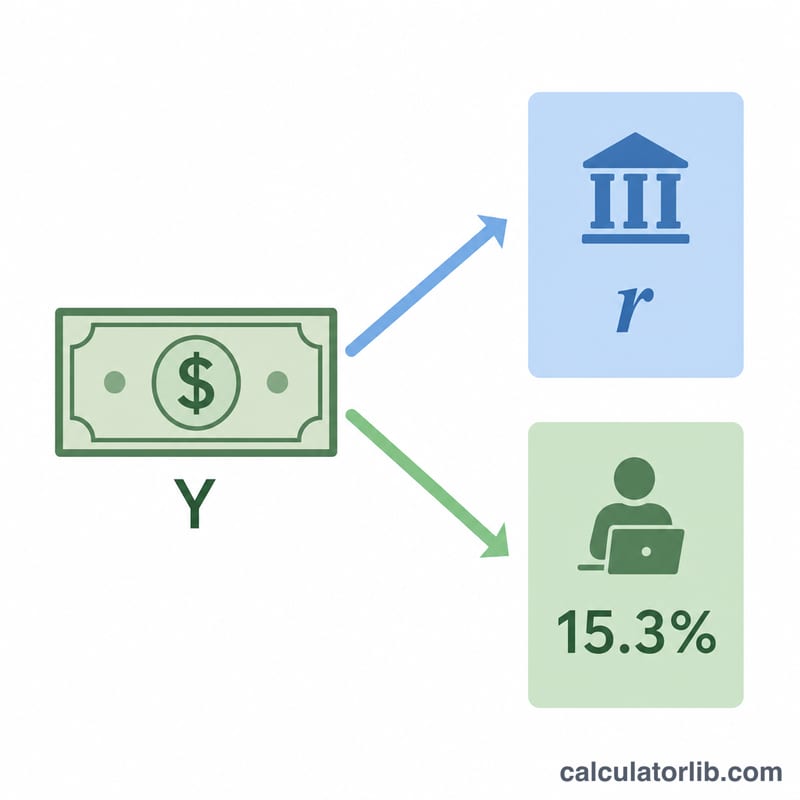
This calculator applies to United States independent contractors and freelancers who receive Form 1099 income. Unlike W-2 employees, 1099 workers pay both halves of Social Security and Medicare taxes — known as the self-employment (SE) tax — on top of regular income tax. This tool gives you a quick estimate of your total federal tax burden so you can plan quarterly estimated payments. Figures use the standard 2024 SE tax rate of 15.3%.
How to Use It
Enter your net 1099 income (gross earnings minus business expenses) and your estimated marginal income tax rate as a percentage. The calculator returns your self-employment tax, income tax, total tax owed, take-home income, and effective tax rate.
The Formula Explained
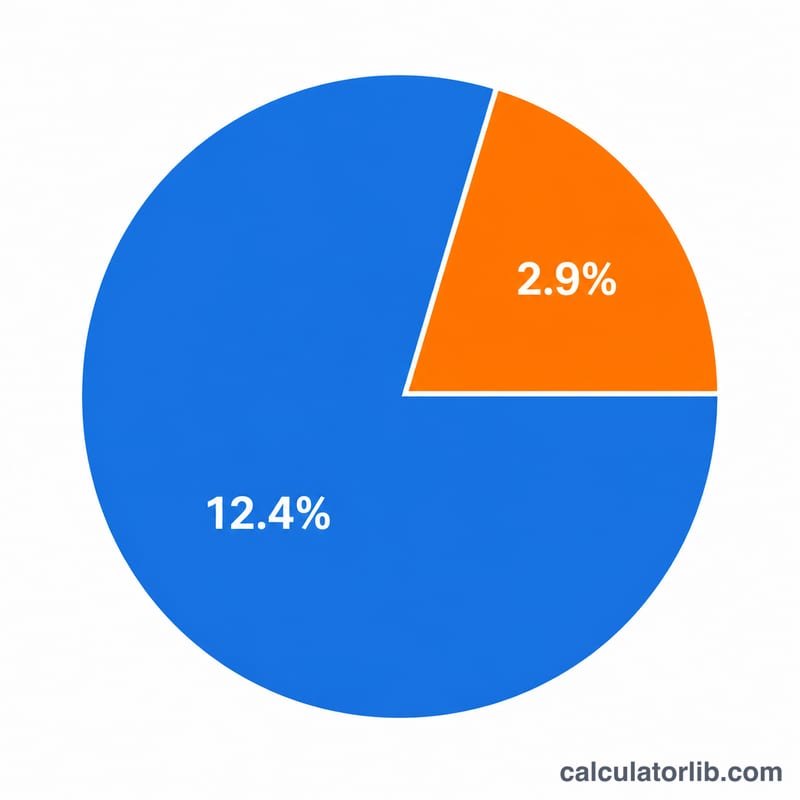
Self-employment tax is calculated on 92.35% of your net earnings (this adjustment accounts for the employer-equivalent deduction). That base is taxed at 15.3% (12.4% Social Security + 2.9% Medicare). Income tax is simply your net income multiplied by your chosen rate:
$$\text{Tax} = \text{Income} \times r + (\text{Income} \times 0.9235) \times 0.153$$
Worked Example
Suppose you earn $60,000 in net 1099 income with a 12% income tax rate. SE tax = \(60{,}000 \times 0.9235 \times 0.153\) = $8,477.73. Income tax = \(60{,}000 \times 0.12\) = $7,200. Total tax = $15,677.73, leaving $44,322.27 after tax — an effective rate of about 26.1%.
Key Rates & Reference Values for 2024
Self-employment (SE) tax for U.S. 1099 contractors is built from a handful of fixed rates and thresholds. These are the values that drive the calculation:
| Item | 2024 Value | Note |
|---|---|---|
| Combined SE tax rate | 15.3% | The self-employed pay both the employee and employer share of FICA. |
| Social Security portion | 12.4% | Applies only up to the annual wage base. |
| Medicare portion | 2.9% | Applies to all net earnings, with no upper limit. |
| Net earnings multiplier | 92.35% | SE tax is figured on \(0.9235 \times\) net profit, which approximates the employer-share adjustment. |
| Social Security wage base | $168,600 | Net earnings above this amount are not subject to the 12.4% Social Security portion (Medicare still applies). |
| Additional Medicare Tax | 0.9% | Added on earnings above $200,000 (single) / $250,000 (married filing jointly). |
| Deductible half of SE tax | 50% | You may deduct one-half of your SE tax as an above-the-line adjustment to income. |
This calculator applies the flat 15.3% rate to 92.35% of net income for a quick estimate; it does not model the wage-base cap or the 0.9% surtax (see Understanding Your Result).
Understanding Your Result
Effective vs. marginal rate. The effective rate this tool reports is your total tax divided by net income — your average tax burden. Your marginal rate is the rate on the next dollar you earn, which is higher because of the way brackets stack. Both matter: the marginal rate helps you plan extra work or deductions, while the effective rate tells you what you actually keep.
This is a federal-only estimate. The figure combines federal income tax and federal self-employment tax. It does not include state or local income tax, which can add several more percentage points depending on where you live.
Why quarterly payments matter. Contractors have no employer withholding, so the IRS generally expects taxes to be paid throughout the year using Form 1040-ES. Missing or underpaying these quarterly estimates can trigger an underpayment penalty even if you settle up in April.
The half-SE-tax deduction. You can deduct one-half of your SE tax when figuring adjusted gross income. This calculator's headline number does not subtract that deduction, so your actual income tax may be slightly lower than the simple estimate here.
Limitations. The flat-rate model ignores the $168,600 Social Security wage cap (which lowers SE tax at high incomes), the 0.9% Additional Medicare Tax (which raises it above $200k/$250k), business deductions, credits, and filing status. Use it for a quick ballpark, then confirm with a detailed tool or a tax professional. This is general information, not personalized tax or financial advice.
FAQ
Why is the SE tax based on 92.35%? The IRS lets you deduct the employer-equivalent portion before computing SE tax, which effectively reduces the taxable base to 92.35%.
Does this include state taxes? No. This estimate covers federal income tax and self-employment tax only. Add your state rate separately.
Is the Social Security wage cap included? This simplified estimate does not apply the Social Security wage base limit. For very high incomes, your actual SE tax may be lower.