
What this calculator does
When you leave a salaried job to work as an independent contractor, your headline pay rate must be higher than your old salary to come out even. As a contractor you pay both halves of payroll/self-employment tax, you fund your own benefits (health insurance, retirement, paid time off), and you only bill a fraction of your working year. This calculator translates an employee salary into the equivalent contractor hourly rate so you can quote with confidence.
How to use it
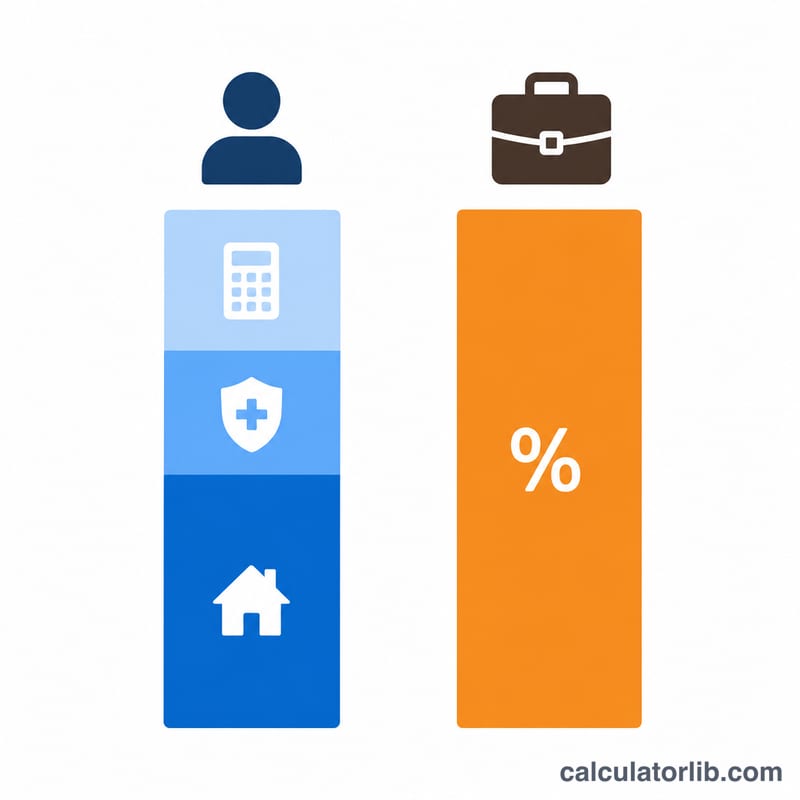
Enter the salary you want to match, the self-employment tax load as a percentage (in the US the extra employer-side payroll portion is roughly 7.65%, and full self-employment tax is about 15.3%), and a benefits/overhead load that covers insurance, retirement and unpaid time. Then enter the number of hours you actually expect to bill in a year — full-time is ~2,080 hours, but vacation, admin, sales and gaps mean most contractors bill 1,600–1,900.
The formula explained
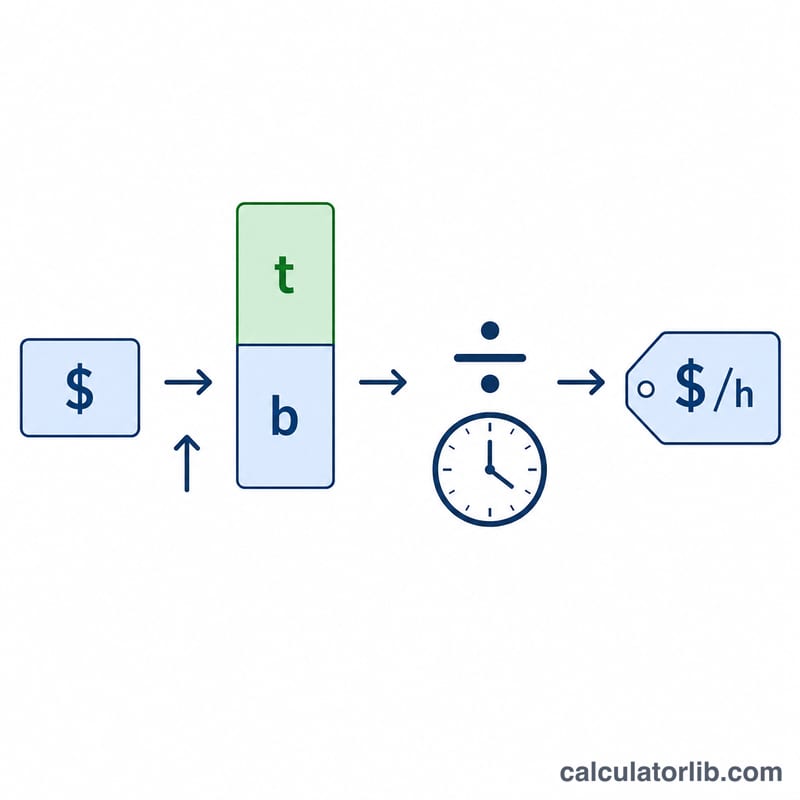
The gross amount you must earn is \(\text{Salary} \times (1 + t + b)\), where t is the tax load and b is the benefits load as decimals. Dividing that gross by your billable hours gives the hourly rate. Fewer billable hours pushes the rate up because the same annual target is spread across less billable time.
$$\text{Rate} = \dfrac{\text{Salary} \times (1 + t + b)}{\text{Billable Hours}}$$
Worked example
Salary $80,000, self-employment tax load 7.65%, benefits/overhead 30%, billable hours 1,800. $$\text{Gross} = 80{,}000 \times (1 + 0.0765 + 0.30) = 80{,}000 \times 1.3765 = \$110{,}120$$ $$\text{Hourly rate} = 110{,}120 \div 1{,}800 \approx \mathbf{\$61.18\text{/hour}}$$ The day rate (8 hours) is about $489.
FAQ
Is this US-specific? The tax field defaults to a US figure, but the percentage inputs are generic — enter whatever tax and overhead rates apply in your country.
Why use billable hours instead of 2,080? You can't bill every hour you work. Using realistic billable hours prevents you from underpricing your time.
Should I add profit margin? Yes — this gives the break-even equivalent. Add a margin on top for genuine profit and risk.