

What Is Holiday Pay?
Holiday pay is the compensation an employee receives for working on a designated holiday, usually at a premium rate higher than their normal wage. Many employers offer "time and a half" (1.5×), "double time" (2×), or even higher multipliers as an incentive or reward for working on holidays. This calculator estimates your total holiday earnings based on the hours you worked, your hourly rate, and the premium multiplier your employer applies.
How to Use the Calculator
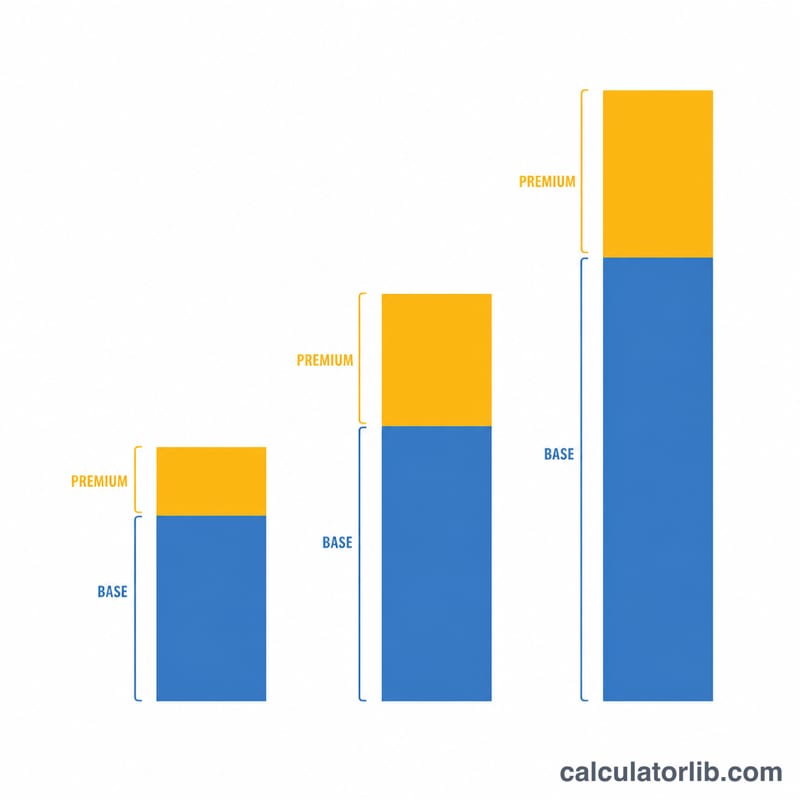
Enter the number of hours you worked on the holiday, your standard hourly rate, and select the premium multiplier (such as 1.5× for time and a half). The calculator instantly shows your total holiday pay, plus a breakdown of your regular base pay and the extra premium earnings on top.
The Formula Explained
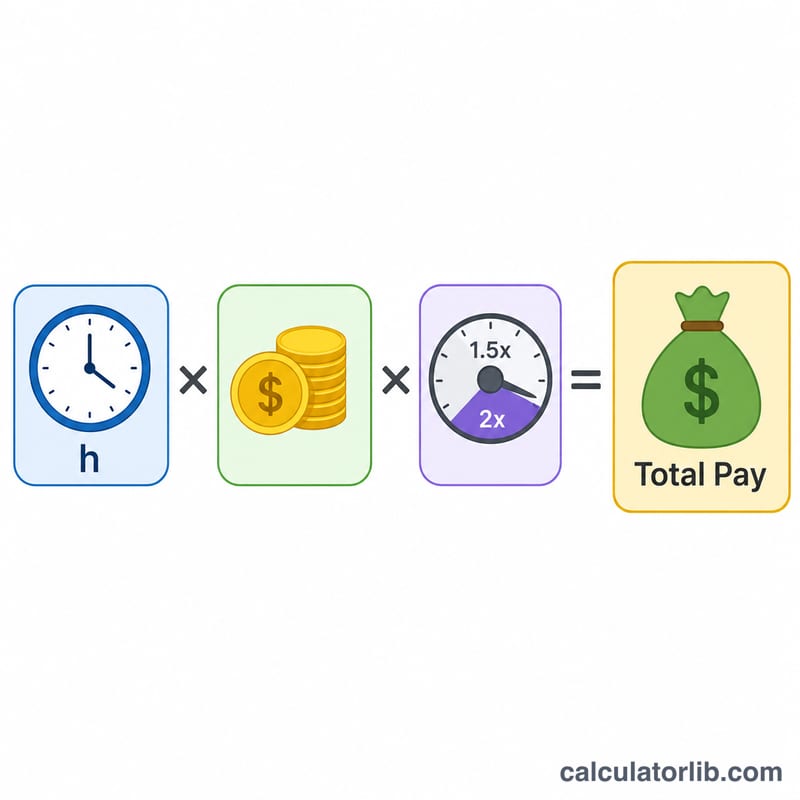
The core equation is simple: $$\text{Holiday Pay} = \text{Hours} \times \text{Hourly Rate} \times \text{Multiplier}$$ The base pay is just \(\text{Hours} \times \text{Rate}\), and the premium is the difference between holiday pay and base pay — i.e. the bonus you earn for the holiday. A multiplier of 1.5 means you earn 50% more per hour than usual; a multiplier of 2 means you earn double.
Worked Example
Suppose you worked 8 hours on a holiday at an hourly rate of $20, with a double-time (2×) policy. Your base pay is $$8 \times \$20 = \$160$$ Your total holiday pay is $$\$160 \times 2 = \$320$$ and the premium (extra earnings) is $$\$320 - \$160 = \$160$$ So you take home $320 for that holiday shift.
FAQ
Is holiday pay required by law? In the United States, federal law does not require premium holiday pay — it is set by employer policy or union contract. Other countries have different rules, so check your local regulations and employment agreement.
What multiplier should I use? Use the rate stated in your contract or company policy. Time-and-a-half (1.5×) and double time (2×) are the most common.
Does this include taxes? No — this is gross pay before any tax or deductions.