
What Is the Annual Pay Calculator?
The Annual Pay Calculator converts the amount you earn each pay period into a yearly total. Whether you are paid weekly, every two weeks, twice a month, or monthly, this tool gives you a quick estimate of your gross annual pay so you can budget, compare offers, or fill out applications.
How to Use It
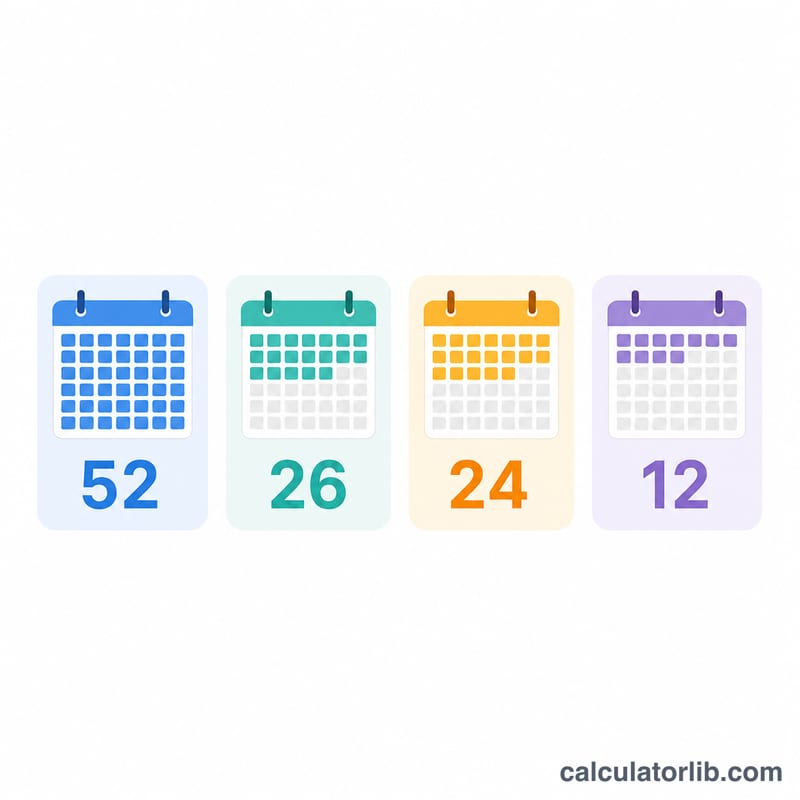
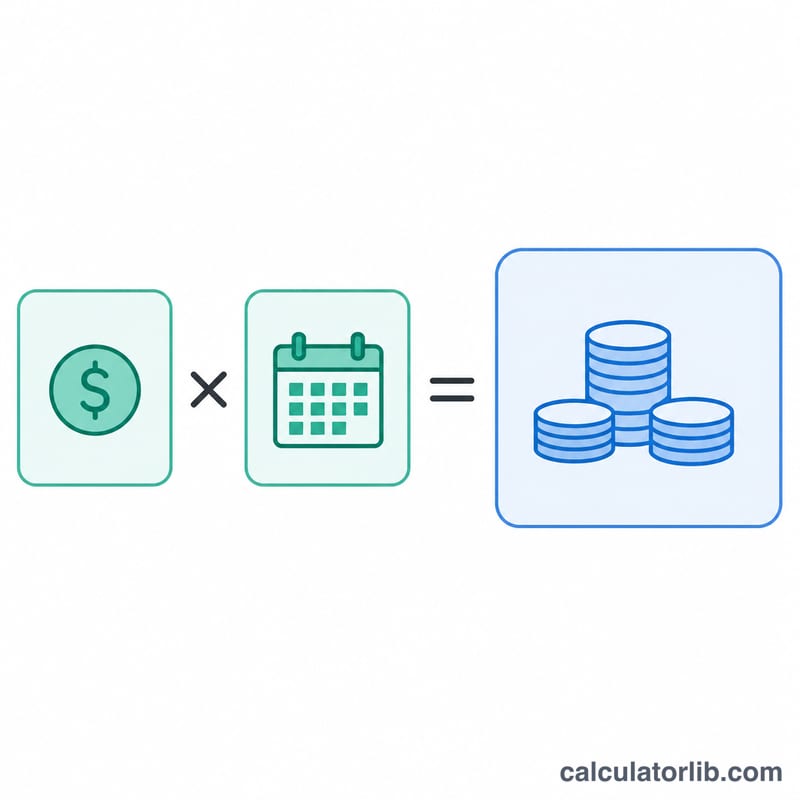
Enter the amount you receive in a single paycheck (your gross pay per period). Then choose how often you are paid: weekly (52 periods), bi-weekly (26 periods), semi-monthly (24 periods), or monthly (12 periods). The calculator multiplies the two values to produce your annual pay.
The Formula Explained
The math is simple multiplication:
$$\text{Annual Pay} = \text{Periodic Pay} \times \text{Pay Periods per Year}$$
The pay periods per year depends on your schedule. Note that bi-weekly (every 2 weeks) gives 26 periods, while semi-monthly (twice a month) gives only 24 — a common source of confusion since both feel like "twice a month."
Worked Example
Suppose you earn $2,000 every two weeks. Bi-weekly pay means 26 periods per year. So your annual pay is $$\$2{,}000 \times 26 = \$52{,}000.$$ If instead you were paid that same $2,000 semi-monthly (24 periods), your annual pay would be \(\$48{,}000\).
Pay Periods per Year by Frequency
The number of times you are paid each year depends on your pay frequency. To convert your per-period pay into an annual figure, multiply it by the number of pay periods that match your schedule:
| Pay frequency | How often you are paid | Pay periods per year |
|---|---|---|
| Weekly | Once every week | 52 |
| Bi-weekly | Once every two weeks | 26 |
| Semi-monthly | Twice a month (e.g. the 15th and last day) | 24 |
| Monthly | Once a month | 12 |
Note that bi-weekly (26) and semi-monthly (24) are not the same: paying every two weeks results in 26 paychecks per year because 52 weeks divided by 2 equals 26, while paying twice each month results in exactly 24 paychecks (\(2 \times 12\)).
Annual Pay Across Pay Frequencies
To show how much the pay frequency matters, the table below holds the per-period pay fixed at $2,000 and applies each frequency. Because annual pay equals per-period pay multiplied by the number of periods, the same $2,000 paycheck produces very different yearly totals:
| Per-period pay | Frequency | Periods per year | Annual pay |
|---|---|---|---|
| $2,000 | Weekly | 52 | $104,000 |
| $2,000 | Bi-weekly | 26 | $52,000 |
| $2,000 | Semi-monthly | 24 | $48,000 |
| $2,000 | Monthly | 12 | $24,000 |
For example, a $2,000 bi-weekly paycheck works out to \(2000 \times 26 = 52{,}000\) per year. If your effective tax rate were about 22%, that gross salary would leave roughly $40,560 in take-home pay.
FAQ
Is this gross or net pay? This calculates gross pay. It does not deduct taxes, insurance, or retirement contributions.
Why is bi-weekly 26 and not 24? A year has about 52 weeks, and bi-weekly means every other week, so \(52 \div 2 = 26\) paychecks.
Can I use any currency? Yes. The math works the same regardless of currency since it is pure multiplication.