
What Is the Powerball Payout Calculator?
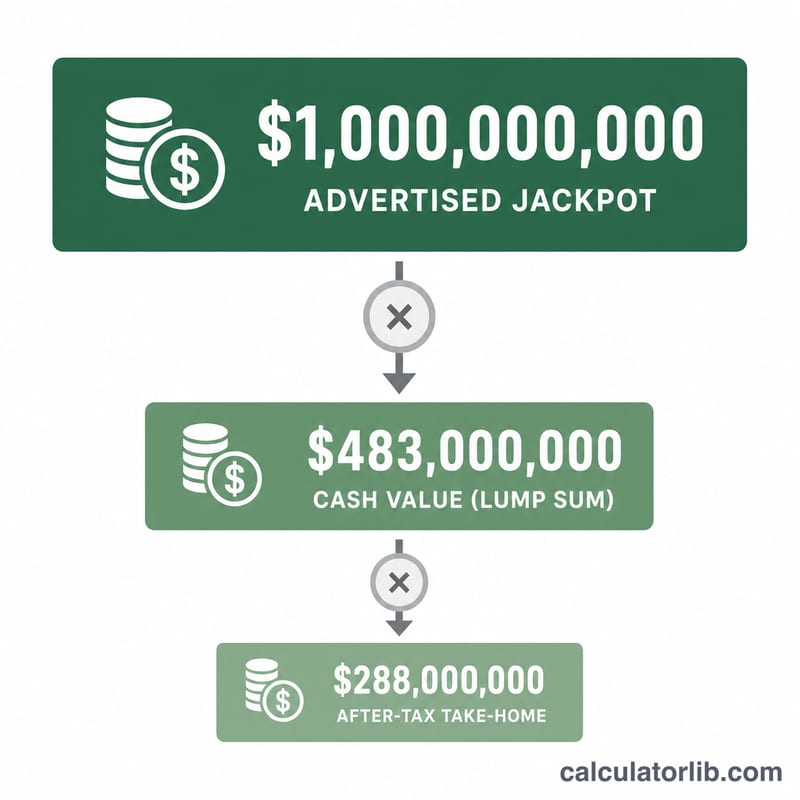
This calculator applies to the US Powerball lottery. When you win, the advertised jackpot is the total 30-year annuity value — but most winners take the smaller "cash value" lump sum, and both are subject to federal and state taxes. This tool estimates what you would actually keep based on your chosen payout option, the cash value factor, and your total tax rate.
How to Use It
Enter the advertised jackpot, the cash value factor (typically about 50–55%, varies with interest rates), and your combined tax rate. Federal withholding on lottery winnings is 24%, but top earners owe up to 37% federally, plus state tax (0% in some states, up to ~10% elsewhere). Pick Lump Sum to apply the cash factor, or Annuity to tax the full jackpot spread over 30 years.
The Formula Explained
For the lump sum, gross payout = jackpot × cash factor. For the annuity, the gross payout equals the full advertised jackpot. Taxes are then gross payout × tax rate, and your take-home is gross payout × (1 − tax rate). The annual figures simply divide the totals by the 30-year annuity schedule.
$$\text{Net Payout} = \text{Jackpot} \times \frac{\text{Cash Factor (\%)}}{100} \times \left(1 - \frac{\text{Tax Rate (\%)}}{100}\right)$$
$$\text{Net Payout} = \text{Jackpot} \times \left(1 - \frac{\text{Tax Rate (\%)}}{100}\right)$$
Worked Example
Suppose the jackpot is $100,000,000 with a 52% cash factor and a 37% combined tax rate, taking the lump sum. Gross cash = \(\$100M \times 0.52 = \$52{,}000{,}000\). Taxes = \(\$52M \times 0.37 = \$19{,}240{,}000\). Take-home = \(\$52M \times 0.63 = \$32{,}760{,}000\).
FAQ
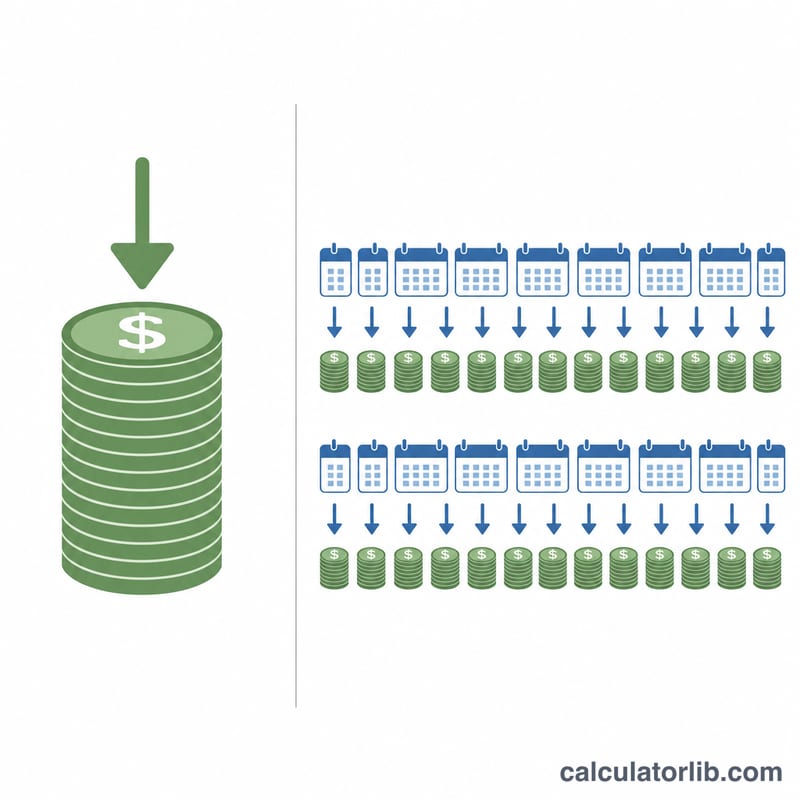
Why is the lump sum so much less than the jackpot? The advertised jackpot funds a 30-year annuity. The cash option pays only the present-day value the lottery has invested, roughly half.
Is 24% the only federal tax? No — 24% is the mandatory withholding. Large winnings push you into the 37% top bracket, so you may owe more at tax time.
Does this include state taxes? Enter a combined federal + state rate in the tax field. State rates vary widely, and a few states tax lottery winnings at 0%.