

What this calculator does
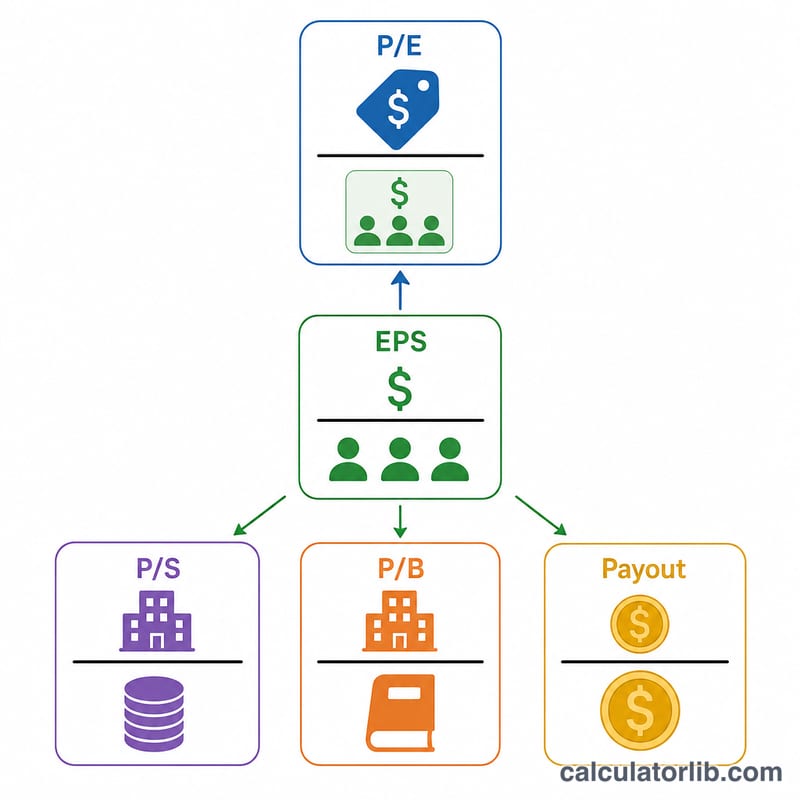
This tool computes the most common per-share and market valuation ratios used in fundamental stock analysis: Earnings Per Share (EPS), Price-to-Earnings (P/E), Price-to-Sales (P/S), Price-to-Book Value (P/B) and the Dividend Payout Ratio. You can fill in one company, or two side by side (column B is optional), to compare them directly. These are universal corporate-finance ratios and are not specific to any country.
How to use it
Enter the figures from a company's income statement and balance sheet for Company A, and optionally Company B. All monetary values must be in the same currency — no unit conversion is applied. If you leave Market Cap blank, it is derived as Price per Share x Shares. Pick how many significant figures to display, then read the results table. Any ratio whose denominator is zero (for example EPS when shares are zero) is shown as N/A.
The formulas explained
\(\text{EPS} = \frac{\text{Net Income}}{\text{Total Shares}}\). \(\text{P/E} = \frac{\text{Price per Share}}{\text{EPS}}\), which also equals \(\frac{\text{Market Cap}}{\text{Net Income}}\). \(\text{P/S} = \frac{\text{Market Cap}}{\text{Total Sales}}\). Book Value (Total Equity) \(= \text{Total Assets} - \text{Total Liabilities}\), and \(\text{P/B} = \frac{\text{Market Cap}}{\text{Book Value}}\). The Dividend Payout Ratio \(= \frac{\text{Total Dividends}}{\text{Net Income}}\), often shown as a percentage. A negative book value means liabilities exceed assets, in which case P/B is flagged as not meaningful.
Worked example
Suppose Net Income = 1,000,000; Shares = 500,000; Price per Share = 40; Total Sales = 8,000,000; Market Cap = 20,000,000; Total Assets = 15,000,000; Total Liabilities = 5,000,000; Total Dividends = 300,000. Then
$$\text{EPS} = \frac{1{,}000{,}000}{500{,}000} = 2.00$$$$\text{P/E} = \frac{40}{2} = 20.0$$$$\text{P/S} = \frac{20{,}000{,}000}{8{,}000{,}000} = 2.50$$$$\text{Book Value} = 10{,}000{,}000$$$$\text{P/B} = \frac{20{,}000{,}000}{10{,}000{,}000} = 2.00$$$$\text{Dividend Payout} = \frac{300{,}000}{1{,}000{,}000} = 0.30 \ (30\%)$$
FAQ
What is a good P/E ratio? There is no single answer — it depends on the industry, growth rate and interest-rate environment. Compare a company to its peers and its own history.
Why is my P/E showing N/A? P/E needs a positive EPS denominator. If shares or net income are zero (or net income is a loss producing a negative EPS), the ratio is suppressed or shown as a negative number.
Should I use diluted or basic shares? Use whichever is consistent with how you want to compare companies; diluted share counts give a more conservative EPS.