
What Is the Dividend Tax Calculator?
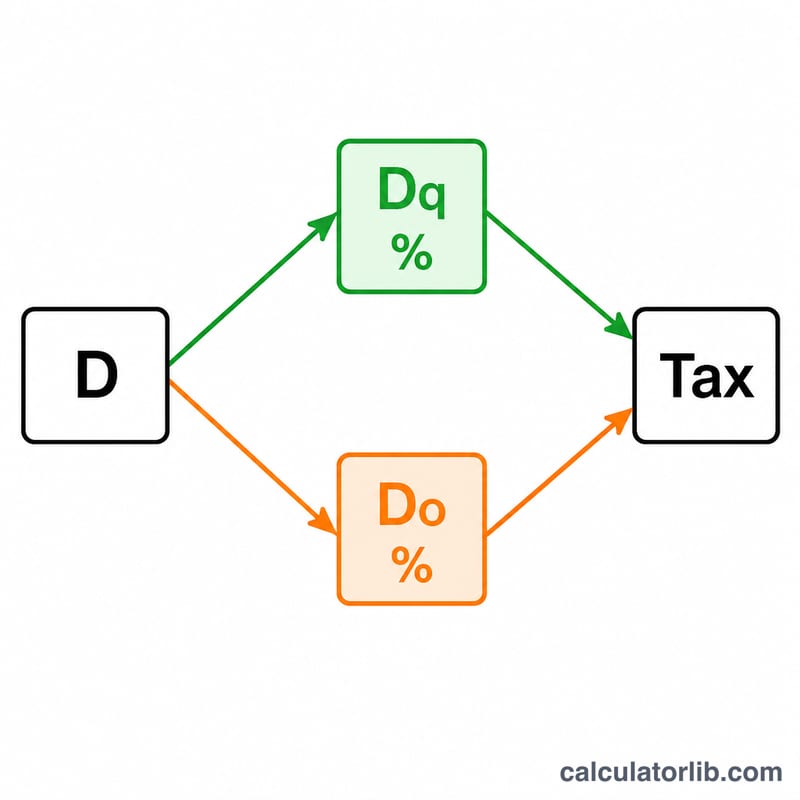
This calculator estimates the U.S. federal income tax you owe on dividend income for the 2024 tax year. Dividends fall into two buckets: qualified dividends, which are taxed at the favorable long-term capital gains rates (0%, 15%, or 20% depending on your taxable income), and ordinary (non-qualified) dividends, which are taxed at your regular marginal income tax rate. This tool covers U.S. federal tax only and does not include state taxes or the 3.8% Net Investment Income Tax.
How to Use It
Enter the dollar amount of qualified dividends and ordinary dividends you received (your 1099-DIV reports these in boxes 1a and 1b). Choose the capital gains rate that matches your income bracket for qualified dividends, then enter your marginal income tax rate for the ordinary portion. The calculator returns total tax, the breakdown by type, your after-tax income, and your effective tax rate.
The Formula Explained
The core equation is
$$\text{Tax} = (\text{qualified dividends} \times \text{qualified rate}) + (\text{ordinary dividends} \times \text{marginal rate})$$Because qualified dividends enjoy lower rates, holding dividend-paying stocks long enough to qualify (generally more than 60 days during the 121-day period around the ex-dividend date) can meaningfully reduce your tax bill.
Worked Example
Suppose you received $5,000 in qualified dividends taxed at 15% and $2,000 in ordinary dividends taxed at a 24% marginal rate. Qualified tax = \(5{,}000 \times 0.15 = \$750\). Ordinary tax = \(2{,}000 \times 0.24 = \$480\). Total tax = $1,230. After-tax income = \(\$7{,}000 - \$1{,}230 = \$5{,}770\), an effective rate of about 17.57%.
FAQ
What makes a dividend "qualified"? It must be paid by a U.S. corporation or qualifying foreign company, and you must meet the IRS holding-period requirement.
Does this include state taxes? No. Most states tax dividends as ordinary income; add your state rate separately.
What about the Net Investment Income Tax? High earners may owe an extra 3.8% NIIT, which this calculator does not include.