
What Is Dividend Yield?
Dividend yield is a financial ratio that shows how much a company pays out in dividends each year relative to its share price. Expressed as a percentage, it lets investors compare the income-generating potential of different dividend-paying stocks regardless of their share price. A higher yield means more dividend income per dollar invested, though an unusually high yield can sometimes signal a falling share price or an unsustainable payout.
How to Use This Calculator
Enter the annual dividend per share — the total dividends a company pays per share over a year — and the current price per share. The calculator divides the dividend by the price and multiplies by 100 to express the result as a percentage. If a company pays quarterly dividends, multiply a single quarterly payment by four to get the annual figure first.
The Formula Explained
The calculation is simple:
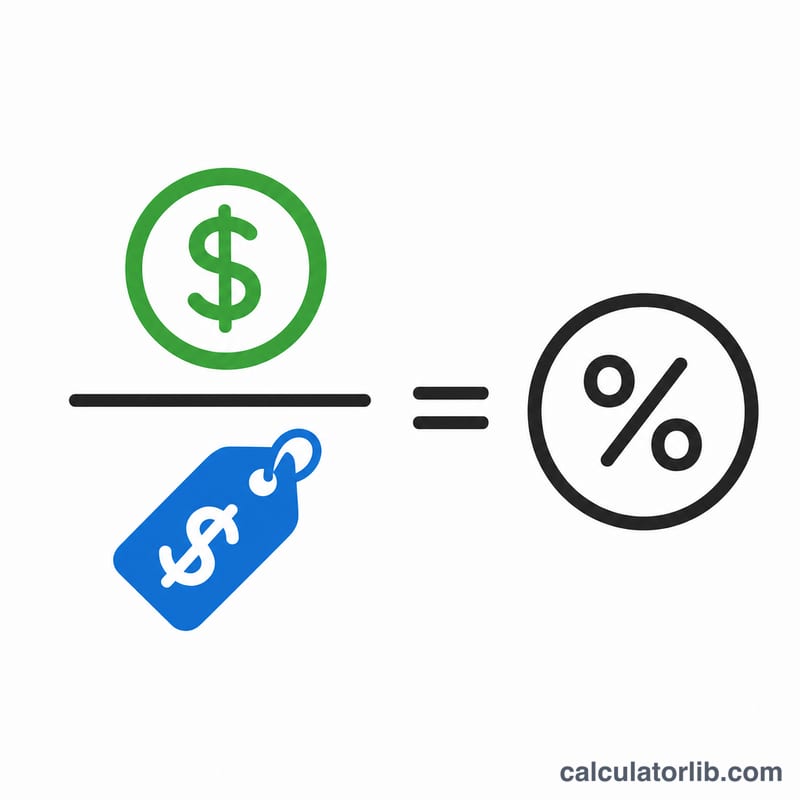
$$\text{Dividend Yield (\%)} = \frac{\text{Annual Dividend (\$)}}{\text{Price per Share (\$)}} \times 100$$
The annual dividend is the cash income; the price is what you pay for that income stream. Dividing the two gives a return rate, and multiplying by 100 converts it to a familiar percentage.
Worked Example
Suppose a stock pays an annual dividend of $2.50 per share and currently trades at $50 per share. The dividend yield is $$(2.50 \div 50) \times 100 = 5\%.$$ This means for every $100 invested, you would receive about $5 in dividends per year, assuming the dividend stays constant.
FAQ
Is a high dividend yield always good? Not necessarily. A very high yield may result from a sharp drop in share price and could indicate the dividend is at risk of being cut.
Does this include stock price appreciation? No. Dividend yield measures only the income from dividends. Total return also includes capital gains or losses.
How often do dividends change? Companies typically review dividends quarterly or annually. Yield changes daily because the share price moves even if the dividend stays the same.