
What Is DuPont Analysis?
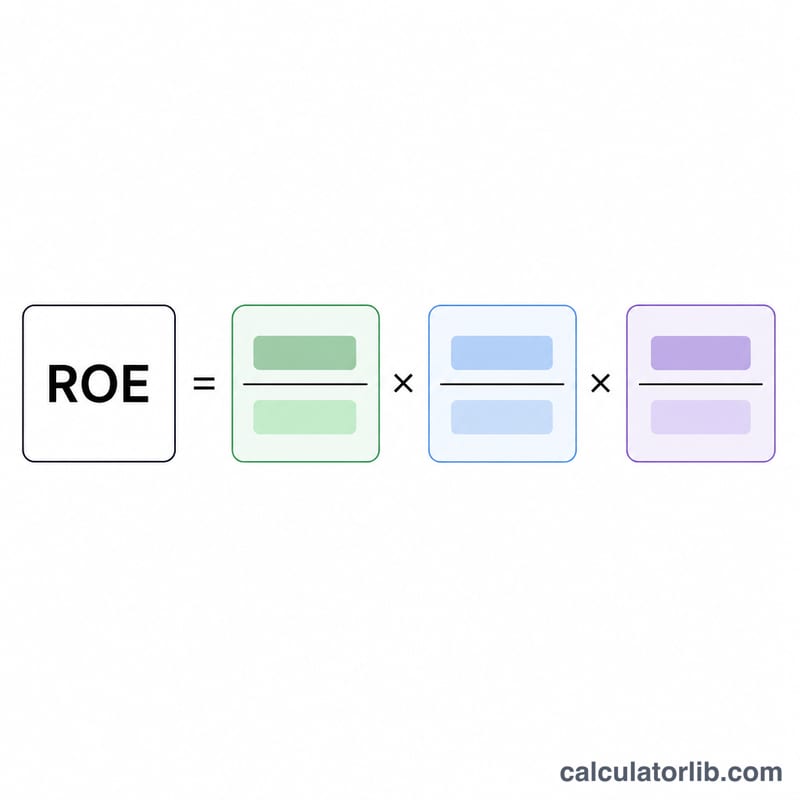
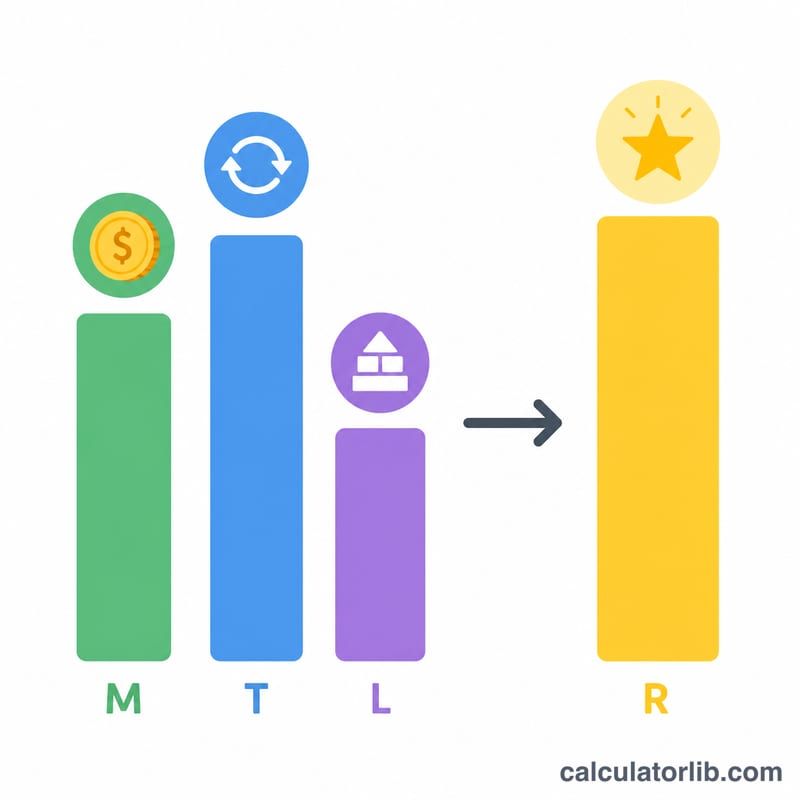
DuPont analysis is a framework that decomposes Return on Equity (ROE) into three drivers: profitability, efficiency, and leverage. Developed by the DuPont Corporation in the 1920s, it shows why a company's ROE is high or low, rather than just reporting a single percentage. The 3-step model multiplies net profit margin, asset turnover, and the equity multiplier together to reconstruct ROE.
How to Use This Calculator
Enter four figures from a company's financial statements: Net Income and Revenue (from the income statement), and Total Assets and Total Equity (from the balance sheet). The calculator returns ROE as a percentage along with each of the three components so you can see what is driving returns.
The Formula Explained
$$\text{ROE} = \frac{\text{Net Income}}{\text{Revenue}} \times \frac{\text{Revenue}}{\text{Assets}} \times \frac{\text{Assets}}{\text{Equity}}$$ The first term is the net profit margin (how much profit per dollar of sales). The second is asset turnover (how efficiently assets generate sales). The third is the equity multiplier (financial leverage). Revenue and Assets cancel algebraically, leaving \(\text{Net Income} \div \text{Equity}\) — the definition of ROE.
Worked Example
Suppose Net Income = $500,000, Revenue = $5,000,000, Total Assets = $4,000,000, and Total Equity = $2,000,000. Net profit margin = \(500{,}000 / 5{,}000{,}000 = 10\%\). Asset turnover = \(5{,}000{,}000 / 4{,}000{,}000 = 1.25\times\). Equity multiplier = \(4{,}000{,}000 / 2{,}000{,}000 = 2.0\times\). $$\text{ROE} = 0.10 \times 1.25 \times 2.0 = 0.25 = \textbf{25\%}$$
FAQ
Why is ROE higher than ROA? Because the equity multiplier (leverage) amplifies returns when assets exceed equity. More debt raises ROE but also raises risk.
What's a good ROE? Many investors look for 15–20%+, but compare within the same industry, since capital intensity varies widely.
Should I use average or year-end balances? For accuracy, use average total assets and average total equity (beginning + ending ÷ 2). This calculator uses whatever balance figures you enter.