
What Is the Graham Number?
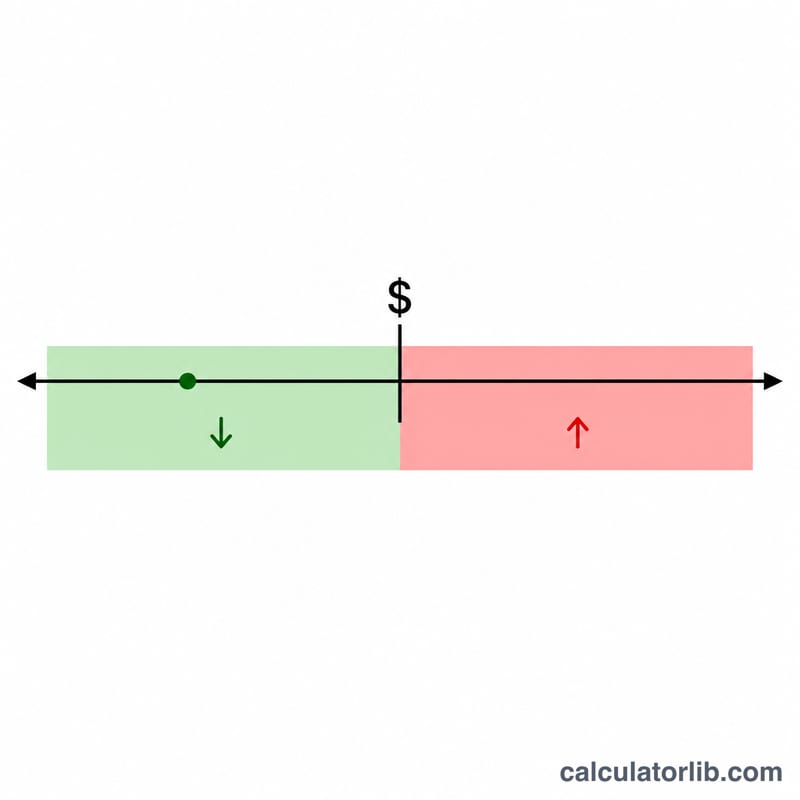
The Graham Number is a quick valuation metric introduced by Benjamin Graham, the father of value investing. It estimates the maximum price a defensive investor should pay for a stock based on two fundamentals: earnings per share (EPS) and book value per share (BVPS). If a stock trades below its Graham Number, it may be undervalued; if it trades above, it may be overpriced relative to its intrinsic worth.
How to Use This Calculator
Enter the company's diluted earnings per share (EPS) and its book value per share (total shareholder equity divided by shares outstanding). Both figures are available on a company's income statement and balance sheet. The calculator returns the Graham Number — the upper bound of a fair price. Compare it with the current market price to gauge whether the stock looks cheap or expensive.
The Formula Explained
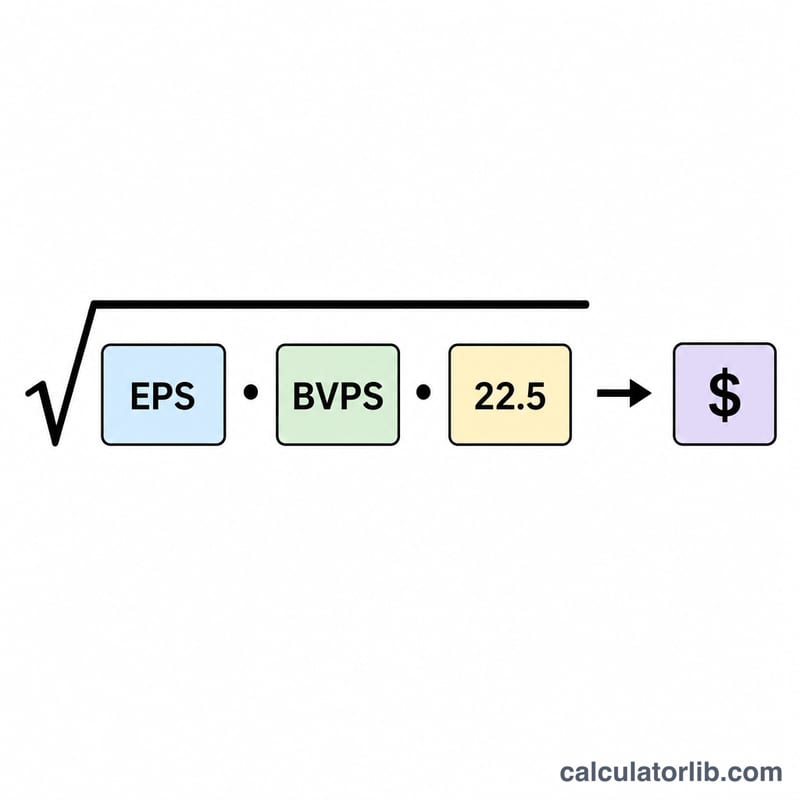
The formula is $$\text{Graham Number} = \sqrt{22.5 \times \text{EPS} \times \text{BVPS}}$$. The constant 22.5 comes from Graham's belief that a stock should not trade above a P/E ratio of 15 and a price-to-book ratio of 1.5 (\(15 \times 1.5 = 22.5\)). Multiplying EPS by BVPS and the constant, then taking the square root, blends both earnings power and asset value into a single fair-value estimate.
Worked Example
Suppose a company reports an EPS of $5 and a book value per share of $20. Then $$\text{Graham Number} = \sqrt{22.5 \times 5 \times 20} = \sqrt{2250} \approx \$47.43$$ If the stock currently trades at $40, it sits below its Graham Number and may be a value opportunity; at $60 it would appear overvalued by this measure.
FAQ
Is the Graham Number a guarantee? No. It is a conservative rule of thumb for defensive investors and works best for stable, profitable, asset-heavy companies. It is less reliable for growth, technology, or financial firms.
What if EPS or book value is negative? The formula requires positive inputs; a negative product has no real square root, so the metric cannot be applied to companies with losses or negative equity.
Should I rely only on this number? No. Use it alongside other metrics like cash flow, debt levels, and growth prospects for a complete analysis.