
What Is the Margin of Safety?
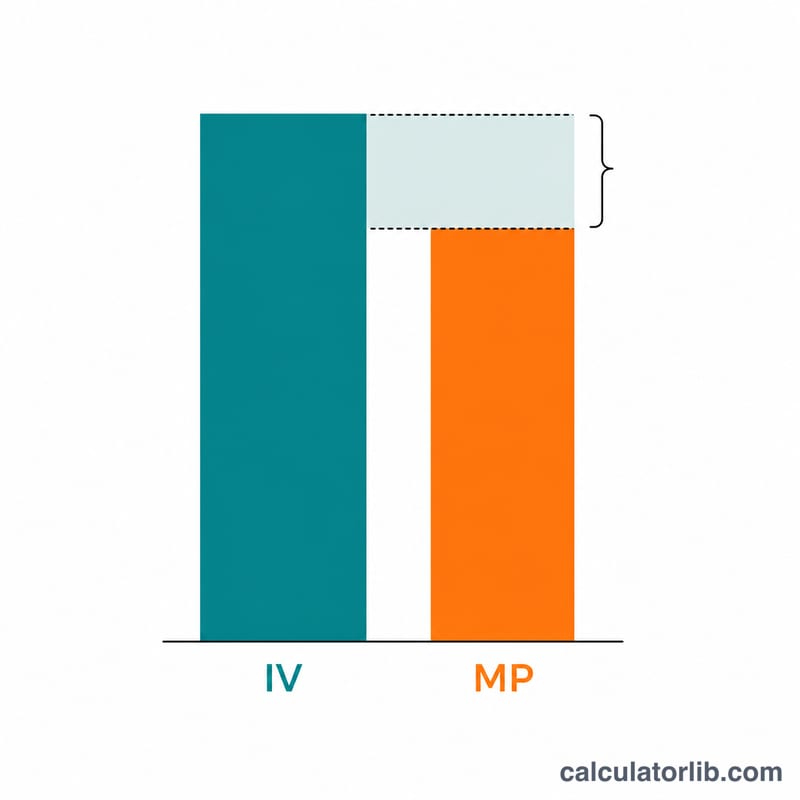
The margin of safety is a core principle of value investing popularized by Benjamin Graham and Warren Buffett. It measures how far below an investment's estimated intrinsic value its current market price sits. A larger margin gives you a cushion against estimation errors, bad luck, and market volatility. In short, you buy a dollar of value for fifty cents whenever possible.
How to Use This Calculator
Enter your own estimate of the asset's intrinsic value (from a discounted cash flow model, earnings multiple, or asset valuation) and the current market price. The calculator returns the margin of safety as a percentage plus the dollar discount. A positive percentage means the asset trades below your value estimate; a negative number means it is overpriced relative to your estimate.
The Formula Explained
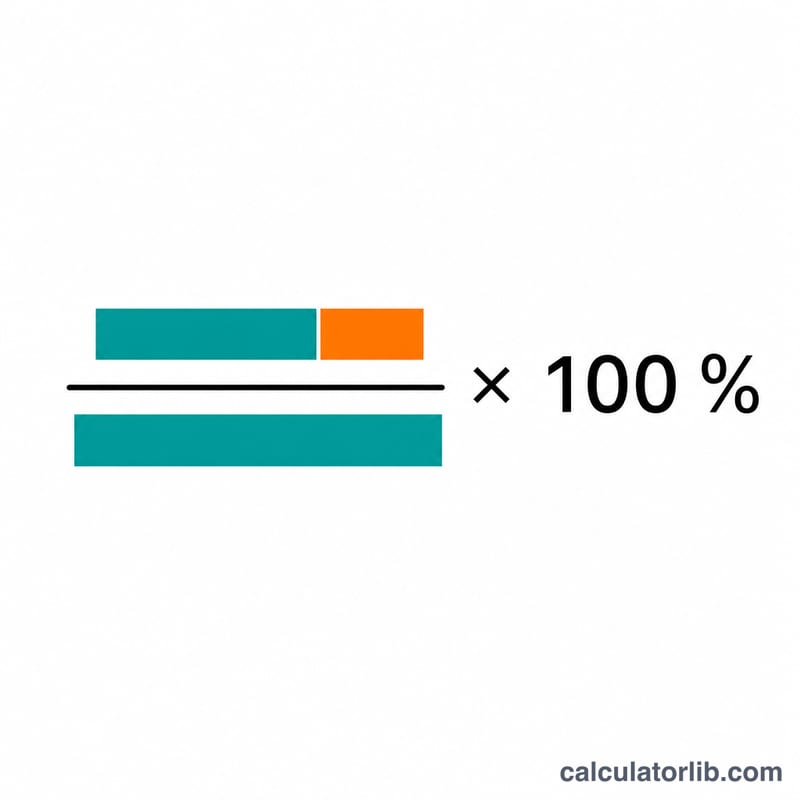
$$\text{Margin of Safety} = \frac{\text{Intrinsic Value} - \text{Market Price}}{\text{Intrinsic Value}} \times 100\%$$ The numerator is the dollar discount, and dividing by intrinsic value scales it to a percentage of true worth. Many disciplined investors look for at least a 25–50% margin before committing capital.
Worked Example
Suppose you estimate a stock's intrinsic value at $100 and it trades at $75. The discount is \(\$100 - \$75 = \$25\). The margin of safety is $$\left(\frac{\$25}{\$100}\right) \times 100 = \mathbf{25\%}$$ You are paying 75 cents for every estimated dollar of value.
FAQ
What is a good margin of safety? Many value investors target 25%–50%, but the right cushion depends on how confident you are in your intrinsic value estimate and the riskiness of the business.
Can the margin of safety be negative? Yes. If the market price exceeds your intrinsic value, the result is negative, signaling the asset may be overvalued.
How do I estimate intrinsic value? Common methods include discounted cash flow (DCF), earnings power value, and comparable multiples. This calculator uses whatever value you supply.