
What Is a Margin Call?
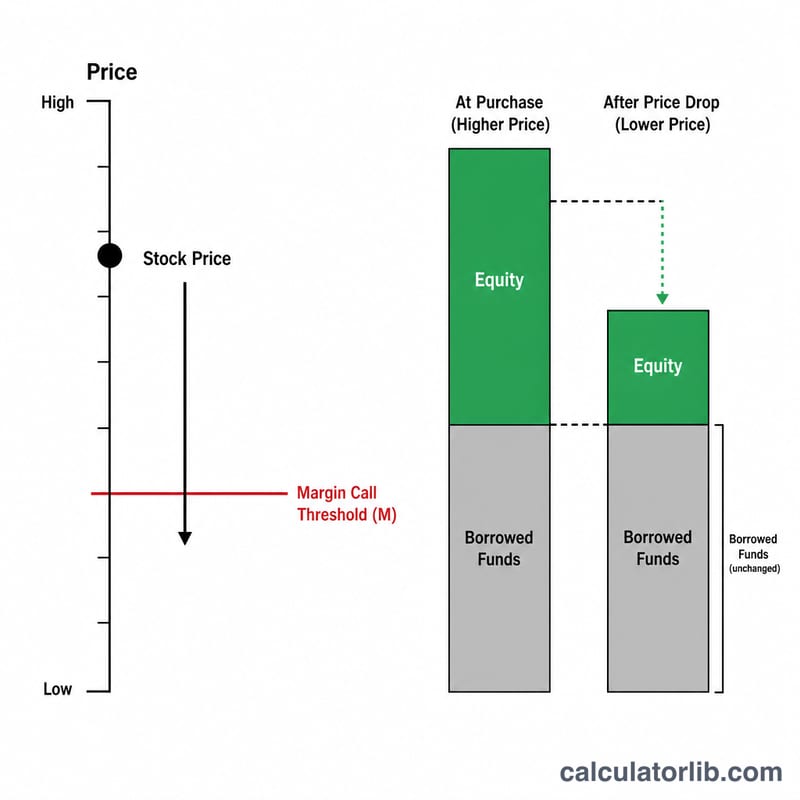
When you buy stock on margin, you borrow part of the purchase price from your broker. A margin call occurs when the value of your position falls far enough that your equity drops below the broker's maintenance margin requirement. At that point you must deposit more cash or securities — or the broker may liquidate your position. This calculator tells you exactly what share price will trigger that call.
How to Use It
Enter the purchase price per share, your initial margin requirement (the percentage of the purchase you funded with your own money, often 50%), and the maintenance margin required by your broker (commonly 25%). The calculator returns the price per share at which a margin call is triggered, plus the percentage drop from your entry price.
The Formula Explained
The margin call price is:
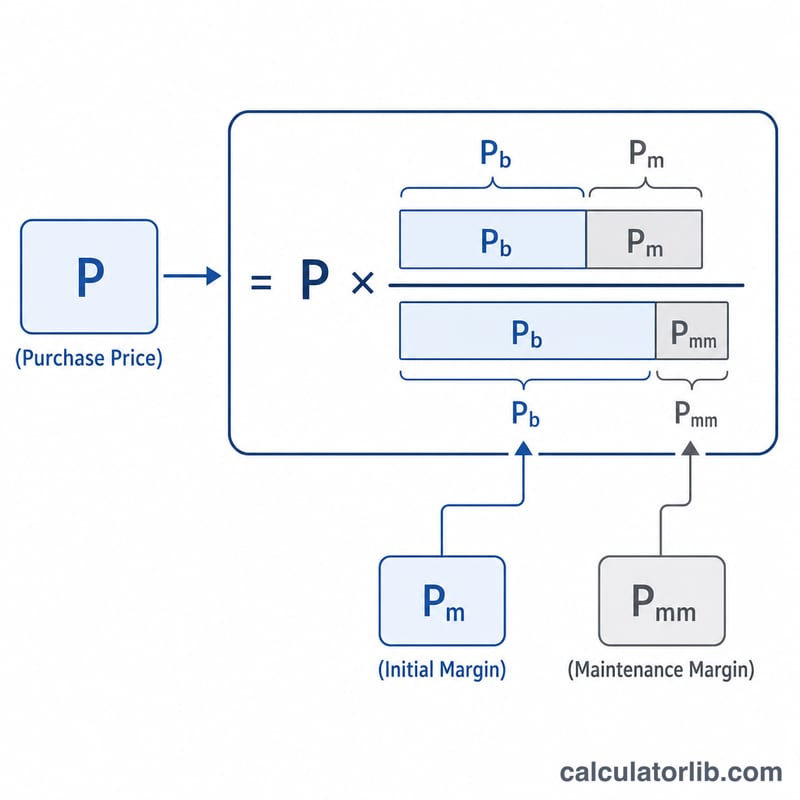
$$P_{\text{call}} = \text{Price} \cdot \frac{1 - \dfrac{\text{Initial Margin (\%)}}{100}}{1 - \dfrac{\text{Maint. Margin (\%)}}{100}}$$
The numerator (1 − Initial Margin) is the fraction of the purchase that was borrowed — i.e. the loan per share, which stays fixed. The denominator (1 − Maintenance Margin) scales that loan up to the lowest share price at which your equity still satisfies the maintenance rule.
Worked Example
Suppose you buy a stock at $100 with a 50% initial margin and your broker requires a 25% maintenance margin. Then:
$$\text{Call Price} = 100 \times \frac{1 - 0.50}{1 - 0.25} = 100 \times \frac{0.50}{0.75} = \$66.67$$ A margin call is triggered if the price falls to about $66.67 — a drop of roughly 33.3% from your entry.
FAQ
What is the difference between initial and maintenance margin? Initial margin is how much equity you must put up to open the position; maintenance margin is the minimum equity you must keep afterward.
Is this US-specific? The concept is universal, but in the US, Regulation T sets a typical 50% initial margin and FINRA sets a 25% maintenance minimum — brokers may require more.
What happens if I get a margin call? You must add funds or securities to restore your equity, or the broker can sell holdings to cover the shortfall, often without prior notice.