
What this calculator does
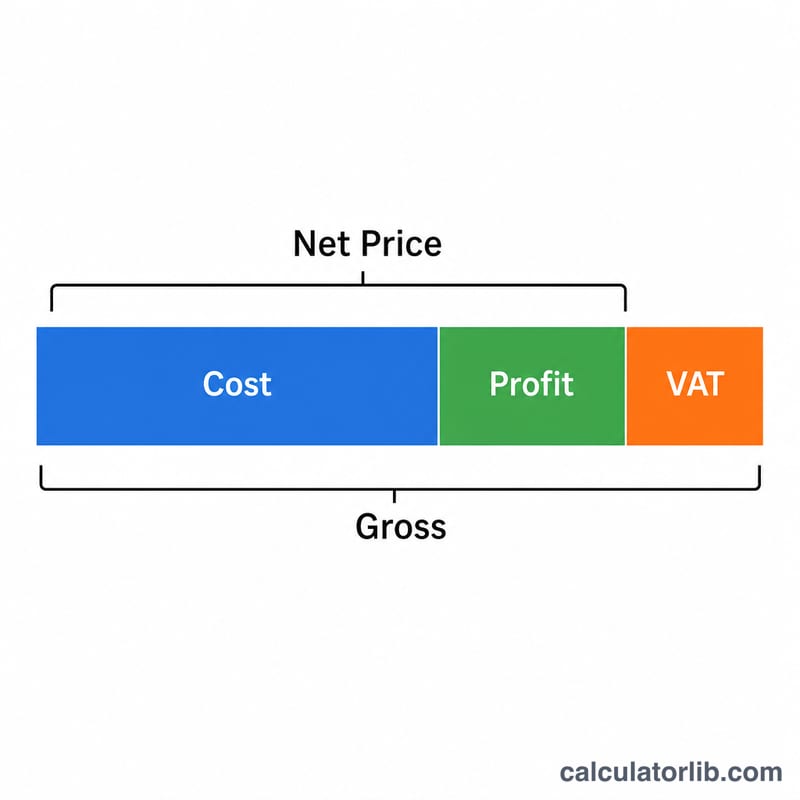
The Margin and VAT Calculator turns a product's net cost into both a net selling price (excluding VAT) and a gross selling price (including VAT). It works in two steps: first it marks up your cost so that the profit equals your target margin percentage of the selling price, then it applies the VAT rate to produce the final price your customer pays.
How to use it
Enter the Cost you pay for the item (net of any reclaimable VAT), the Margin you want to earn as a percentage of the selling price, and the VAT rate that applies in your market. The calculator returns the net selling price, the gross price including VAT, the profit you make and the VAT amount you collect.
The formula explained
Margin is profit divided by selling price, not by cost. So if you want a 25% margin, profit is 25% of the price, leaving cost at 75% of the price. Rearranged, \(\text{Price} = \dfrac{\text{Cost}}{1 - \frac{\text{Margin}}{100}}\). Note this differs from markup, where the percentage is applied to cost. After the net price is known, VAT is added: $$\text{Gross} = \text{Price} \times \left(1 + \frac{\text{VAT}}{100}\right)$$
Worked example
Cost = 100, Margin = 25%, VAT = 20%. Net price = \(100 / (1 - 0.25) = 100 / 0.75 = 133.33\). Profit = 33.33. VAT = \(133.33 \times 0.20 = 26.67\). Gross price = \(133.33 \times 1.20 = 160.00\).
FAQ
Is margin the same as markup? No. Markup is a percentage of cost; margin is a percentage of selling price. A 25% margin equals a 33.3% markup.
What VAT rate should I use? Use the standard or reduced rate that applies to your product in your country (for example 20% in the UK, varying rates across the EU).
Can margin be 100%? No — a 100% margin would imply an infinite price, so keep margin below 100%.