
What Is a Markdown Calculator?
A markdown calculator measures how much a product's price has been reduced from its original (regular) price down to its current sale price. The result is expressed as a percentage, which makes it easy to compare discounts across items of different prices. Retailers use markdowns to clear inventory, drive traffic, and respond to seasonal demand, while shoppers use the same math to judge whether a "sale" is actually a good deal.
How to Use It
Enter the original price (the regular or list price before any reduction) and the sale price (what the item costs now). The calculator returns the markdown percentage along with the dollar amount of the reduction. Both prices should use the same currency.
The Formula Explained
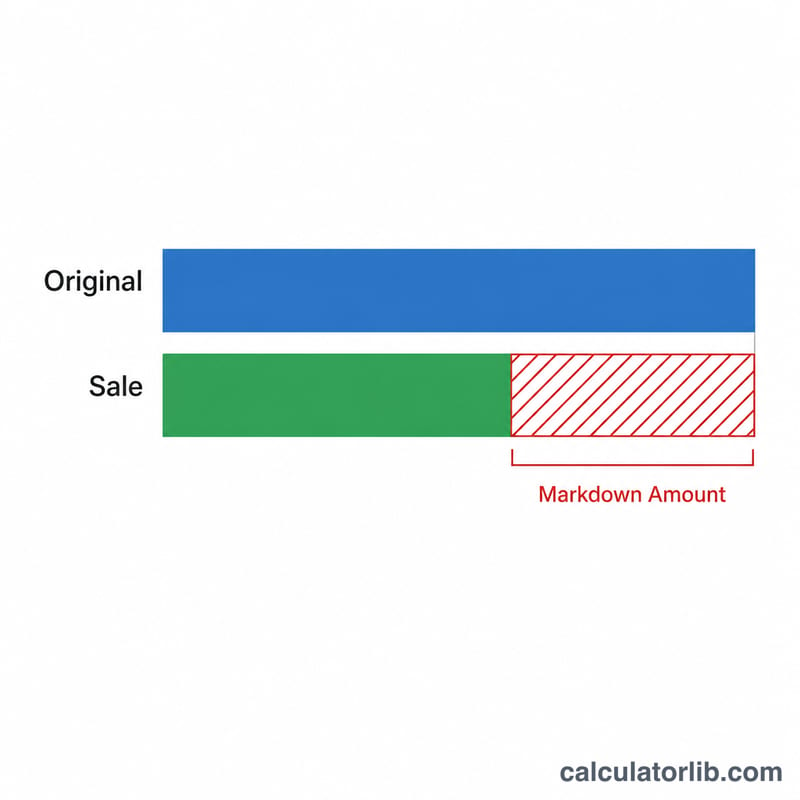
The markdown percentage is the difference between the two prices divided by the original price, multiplied by 100:
$$\text{Markdown \%} = \frac{\text{Original Price} - \text{Sale Price}}{\text{Original Price}} \times 100$$
Dividing by the original price (not the sale price) is what defines a markdown. This is the same convention used for retail discounts.
Worked Example
Suppose a jacket originally costs $120 and is now on sale for $90. The markdown amount is \(\$120 - \$90 = \$30\). The markdown percentage is $$\$30 / \$120 \times 100 = 25\%$$ So the jacket is marked down 25%.
FAQ
Is markdown the same as discount? In everyday use, yes — both describe a reduction from the original price. "Markdown" is the common retail term for a permanent or planned price reduction.
What if the sale price is higher than the original? The markdown percentage will be negative, indicating a markup (price increase) rather than a reduction.
How do I find the sale price from a markdown percent? Multiply the original price by \((1 - \text{markdown \%} / 100)\). For example, 25% off $120 is \(\$120 \times 0.75 = \$90\).