What Is Accounting Profit?
Accounting profit is the net income a business reports on its income statement after subtracting all explicit costs from total revenue. Explicit costs are the actual, measurable cash outflows a company pays — wages, rent, materials, utilities, interest and taxes. Unlike economic profit, accounting profit ignores implicit (opportunity) costs, which makes it the standard figure used for financial reporting and tax purposes.
How to Use This Calculator
Enter your total revenue (all money earned from sales and services during the period) and your explicit costs (the sum of every expense actually paid out). The calculator subtracts costs from revenue to show your accounting profit, and it also reports your profit margin as a percentage of revenue so you can gauge efficiency.
The Formula Explained
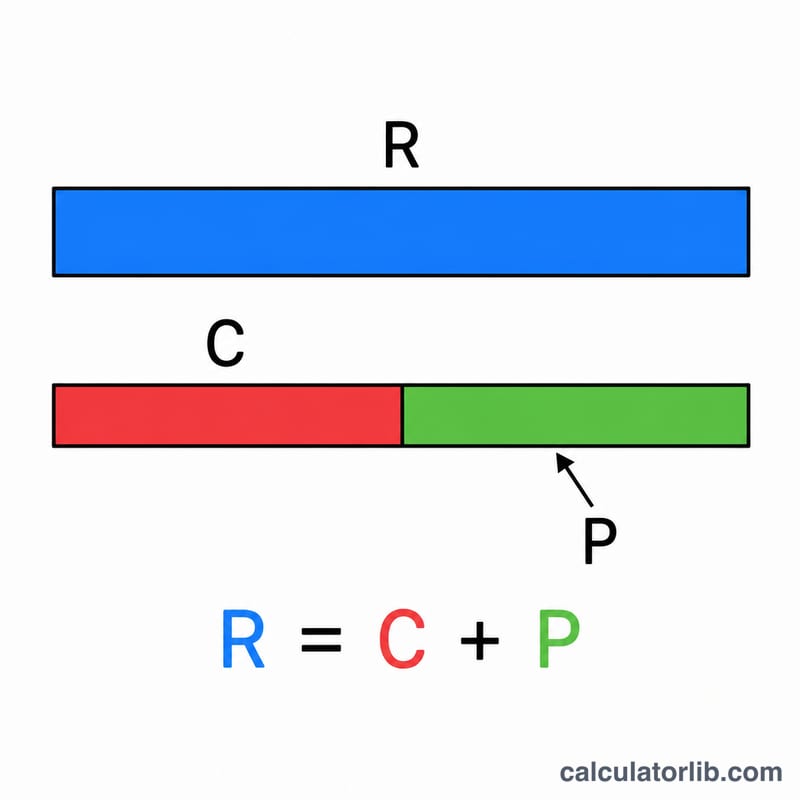
The core equation is simple: $$\text{Accounting Profit} = \text{Total Revenue} - \text{Explicit Costs}$$ A positive result means the business earned more than it spent; a negative result is an accounting loss. The profit margin is calculated as $$\text{Margin} = \frac{\text{Accounting Profit}}{\text{Total Revenue}} \times 100$$ telling you how many cents of profit remain from each dollar of sales.
Worked Example
Suppose a small bakery generates $100,000 in total revenue and pays $60,000 in explicit costs (flour, wages, rent, utilities). Accounting profit = $$\$100{,}000 - \$60{,}000 = \$40{,}000$$ The profit margin = $$\frac{\$40{,}000}{\$100{,}000} \times 100 = 40\%$$
Interpreting Your Profit Margin
Accounting profit is the amount of money left over after subtracting all explicit (out-of-pocket) costs from total revenue:
$$\text{Accounting Profit} = \text{Total Revenue} - \text{Explicit Costs}$$The sign of the result tells you the basic story of the period:
- Positive accounting profit means revenue exceeded explicit costs — the business covered its bills and kept the difference.
- Negative accounting profit (a loss) means explicit costs outran revenue, so the business spent more than it earned.
- Zero (break-even) means revenue exactly matched explicit costs.
The profit margin expresses that profit as a share of revenue, which makes results comparable across different sizes of business:
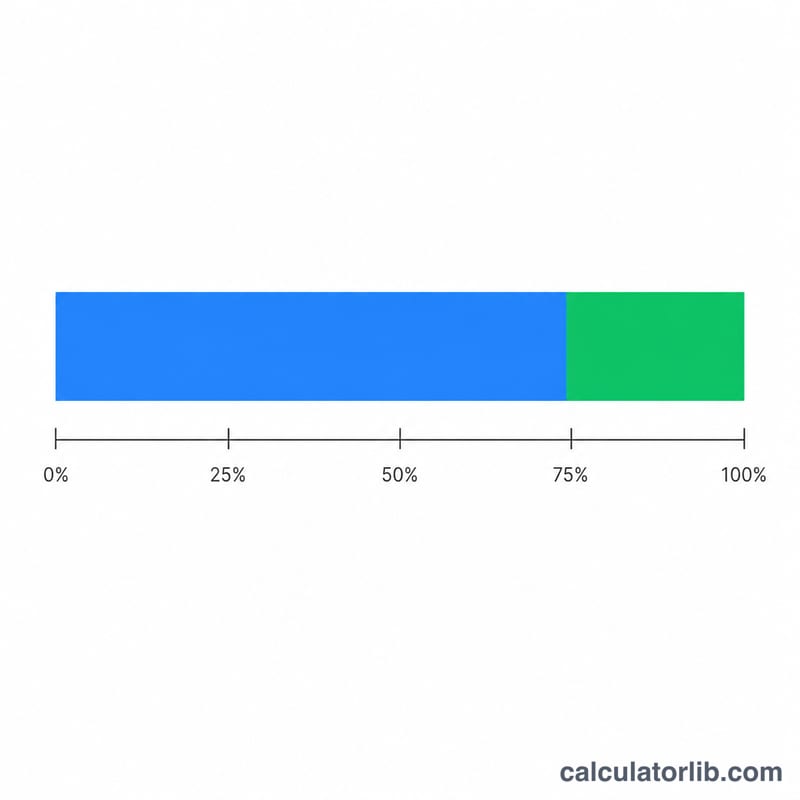
$$\text{Profit Margin} = \frac{\text{Accounting Profit}}{\text{Total Revenue}} \times 100\%$$For example, a business with $500,000 in revenue and $430,000 in explicit costs has an accounting profit of $70,000, giving a profit margin of 14%.
How to read the percentage: a higher margin means more of each dollar of revenue is retained as profit. Margins vary widely by industry — net profit margins commonly fall anywhere from the low single digits (in high-volume, low-margin sectors such as grocery and general retail) up to roughly 20% or more (in some software and service businesses). Because of this spread, a margin is most meaningful when compared against typical figures for the same industry and against the same business over prior periods, rather than against an unrelated sector.
This is general information, not professional financial advice. For decisions specific to your situation, consult a qualified accountant or financial professional.
Key Terms & Definitions
- Total Revenue
- The full amount a business earns from selling its goods or services over a period, before any costs are deducted. Sometimes called sales or turnover.
- Explicit Costs
- Direct, out-of-pocket payments a business makes, such as wages, rent, raw materials, utilities, and interest. These are recorded in the accounts and are the only costs subtracted to find accounting profit.
- Implicit (Opportunity) Costs
- The value of resources the owner already owns that are used in the business — for example, forgone salary or the return that invested capital could have earned elsewhere. These are not recorded as cash expenses but represent value given up.
- Accounting Profit
- Total revenue minus explicit costs. It reflects the bookkeeping result of operations and is the figure reported in financial statements.
- Economic Profit
- Total revenue minus both explicit and implicit costs. Because it also subtracts opportunity costs, economic profit is always less than or equal to accounting profit.
- Net Income
- The bottom-line profit after all expenses, including operating costs, interest, and taxes, have been deducted from revenue. In everyday use it closely overlaps with accounting profit, though it specifically accounts for taxes and non-operating items.
- Profit Margin
- Profit expressed as a percentage of revenue (profit ÷ revenue × 100%). It shows how much of each dollar of sales is kept as profit and allows comparison across businesses of different sizes.
FAQ
How is accounting profit different from economic profit? Economic profit also subtracts implicit costs — the value of forgone opportunities — so it is usually lower than accounting profit.
What counts as an explicit cost? Any expense that involves an actual payment: salaries, supplies, rent, insurance, interest and taxes.
Can accounting profit be negative? Yes. If explicit costs exceed revenue, the business records an accounting loss.