What Is the Profit and Loss Percentage Calculator?
This calculator works out whether a transaction resulted in a profit or a loss and expresses the result as a percentage of the cost price. It is a universal financial and business tool useful for retailers, traders, students, and anyone buying and selling goods. By comparing the cost price (CP) — what you paid — against the selling price (SP) — what you received — it tells you both the absolute gain or loss and the relative percentage.
How to Use It
Enter the Cost Price (the price at which you bought the item) and the Selling Price (the price at which you sold it). The calculator instantly determines whether you made a profit or a loss, shows the amount, and computes the percentage relative to the cost price. If SP equals CP, the result is a break-even.
The Formula Explained
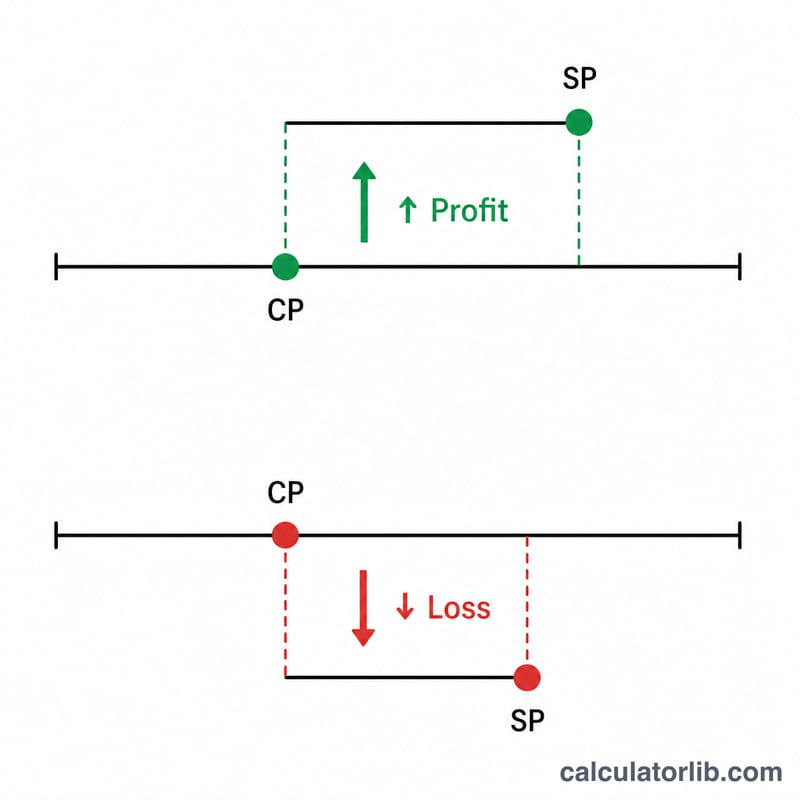
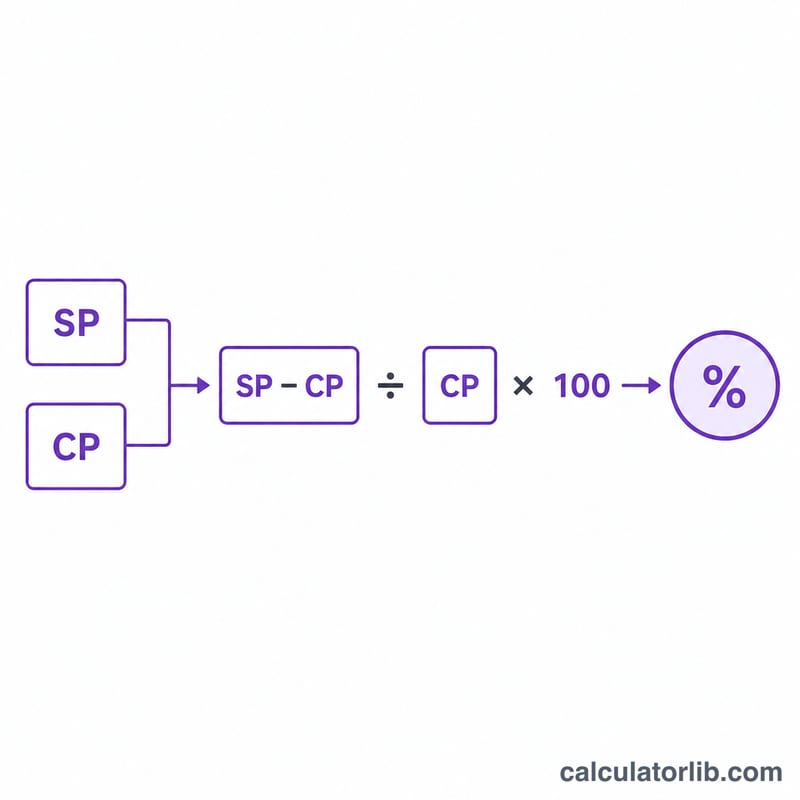
Profit or loss percentage is always calculated on the cost price, not the selling price. When SP > CP you have a profit; when CP > SP you have a loss.
$$\text{Profit\%} = \frac{\text{SP} - \text{CP}}{\text{CP}} \times 100$$$$\text{Loss\%} = \frac{\text{CP} - \text{SP}}{\text{CP}} \times 100$$The numerator is the gain or loss in money, and dividing by CP normalises it so different-sized deals can be compared fairly.
Worked Example
Suppose you buy an item for a cost price of 200 and sell it for 250. The profit amount is \(250 - 200 = 50\). The profit percentage is $$\left(\frac{50}{200}\right) \times 100 = 25\%$$ So you earned a 25% profit. If instead you sold it for 150, the loss is \(200 - 150 = 50\), giving a loss percentage of $$\left(\frac{50}{200}\right) \times 100 = 25\%$$
Key Terms: Cost Price, Selling Price, Profit, Loss
- Cost Price (CP)
- The amount paid to acquire or produce an item. It is the base against which profit or loss percentage is measured.
- Selling Price (SP)
- The amount for which the item is actually sold.
- Profit
- The gain made when SP is greater than CP: \(\text{Profit} = SP - CP\).
- Loss
- The shortfall when SP is less than CP: \(\text{Loss} = CP - SP\).
- Break-even
- The point where SP equals CP, so there is neither profit nor loss (0%).
The calculator uses this formula:
$$\text{Profit/Loss \%} = \frac{SP - CP}{CP} \times 100$$
A positive result is a profit percentage and a negative result is a loss percentage.
Profit percentage vs. margin vs. markup
- Profit percentage (on cost) and markup use CP as the base: \(\frac{SP - CP}{CP} \times 100\). When the extra amount added to cost is expressed as a percentage, it is the markup, which equals the profit percentage on cost.
- Profit margin uses SP as the base: $$\text{Margin \%} = \frac{SP - CP}{SP} \times 100$$
Because the bases differ, the same sale gives different numbers for profit percentage and margin. Always check which base a figure refers to.
Interpreting Your Profit or Loss Percentage
- Relative to cost price: The percentage tells you the gain or shortfall as a share of CP, not of SP.
- Positive result: SP is greater than CP, so there is a profit.
- Negative result: SP is less than CP, so there is a loss. The calculator shows this as a negative percentage, and the loss percentage is the same number without the minus sign.
- Zero: SP equals CP, so you are at break-even.
Limits of the scale
Loss percentage cannot go beyond 100%. The most you can lose is the entire cost, which happens when SP = 0: \(\frac{0 - CP}{CP} \times 100 = -100\%\). Profit percentage has no upper limit, because SP can be many times CP. For example, CP = 50 and SP = 200 gives \(\frac{200 - 50}{50} \times 100 = 300\%\).
What the percentage does not include
The result reflects only the CP and SP you enter. Overheads, taxes, shipping, fees, and other costs are not counted unless you have included them in the cost price.
Profit on cost vs. margin on selling price
A profit percentage on cost is not the same as a margin on selling price. For instance, with CP = 80 and SP = 100, the profit percentage is \(\frac{100 - 80}{80} \times 100 = 25\%\), while the margin is \(\frac{100 - 80}{100} \times 100 = 20\%\). The same transaction is therefore described as 25% profit on cost or a 20% margin.
FAQ
Is the percentage based on cost or selling price? By standard convention, profit and loss percentages are calculated on the cost price.
What does break-even mean? Break-even occurs when the selling price equals the cost price, so the percentage is 0% — no profit, no loss.
Can I use it for any currency? Yes. The calculator is currency-neutral; just enter both prices in the same currency.