
What Is a Profit and Loss Calculator?
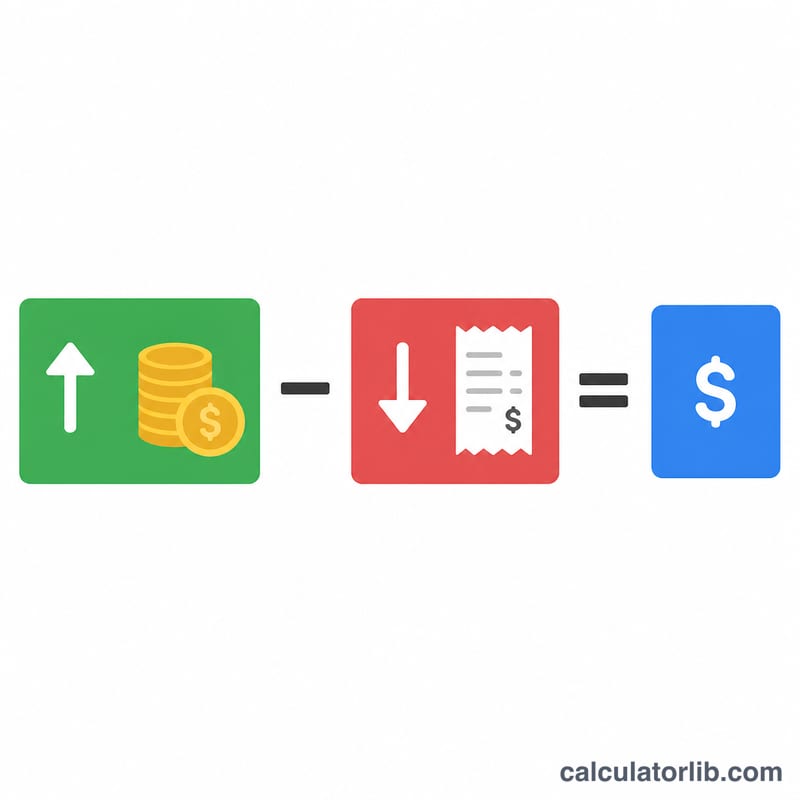
A Profit and Loss (P&L) calculator measures the financial result of a business, project, or period by subtracting total expenses from total revenue. The outcome tells you whether you made a net profit (a positive number) or incurred a net loss (a negative number). It also reports your profit margin — the share of revenue that remains after costs — which is one of the most important indicators of business health.
How to Use It
Enter your Total Revenue (all money earned from sales, services, or other income) and your Total Expenses (cost of goods sold, salaries, rent, marketing, taxes, and every other cost). Click calculate and the tool returns your net profit or loss along with your profit margin as a percentage. Use it for a single transaction, a month, a quarter, or a full year.
The Formula Explained
The calculation is simple but powerful:
$$\text{Net P\&L} = \text{Total Revenue} - \text{Total Expenses}$$
$$\text{Profit Margin (\%)} = \frac{\text{Net P\&L}}{\text{Total Revenue}} \times 100$$
Net P&L is an absolute dollar figure, while the margin expresses profitability relative to size, making it easy to compare periods or businesses of different scales.
Worked Example
Suppose a small shop earns $100,000 in revenue and spends $70,000 on inventory, wages, and rent. Net P&L = $$100{,}000 - 70{,}000 = 30{,}000$$ $30,000 profit. Profit margin = $$\frac{30{,}000}{100{,}000} \times 100 = 30\%$$ 30%. This means 30 cents of every revenue dollar becomes profit.
FAQ
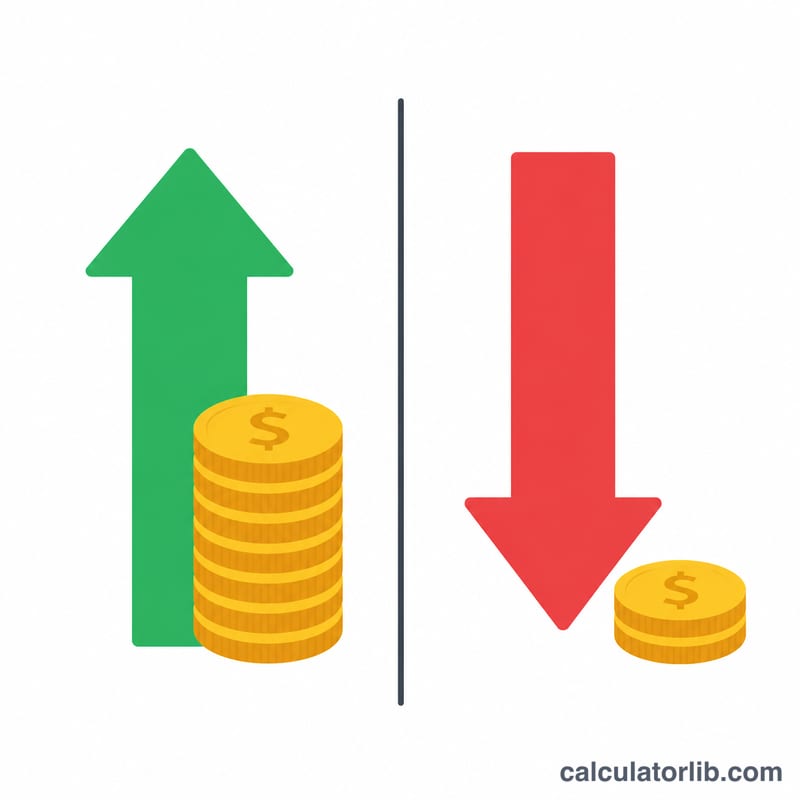
What if expenses exceed revenue? The net result will be negative, indicating a loss, and the margin will also be negative.
Should revenue include tax? Use revenue net of sales tax you collect on behalf of authorities; include only income you actually keep.
Is this gross or net profit? If your expenses include all operating costs, taxes, and interest, this reflects net profit. If you only enter cost of goods sold, it reflects gross profit.