

What This Calculator Does
The Part-Time Annual Salary Calculator turns an hourly wage into an estimated yearly income. It is ideal for part-time workers, students, freelancers paid by the hour, and anyone weighing a job offer who wants to understand the bigger financial picture beyond the hourly figure.
How to Use It
Enter three values: your hourly rate, the number of hours you typically work each week, and how many weeks you actually work in a year. Many full-time roles assume 52 weeks, but part-time and seasonal workers often plan around 48–50 weeks to account for unpaid time off. The calculator instantly returns your gross annual, average monthly, and weekly pay.
The Formula Explained
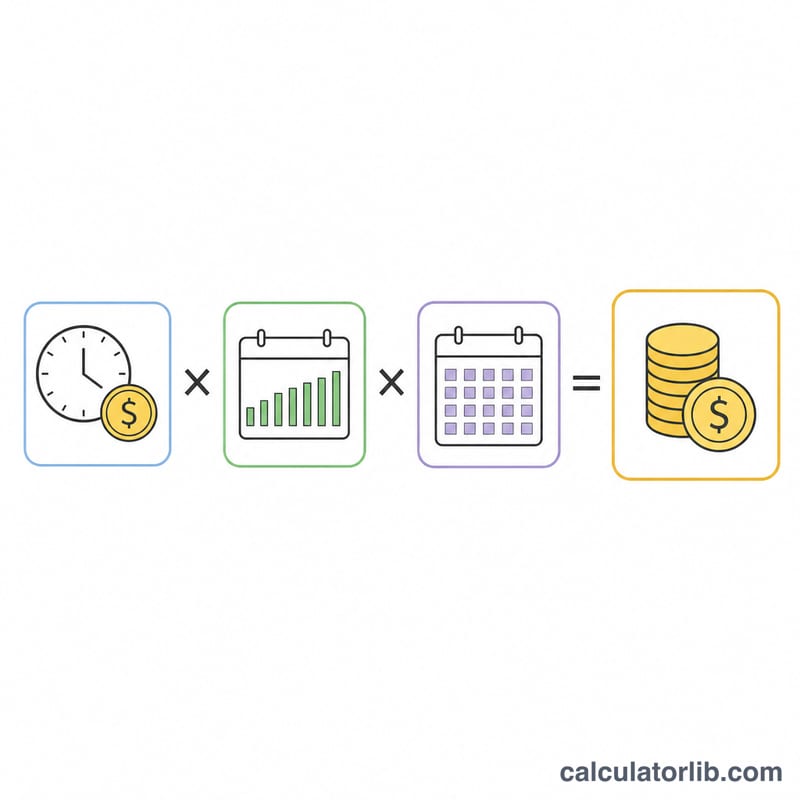
The core math is simple multiplication:
$$\text{Annual} = \text{Hourly} \times \text{Hours per Week} \times \text{Weeks Worked per Year}$$
Weekly pay is just \(\text{Hourly} \times \text{Hours per Week}\), and average monthly pay is the annual total divided by 12. These figures are gross amounts — before income tax, retirement contributions, or other deductions.
Worked Example
Suppose you earn $20 per hour, work 25 hours a week, and work 50 weeks a year. Your annual salary is $$20 \times 25 \times 50 = \$25{,}000.$$ Your weekly pay is \(20 \times 25 = \$500\), and your average monthly pay is \(25{,}000 \div 12 \approx \$2{,}083.33\).
FAQ
Is this my take-home pay? No. The result is gross pay before taxes and deductions. Your net income will be lower.
How many weeks should I enter? Use 52 for year-round work with no time off, or fewer (e.g. 48–50) if you take unpaid breaks or work seasonally.
Does it account for overtime? No. It assumes a consistent hourly rate. If you regularly earn overtime, calculate that separately and add it.