

What Is a Net Pay (Take-Home) Calculator?
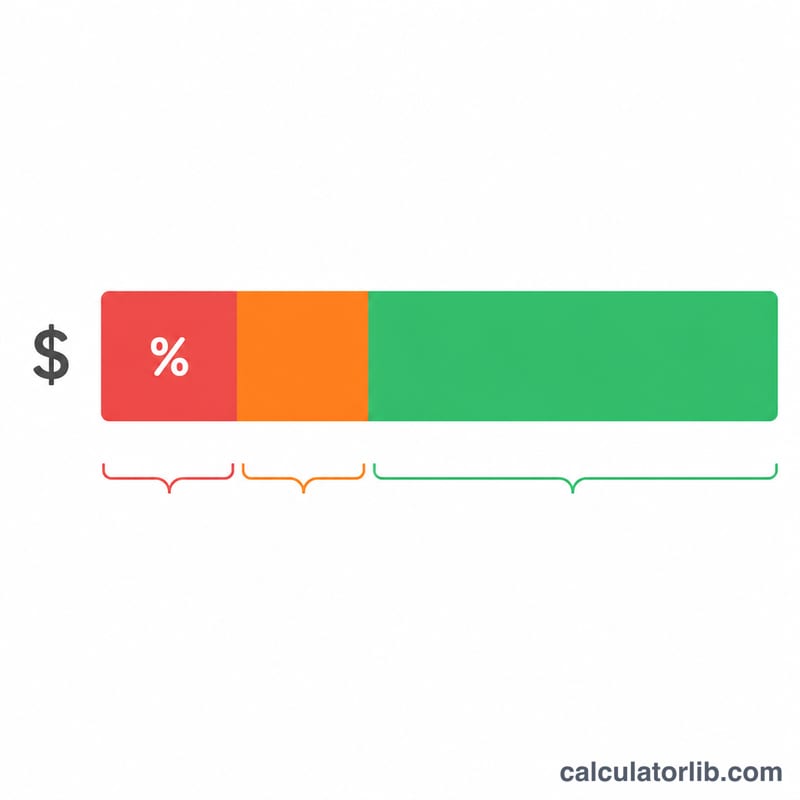
Your gross pay is the total amount you earn before anything is taken out. Your net pay, or take-home pay, is what actually lands in your bank account after taxes and other deductions. This calculator gives you a quick, jurisdiction-neutral estimate: you supply a single combined tax rate and a fixed deduction amount, and it returns your net pay, the estimated tax, your total deductions, and the percentage of gross pay you keep.
How to Use It
Enter three values: your gross pay for the period (weekly, monthly, or annual — the calculator is unit-agnostic), the total tax rate as a percentage combining income tax and any payroll/social taxes you want to model, and your fixed deductions (e.g. health insurance, retirement contributions, union dues). The result updates with your take-home amount and a breakdown.
The Formula Explained
The math is straightforward:
$$\text{Net Pay} = \text{Gross Pay} - \left(\text{Gross Pay} \times \frac{\text{Tax Rate (\%)}}{100}\right) - \text{Fixed Deductions}$$
The tax term scales with your gross pay, while fixed deductions are subtracted as a flat amount. The take-home rate is simply \(\text{Net Pay} \div \text{Gross Pay} \times 100\).
Worked Example
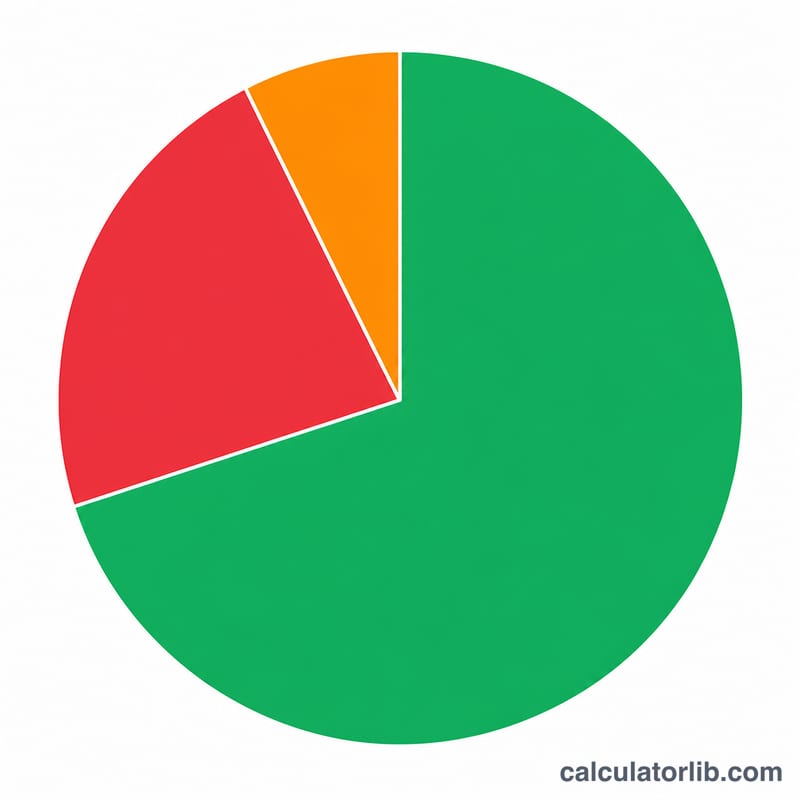
Suppose your gross pay is 5,000, your total tax rate is 25%, and your fixed deductions are 300.
$$\text{Tax} = 5{,}000 \times 25 \div 100 = 1{,}250$$ $$\text{Total deductions} = 1{,}250 + 300 = 1{,}550$$ $$\text{Net pay} = 5{,}000 - 1{,}550 = \mathbf{3{,}450}$$ $$\text{Take-home rate} = 3{,}450 \div 5{,}000 \times 100 = \mathbf{69\%}$$
FAQ
Is this accurate for my country? It uses a single combined tax rate, so it is an estimate. Real payroll systems use tiered brackets, allowances, and multiple separate taxes. Use your effective tax rate for the best approximation.
What counts as a fixed deduction? Any flat amount removed regardless of tax — insurance premiums, fixed retirement contributions, garnishments, or union dues.
Can I use it for annual or hourly pay? Yes. The calculator works with whatever period you enter, as long as the tax rate and fixed deductions match that same period.