

What Is the Weekly to Annual Salary Calculator?
This calculator converts your weekly pay into an annualized salary so you can understand your true yearly earnings. It's useful for comparing job offers, budgeting, applying for loans, or filing tax estimates where annual income figures are required.
How to Use It
Enter your weekly pay in dollars and the number of weeks you work per year. Most full-time employees use 52 weeks. If you take unpaid time off, lower the weeks accordingly. The calculator instantly shows your annual, monthly, and bi-weekly income.
The Formula Explained
The core formula is simply \(\text{Annual} = \text{Weekly Pay} \times \text{Weeks}\). With a standard year of 52 weeks, weekly pay multiplied by 52 gives your gross yearly salary. Monthly pay is the annual figure divided by 12, and bi-weekly pay is your weekly amount doubled.
$$\text{Annual} = \text{Weekly Pay} \times \text{Weeks}$$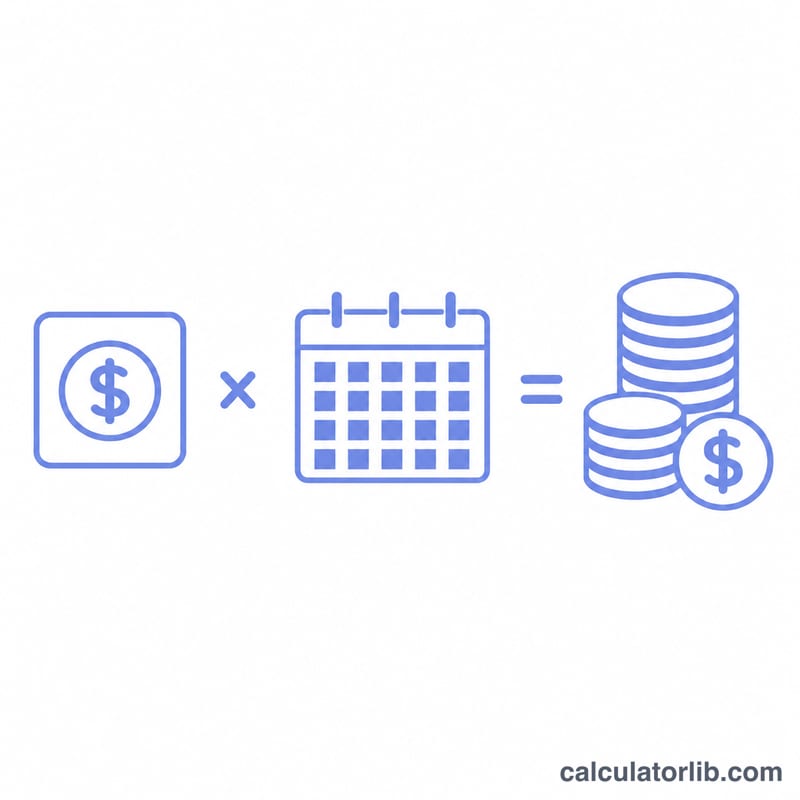
Worked Example
Suppose you earn $1,000 per week and work all 52 weeks. Your annual salary is $$1{,}000 \times 52 = \$52{,}000$$ Dividing by 12 gives roughly \(\$4{,}333.33\) per month, and your bi-weekly pay would be \(\$2{,}000\).

FAQ
How many weeks should I use? Use 52 for a standard full-year estimate. Use fewer weeks if you have unpaid leave or seasonal work.
Is this gross or net pay? These figures are gross (before taxes and deductions). Your take-home pay will be lower after withholdings.
Why is monthly pay not weekly × 4? A month averages about 4.33 weeks, so dividing the annual total by 12 is more accurate than multiplying weekly pay by 4.