
What Is a Salary Counteroffer Calculator?
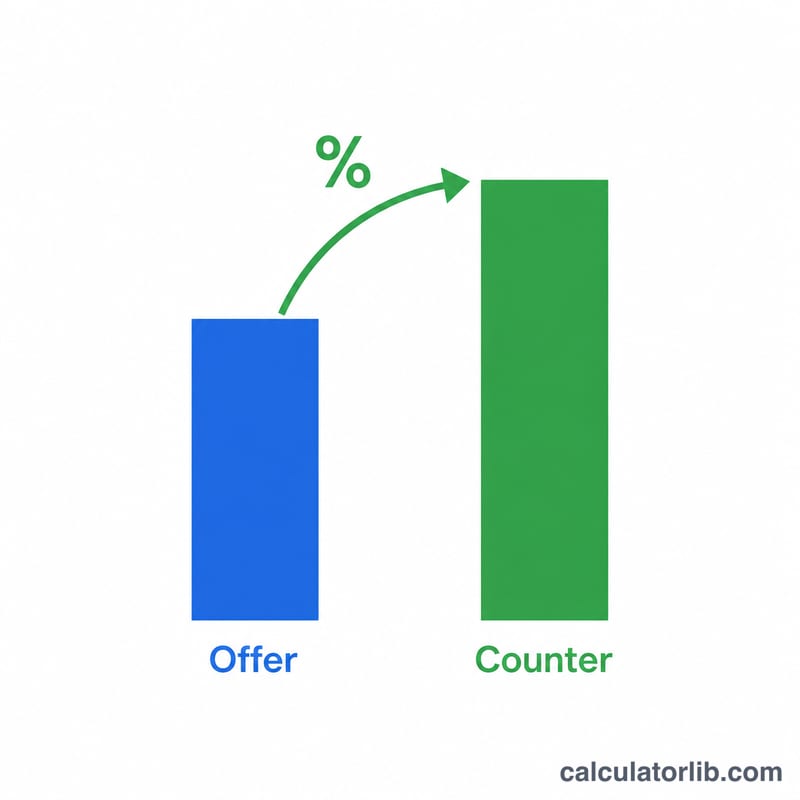
When you receive a job offer, the first number is rarely the final number. This calculator helps you decide what salary to counter with by scaling the employer's initial offer up by a target percentage you choose. It turns a gut feeling — "I think I could get more" — into a concrete, defensible figure you can bring to the negotiation table.
How to Use It
Enter the initial offer the employer put on the table, then enter your target increase as a percentage. Common counteroffers fall in the 5%–20% range, depending on market data, your experience, and how strong your alternatives are. The tool instantly shows your recommended counteroffer and the dollar raise it represents.
The Formula Explained
The math is straightforward percentage growth:
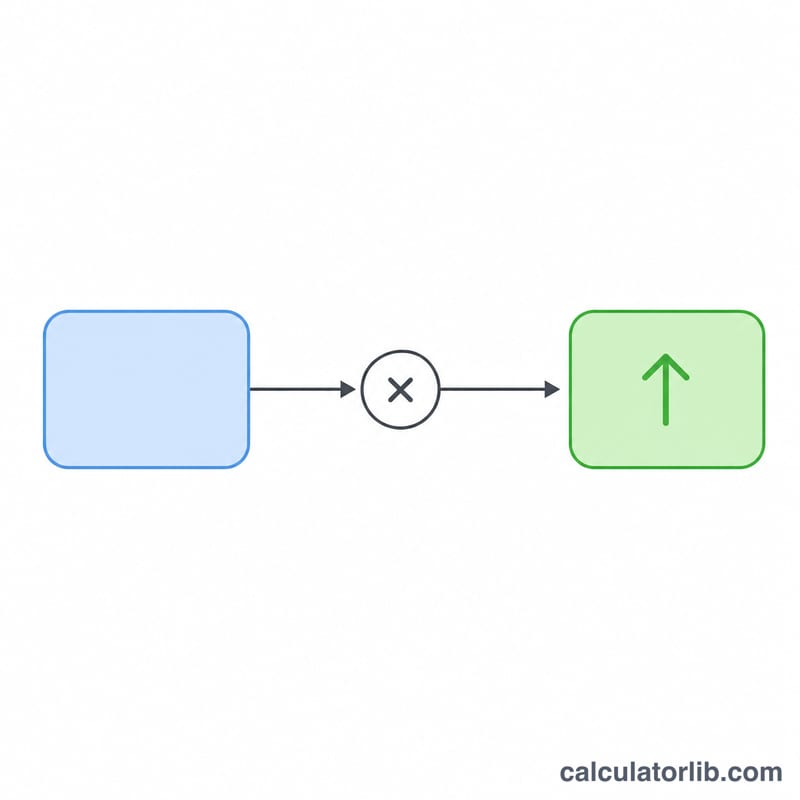
$$\text{Counter} = \text{Offer} \times \left(1 + \frac{\text{Increase}\%}{100}\right)$$
If the increase percentage is 10%, you multiply the offer by \(1.10\). The raise amount is simply the counteroffer minus the original offer.
Worked Example
Suppose you receive an offer of $80,000 and decide to counter for 10% more. The calculation is $$80{,}000 \times (1 + 0.10) = 80{,}000 \times 1.10 = \$88{,}000$$ That is a raise of $8,000 over the original offer — a clean, round number that is easy to justify if you have market data to support it.
FAQ
How much should I counter for? A 10%–20% bump above the initial offer is typical, but anchor your number to salary research for your role, location, and seniority.
Will I lose the offer by countering? Rarely. Most employers expect negotiation and leave headroom in their first offer. A polite, data-backed counter is standard practice.
Does this include bonuses or equity? No — this tool focuses on base salary. Consider negotiating the total package (bonus, equity, signing bonus, PTO) separately.