
What is the Wage to Salary Calculator?
This calculator converts an hourly wage into the equivalent annual salary, along with monthly, weekly and daily pay. It's ideal for comparing a job offer quoted by the hour against a salaried role, or for understanding what your take-home rate adds up to over a full year.
How to use it
Enter your hourly wage, the number of hours you work each week, the number of weeks you work per year (52 for a full year), and how many days a week you work. The calculator instantly shows your equivalent annual salary plus your monthly, weekly and daily earnings before tax.
The formula explained
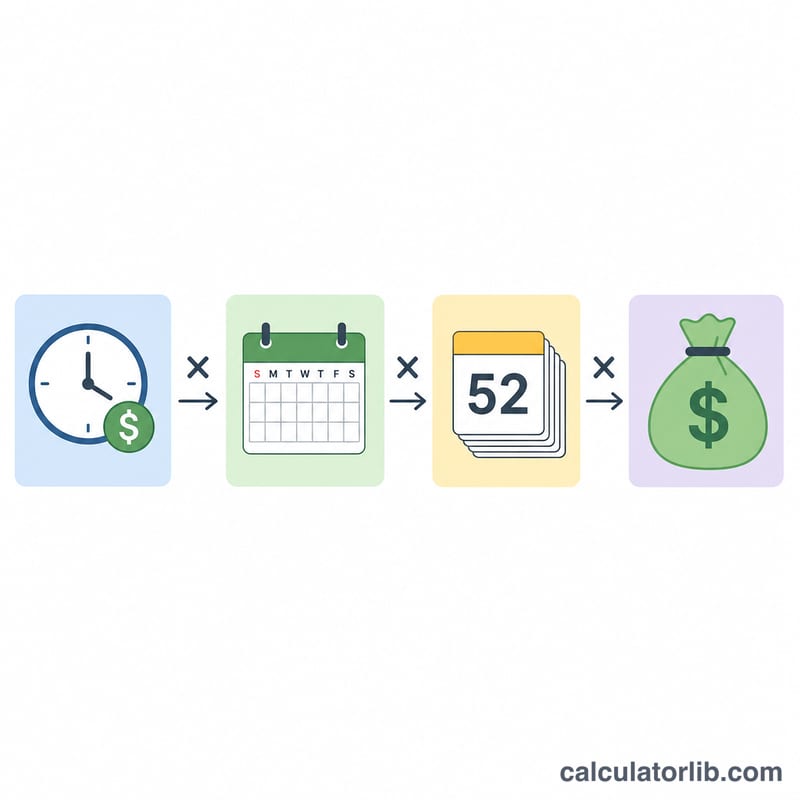
The core formula is $$\text{annual salary} = \text{hourly wage} \times \text{hours per week} \times \text{weeks per year}$$. Weekly pay is simply \(\text{wage} \times \text{hours per week}\), and monthly pay is the annual figure divided by 12. Daily pay is calculated as your hourly wage multiplied by the average hours worked per day, where \(\text{average hours per day} = \text{hours per week} \div \text{days per week}\).
Worked example
Suppose you earn $25/hour, work 40 hours over 5 days each week, for 52 weeks a year. Weekly pay = \(25 \times 40 = \$1{,}000\). Annual salary = \(1{,}000 \times 52 = \$52{,}000\). Monthly pay = \(52{,}000 \div 12 \approx \$4{,}333.33\). Average hours per day = \(40 \div 5 = 8\), so daily pay = \(25 \times 8 = \$200\).
FAQ
Why is daily pay based on hours per day, not weekly pay divided by days? Both approaches give the same result. Daily pay equals your wage times the hours you actually work in a typical day.
Does this include taxes? No. All figures are gross (before tax) earnings. Your net pay will be lower after deductions.
What weeks-per-year should I use? Use 52 to assume no unpaid time off, or fewer weeks to account for unpaid vacation.