
What This Calculator Does
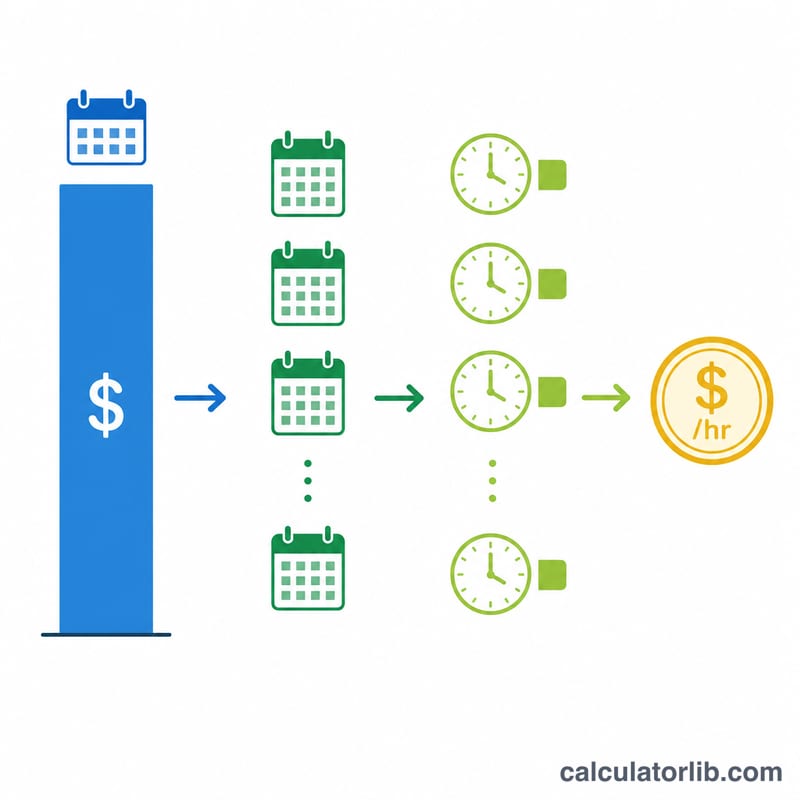
This tool tells you the hourly wage you'd need to earn in order to take home the same gross income as a fixed annual salary. It's perfect for freelancers, contractors, and anyone comparing an hourly job offer against a salaried one. By dividing the yearly salary by the total number of hours you expect to work in a year, you get a clear, comparable hourly rate.
How to Use It
Enter the target annual salary you want to match, the number of hours you plan to work each week, and the number of weeks you work per year (52 if you take no unpaid time off). The calculator instantly returns the required hourly rate along with the equivalent weekly and monthly pay so you can sanity-check the numbers.
The Formula Explained
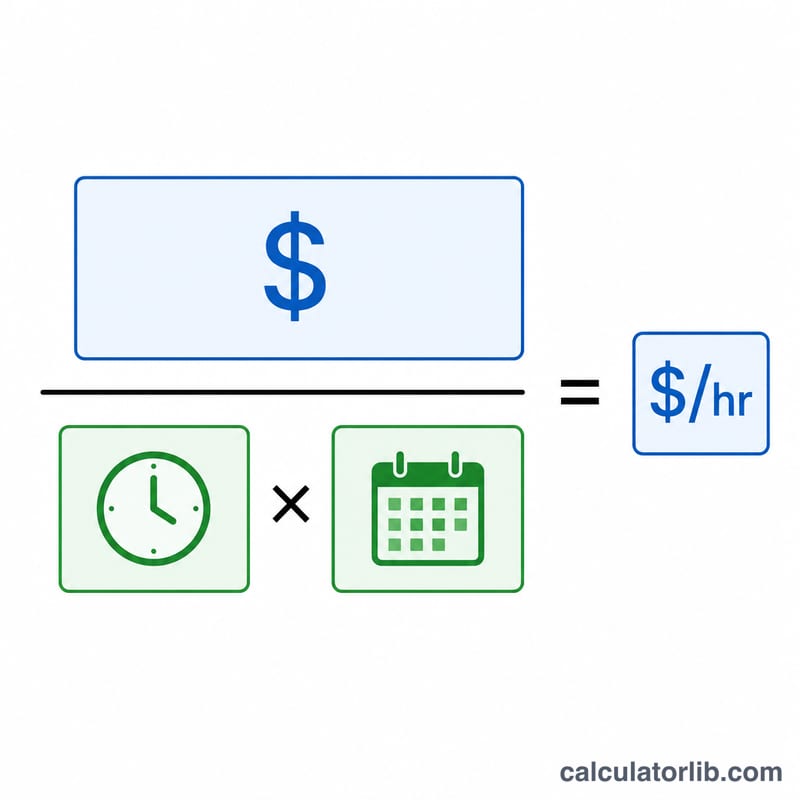
The core equation is:
$$\text{Hourly} = \frac{\text{Annual Salary}}{\text{Hours per Week} \times \text{Weeks per Year}}$$The denominator is simply your total working hours for the year. Multiplying weekly hours by weeks worked gives that total, and dividing the salary by it spreads the pay evenly across every hour. Note these figures are gross (pre-tax) and don't account for benefits, paid leave, or self-employment overhead.
Worked Example
Suppose you want to match a $60,000 salary while working 40 hours per week for 52 weeks. Total hours = \(40 \times 52 = 2{,}080\). Hourly = \(60{,}000 \div 2{,}080 \approx\) $28.85 per hour. If you instead worked only 50 weeks, the total would be 2,000 hours and you'd need $30.00 per hour.
FAQ
Should I use 52 weeks or fewer? Use 52 for a continuous full-time equivalent. Reduce it to reflect unpaid vacation if you want the rate that covers time off.
Does this include taxes or benefits? No. The result is a gross comparison. Contractors often add 20–30% to cover self-employment taxes, health insurance, and lack of paid leave.
What about overtime? This assumes all hours are paid at the same rate. If you earn overtime premiums, your effective base rate could be lower.