What Is a Liters to Milliliters Converter?
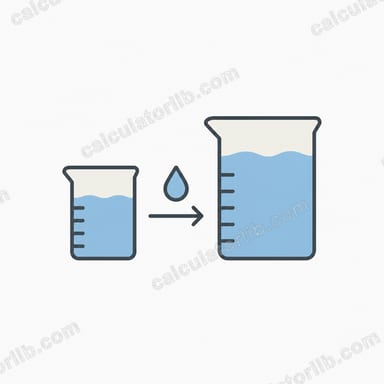
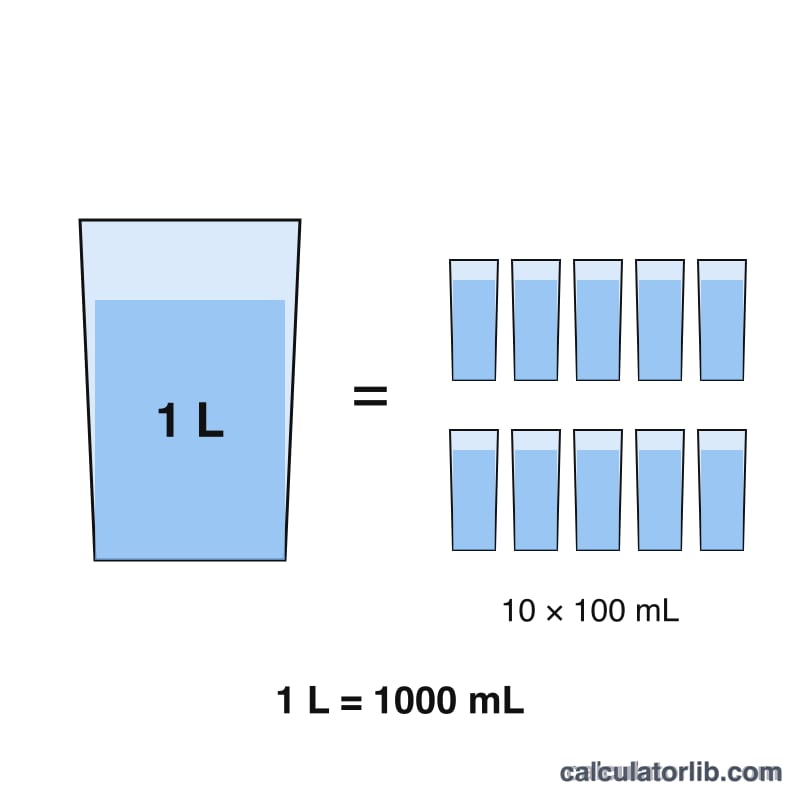
A liters to milliliters converter changes a volume measured in liters (L) into the equivalent number of milliliters (mL). Both units belong to the metric system, where 1 liter is defined as exactly 1,000 milliliters. This conversion is universal and applies the same way everywhere in the world.
How to Use It
Type the volume in liters into the input box and the calculator instantly returns the value in milliliters. You can enter whole numbers like 2 or decimals like 0.75. The tool handles both small and large quantities with full precision.
The Formula Explained
The relationship between the two units is a simple multiplication: $$\text{mL} = \text{L} \times 1000$$ Because the metric prefix "milli" means one-thousandth, one liter contains a thousand milliliters. To reverse the process, divide milliliters by 1000 to return to liters.
Worked Example
Suppose you have 2.5 liters of water. Multiply 2.5 by 1000: $$2.5 \times 1000 = 2{,}500$$ So 2.5 liters equals 2,500 milliliters. Likewise, half a liter (0.5 L) equals 500 mL, and a quarter liter (0.25 L) equals 250 mL.
Common Liters to Milliliters Conversions
To convert liters to milliliters, multiply by 1,000: \(\text{mL} = \text{L} \times 1000\). The prefix "milli" means one thousandth, so 1 mL = 0.001 L. This applies in the metric system (SI) everywhere.
| Liters (L) | Milliliters (mL) |
|---|---|
| 0.001 L | 1 mL |
| 0.01 L | 10 mL |
| 0.05 L | 50 mL |
| 0.1 L | 100 mL |
| 0.25 L | 250 mL |
| 0.5 L | 500 mL |
| 0.75 L | 750 mL |
| 1 L | 1,000 mL |
| 1.5 L | 1,500 mL |
| 2 L | 2,000 mL |
| 5 L | 5,000 mL |
| 10 L | 10,000 mL |
| 100 L | 100,000 mL |
Worked example: \(2.5\ \text{L} \times 1000 = \)2500 mL.
Everyday Volume Reference Values
These are typical, approximate volumes that help you picture common quantities in both units. Container sizes vary by product and country.
| Item | Milliliters (mL) | Liters (L) |
|---|---|---|
| Teaspoon (approx.) | 5 mL | 0.005 L |
| Tablespoon (approx.) | 15 mL | 0.015 L |
| Standard metric cup / drink | 250 mL | 0.25 L |
| Small water bottle | 500 mL | 0.5 L |
| Wine bottle (standard) | 750 mL | 0.75 L |
| Standard bottle | 1,000 mL | 1 L |
| Soda bottle (large) | 2,000 mL | 2 L |
Useful volume equivalences: 1 mL = 1 cm³, and 1 L = 1 dm³ = 1,000 cm³. Note that a tablespoon is 15 mL in the metric standard used for cooking in many countries, but some countries use slightly different spoon sizes (for example, 20 mL in Australia).
FAQ
How many milliliters are in 1 liter? Exactly 1,000 milliliters.
How do I convert milliliters back to liters? Divide the number of milliliters by 1,000. For example, \(750 \text{ mL} \div 1000 = 0.75 \text{ L}\).
Is this conversion the same in every country? Yes. The liter and milliliter are standard SI-derived metric units, so the factor of 1,000 never changes.