What This Calculator Does
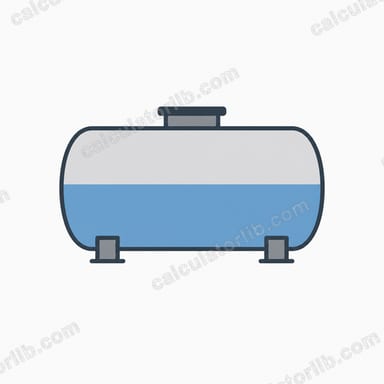
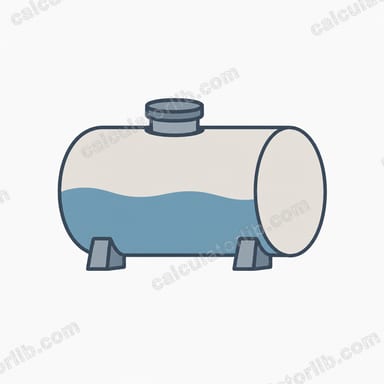
This tool estimates how much heating oil sits inside a horizontal cylindrical tank — the most common shape for residential basement and outdoor oil tanks. By measuring the depth of oil with a dip stick (the "stick reading") and knowing the tank's diameter and length, you can convert that depth into US gallons without draining or guessing.

How to Use It
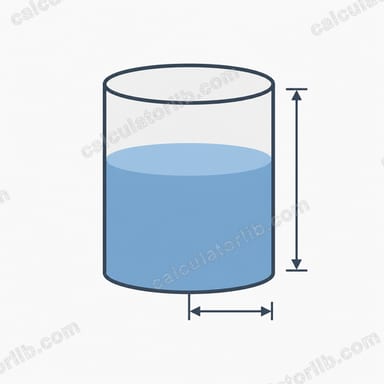
Enter three measurements in inches: the tank diameter (the full height of the round end), the tank length (end to end), and the oil fill depth read from your dip stick. The calculator returns gallons in the tank, the total volume in cubic inches and liters, the tank's full capacity, and the percent full.
The Formula Explained
A horizontal cylinder filled partway forms a "circular segment" cross-section. With radius \(r = \text{diameter} \div 2\) and fill depth \(h\), the segment area is \(r^{2}\cdot\arccos\!\left(\frac{r-h}{r}\right) - (r-h)\cdot\sqrt{2rh-h^{2}}\). Multiply by the length \(L\) to get cubic inches, then divide by 231 (cubic inches per US gallon) for gallons. The angle term uses the inverse cosine, which is why a simple "depth ÷ diameter × capacity" estimate is inaccurate near the top and bottom.
$$V_{gal} = \frac{L\left[r^{2}\arccos\!\left(\frac{r-h}{r}\right) - (r-h)\sqrt{2rh - h^{2}}\right]}{231}$$
Worked Example
Suppose a tank is 44 in in diameter, 60 in long, and the oil depth is exactly 22 in (half full). Here \(r = 22\) and \(h = 22\), so \(r-h = 0\). The area becomes $$22^{2}\cdot\arccos(0) = 484\cdot\left(\frac{\pi}{2}\right) = 760.27\ \text{in}^{2}.$$ Times length 60 = 45{,}616 in³, divided by 231 ≈ 197.5 gallons — exactly half of the ~395-gallon full capacity.
Standard Oil Tank Sizes and Capacities
These are common residential heating oil tank sizes, mostly found in North America. Dimensions are approximate and vary by manufacturer, so check the data plate or datasheet for your tank.
| Nominal capacity | Approx. diameter × length (in) | Shape | Geometric volume of a true cylinder |
|---|---|---|---|
| 275 gal | about 27 × 44 cross-section, about 60 long | Usually oblong/oval (obround) | Not applicable (see note) |
| 330 gal | 44 × 51 | Round cylinder | about 336 gal |
| 550 gal | 44 × 83 | Round cylinder | about 546 gal |
| 1000 gal | 48 × 128 | Round cylinder | about 1,003 gal |
Note on 275-gallon tanks: most are oval, with a cross-section about 27 in wide and 44 in tall, not a circle. The circular-segment formula used by this calculator will not give accurate gallons for them. Use the manufacturer's dip chart instead.
Nominal capacity is the rated size. The geometric volume of a round tank can differ slightly from it because of end caps, seams and rounding.
Gallons by Dip Depth for a Common Tank
Take a horizontal round tank 44 in in diameter and 60 in long. Its full volume is \(\pi \cdot 22^2 \cdot 60 / 231 \approx 394.9\) gallons, or about 395. The table shows gallons at different stick depths.
| Dip depth (in) | Depth as % of diameter | Gallons | % full (by volume) |
|---|---|---|---|
| 4 | 9.1% | 17.87 | 4.5% |
| 8 | 18.2% | 49.05 | 12.4% |
| 11 | 25% | 77.21 | 19.5% |
| 22 | 50% | 197.47 | 50.0% |
| 33 | 75% | 317.73 | 80.5% |
| 40 | 90.9% | 377.07 | 95.5% |
Worked check for 11 in: here \(r = 22\), \(h = 11\) and \(L = 60\), so \(r - h = 11\).
$$V = \frac{60\left[22^2\arccos\left(\frac{11}{22}\right) - 11\sqrt{2\cdot 22\cdot 11 - 11^2}\right]}{231} = \frac{60\left[484(1.0472) - 11(19.0526)\right]}{231} = \frac{60(297.27)}{231} \approx 77.21 \text{ gal}$$
A stick reading of 25% of the diameter holds only about 19.5% of the volume, not 25%. The tank is narrow near the bottom, so the first inches hold little oil. Near the middle each inch holds much more.
Interpreting Your Result
- Geometric volume: the result is the volume of oil in a perfect horizontal cylinder at the measured depth. It does not account for end-cap shape, internal baffles, fittings or tank dents.
- Never 100% full: the fill pipe, vent and air space limit the safe fill level. It is commonly about 90–95% of nominal capacity, so a tank rarely reads full on the stick.
- Unusable bottom inches: the last few inches are generally not usable. Sludge and water collect at the bottom, and the outlet sits above the lowest point. The calculated gallons near empty therefore overstate what can actually be drawn.
- Dip stick accuracy: reading error matters most near mid-depth. In the 44 × 60 in example, one inch of depth at the middle is about \(60 \cdot 44 / 231 \approx 11.4\) gallons, so a 1/4 in error is roughly 3 gallons. Near the bottom or top the same error means fewer gallons.
- Temperature: heating oil expands as it warms, by roughly 1% for a 20–25 °F change. The same mass of oil can therefore read a slightly different volume at different temperatures.
- Tank shape: the formula assumes a round cross-section. For oval tanks, such as most 275-gallon ones, use the manufacturer's chart.
This tool gives an estimate from the dimensions you enter, not a certified measurement.
FAQ
Why divide by 231? One US liquid gallon is defined as 231 cubic inches.
My tank is oval, not round. This formula assumes a true circular cross-section; oval ("obround") tanks need a different equation and will read slightly off.
Does temperature matter? Oil expands slightly with heat, so volume readings can vary by a percent or two between cold and warm conditions — this calculator reports geometric volume only.