
What Is the Septic Tank Volume Calculator?
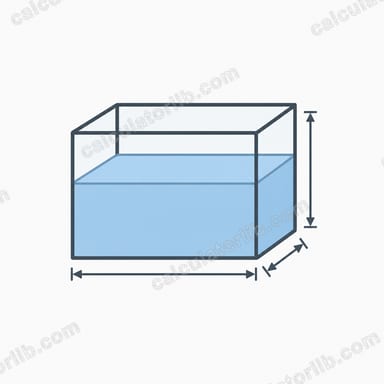
This calculator estimates the holding capacity of a rectangular (box-shaped) septic tank. Enter the inside length, width and liquid depth in feet and it returns the working volume in US gallons, along with the equivalent cubic feet and liters. Knowing the volume helps you confirm a tank meets local sizing requirements, plan pump-out schedules, and size replacement units.
How to Use It
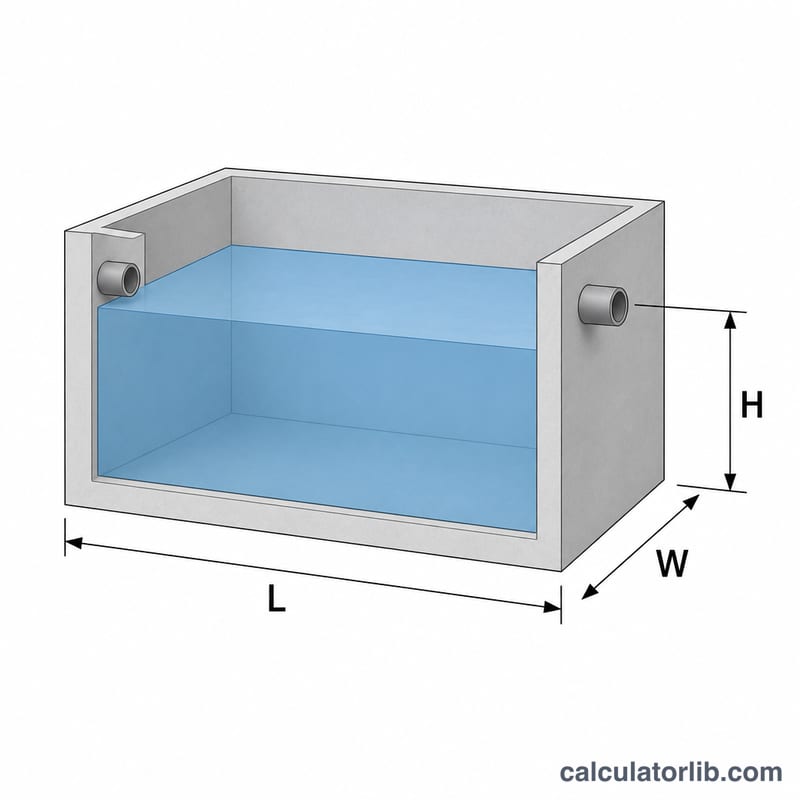
Measure the inside dimensions of the tank. For an existing tank, use the liquid depth (the height up to the outlet pipe) rather than the full physical height, since the space above the outlet is not part of the working capacity. Type the three measurements in feet and read the result instantly.
The Formula Explained
Volume in cubic feet is simply length \(\times\) width \(\times\) height. Because one cubic foot holds \(7.48052\) US gallons, multiplying cubic feet by that factor gives gallons:
$$V \text{ (gallons)} = L \times W \times H \times 7.48052$$
To convert to liters, multiply gallons by \(3.785411784\).
Worked Example
A tank measures 8 ft long, 4 ft wide with a 5 ft liquid depth. Cubic feet = \(8 \times 4 \times 5 = 160 \text{ ft}^3\). Gallons = \(160 \times 7.48052 \approx\) 1,196.88 gallons. That comfortably exceeds the common 1,000-gallon minimum for a small home.
FAQ
Should I use full height or liquid depth? Use liquid depth (height to the outlet invert) for working capacity. The full physical height overstates usable volume.
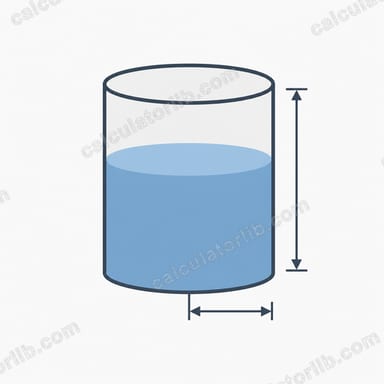
Does this work for cylindrical tanks? No — this version assumes a rectangular box. For a round tank, use \(\pi \times r^2 \times \text{length}\) instead.
How big a tank do I need? Sizing depends on household size and local code, but many jurisdictions require at least 1,000 gallons for a 1–3 bedroom home. Always check local regulations.