What it is
This trigonometric functions calculator computes all six trig ratios — sine, cosine, tangent, cosecant, secant, and cotangent — for an angle entered in DEGREES. The angle may be a plain decimal value (5.25) or in degrees-minutes-seconds (DMS) notation (5'12'6). It is a pure-math tool that applies identically everywhere.
How to use it
Enter your angle in the Angle field. For a decimal angle type the number directly, e.g. 45 or 5.25. For DMS, separate degrees, arc-minutes and arc-seconds with apostrophes: 5'12'6 means 5 degrees, 12 minutes, 6 seconds. Choose how many display digits you want, then read off the six ratios. Undefined values (such as tan 90 degrees) are shown as "undefined".
The formula explained
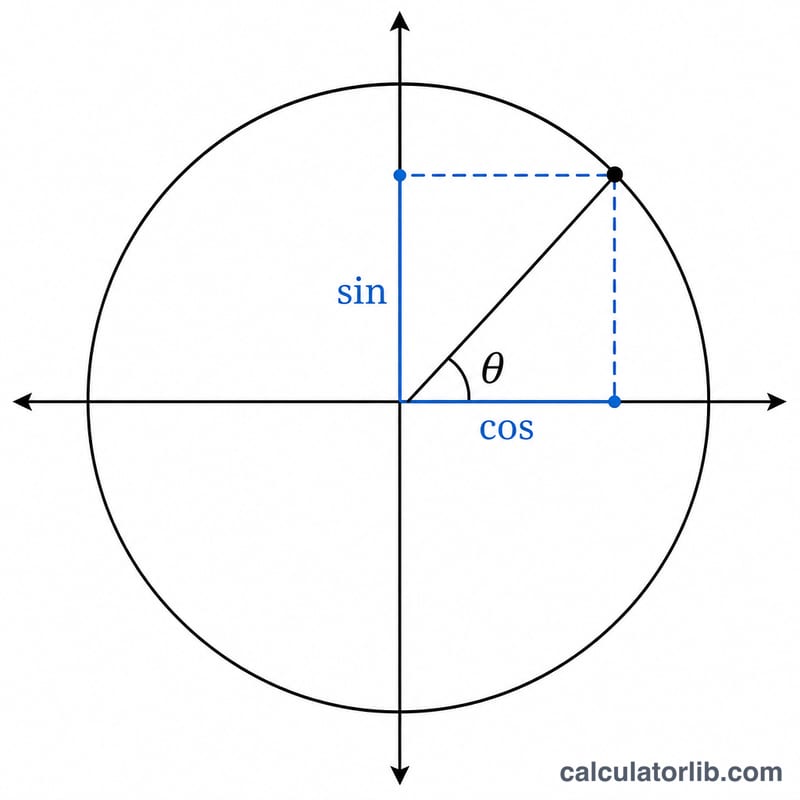
The angle in degrees is first converted to decimal degrees (degrees + minutes/60 + seconds/3600) and then to radians using \(\theta_{rad}=\theta_{deg}\cdot\frac{\pi}{180}\). From sin and cos the rest follow:
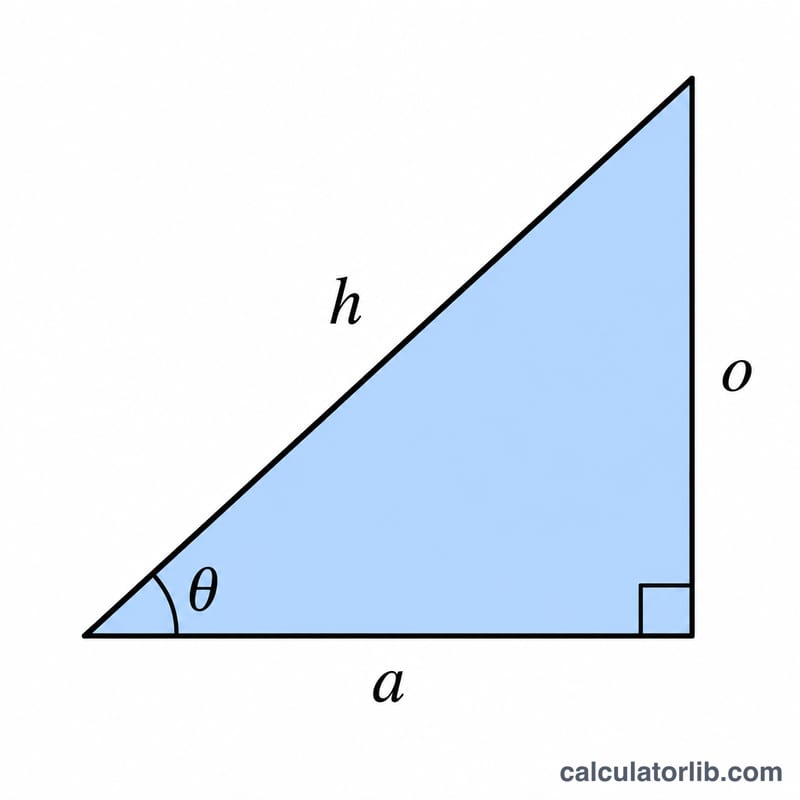
$$\sin\theta=\sin\!\left(\theta\cdot\frac{\pi}{180}\right),\quad \cos\theta=\cos\!\left(\theta\cdot\frac{\pi}{180}\right),\quad \tan\theta=\frac{\sin\theta}{\cos\theta}$$The reciprocal ratios are
$$\csc\theta=\frac{1}{\sin\theta},\ \sec\theta=\frac{1}{\cos\theta},\ \cot\theta=\frac{\cos\theta}{\sin\theta}$$Reciprocal functions are undefined where their denominator is zero, so tan and sec are undefined at 90 and 270 degrees, while csc and cot are undefined at 0 and 180 degrees.
Worked example
For 5'12'6 the decimal angle is
$$5 + \frac{12}{60} + \frac{6}{3600} = 5.2016666667 \text{ degrees}$$In radians that is \(0.0907866\). Then \(\sin = 0.090661937\), \(\cos = 0.995882104\) and \(\tan = 0.091036699\).
Exact Trig Values for Common Angles
These exact (surd) values come from the 30-60-90 and 45-45-90 triangles and the unit circle. Each cell shows the exact value with its decimal approximation to 4 places. "undef" means the function is undefined because it needs a division by zero.
| Angle | sin | cos | tan | csc | sec | cot |
|---|---|---|---|---|---|---|
| 0° | 0 | 1 | 0 | undef | 1 | undef |
| 30° | 1/2 (0.5) | √3/2 (0.8660) | √3/3 (0.5774) | 2 | 2√3/3 (1.1547) | √3 (1.7321) |
| 45° | √2/2 (0.7071) | √2/2 (0.7071) | 1 | √2 (1.4142) | √2 (1.4142) | 1 |
| 60° | √3/2 (0.8660) | 1/2 (0.5) | √3 (1.7321) | 2√3/3 (1.1547) | 2 | √3/3 (0.5774) |
| 90° | 1 | 0 | undef | 1 | undef | 0 |
| 120° | √3/2 (0.8660) | −1/2 (−0.5) | −√3 (−1.7321) | 2√3/3 (1.1547) | −2 | −√3/3 (−0.5774) |
| 135° | √2/2 (0.7071) | −√2/2 (−0.7071) | −1 | √2 (1.4142) | −√2 (−1.4142) | −1 |
| 150° | 1/2 (0.5) | −√3/2 (−0.8660) | −√3/3 (−0.5774) | 2 | −2√3/3 (−1.1547) | −√3 (−1.7321) |
| 180° | 0 | −1 | 0 | undef | −1 | undef |
| 270° | −1 | 0 | undef | −1 | undef | 0 |
| 360° | 0 | 1 | 0 | undef | 1 | undef |
Undefined entries: tan and sec at 90° and 270°; csc and cot at 0°, 180° and 360°. A calculator will report these as undefined or as an error rather than as a number.
Signs and Quadrants of the Trig Functions
The sign of each function depends on the quadrant of the angle. The mnemonic "All Students Take Calculus" lists the positive functions going counter-clockwise from quadrant I.
| Quadrant | Angle range | Positive functions | Negative functions |
|---|---|---|---|
| I (All) | 0° to 90° | sin, cos, tan, csc, sec, cot | none |
| II (Students) | 90° to 180° | sin, csc | cos, sec, tan, cot |
| III (Take) | 180° to 270° | tan, cot | sin, csc, cos, sec |
| IV (Calculus) | 270° to 360° | cos, sec | sin, csc, tan, cot |
Reference angle method
The reference angle \(\alpha\) is the acute angle between the terminal side and the x-axis. For an angle \(\theta\) between 0° and 360°:
- Quadrant I: \(\alpha = \theta\)
- Quadrant II: \(\alpha = 180^\circ - \theta\)
- Quadrant III: \(\alpha = \theta - 180^\circ\)
- Quadrant IV: \(\alpha = 360^\circ - \theta\)
The magnitude of each function at \(\theta\) equals its value at \(\alpha\). The quadrant supplies the sign.
Periodicity
- sin, cos, csc and sec repeat every 360°: \(\sin(\theta + 360^\circ) = \sin\theta\).
- tan and cot repeat every 180°: \(\tan(\theta + 180^\circ) = \tan\theta\).
Range of values
- \(-1 \le \sin\theta \le 1\) and \(-1 \le \cos\theta \le 1\).
- \(|\csc\theta| \ge 1\) and \(|\sec\theta| \ge 1\), because they are reciprocals of values with magnitude at most 1.
- tan and cot can take any real value.
FAQ
Is the angle in degrees or radians? Degrees. The tool converts to radians internally before computing.
Why does tan 90 show undefined? Because cos 90 degrees is zero, and tangent equals sine divided by cosine, so it is mathematically undefined.
Can I enter negative or very large angles? Yes. Trig functions are periodic, so any real angle works; a leading minus sign applies to the whole DMS magnitude.