
What this calculator does
The Trigonometric Functions Calculator evaluates all six trigonometric ratios — sine (sin), cosine (cos), tangent (tan), cosecant (csc), secant (sec) and cotangent (cot) — for any angle you enter. You can work in degrees or radians, making it useful for geometry homework, physics problems, engineering, surveying and signal processing. This is a universal mathematical tool and applies anywhere.
How to use it
Enter your angle in the input box, choose whether it is measured in degrees or radians, then read the six results. The hero box shows the sine value, while the table lists every ratio. Where a ratio is mathematically undefined (for example \(\tan 90°\) or \(\csc 0°\)), the calculator clearly reports "undefined" rather than a misleading huge number.
The formulas explained
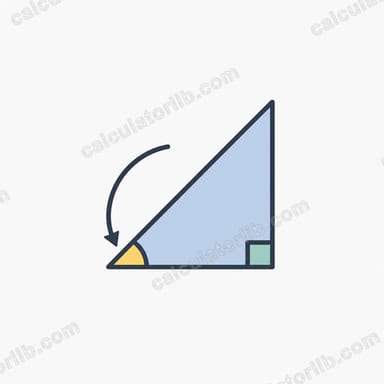
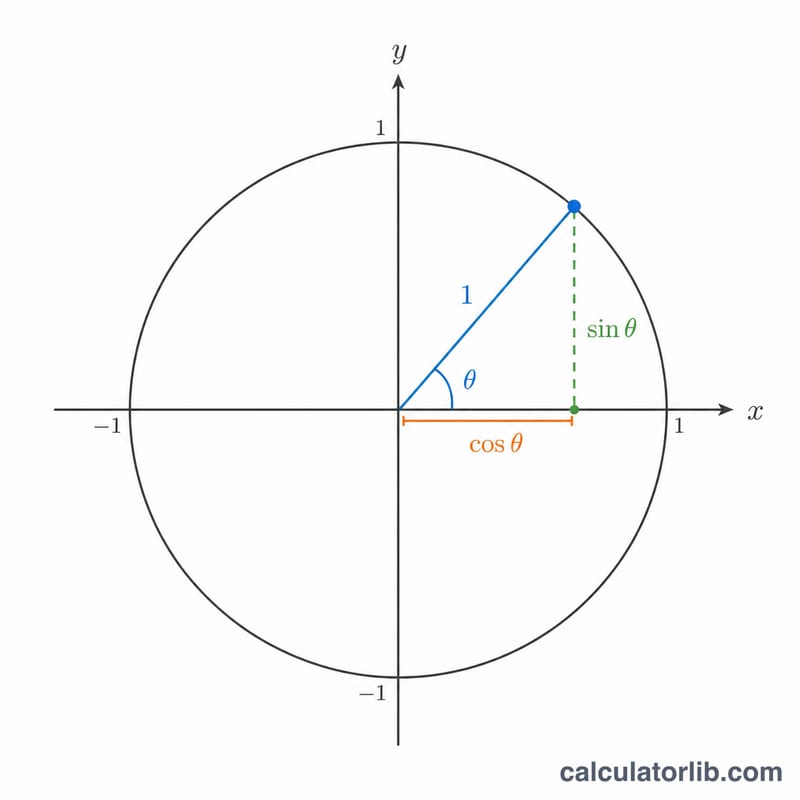
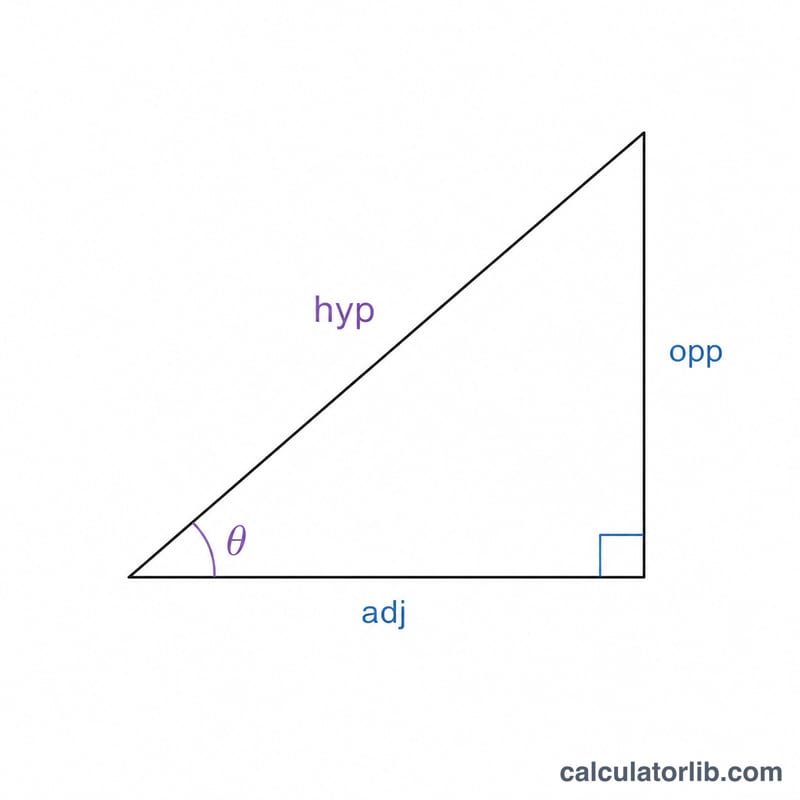
The three primary ratios in a right triangle are $$\sin\theta=\frac{\text{opposite}}{\text{hypotenuse}},\quad \cos\theta=\frac{\text{adjacent}}{\text{hypotenuse}},\quad \tan\theta=\frac{\text{opposite}}{\text{adjacent}}=\frac{\sin\theta}{\cos\theta}.$$ The reciprocal ratios follow directly: $$\csc\theta=\frac{1}{\sin\theta},\quad \sec\theta=\frac{1}{\cos\theta},\quad \cot\theta=\frac{1}{\tan\theta}.$$ Internally the calculator converts degrees to radians using $$\text{radians}=\text{degrees}\times\frac{\pi}{180}$$ because the standard library trig functions operate in radians.
Worked example
For \(\theta = 30°\): $$\sin 30° = 0.5,\quad \cos 30° \approx 0.866025,\quad \tan 30° \approx 0.577350.$$ The reciprocals are $$\csc 30° = \frac{1}{0.5} = 2,\quad \sec 30° \approx 1.154701,\quad \cot 30° \approx 1.732051.$$ These match the well-known exact values \(\tfrac{1}{2}\), \(\tfrac{\sqrt{3}}{2}\) and \(\tfrac{1}{\sqrt{3}}\).
FAQ
Why is \(\tan 90°\) undefined? Because \(\cos 90° = 0\), and dividing sin by zero is undefined. The calculator returns "undefined" in such cases.
Can I enter negative or large angles? Yes. Trigonometric functions are periodic, so values like \(390°\) or \(-45°\) work correctly.
How do I switch to radians? Select "Radians" from the unit menu; then \(\pi/2 \approx 1.5708\) behaves like \(90°\).