
What this calculator does
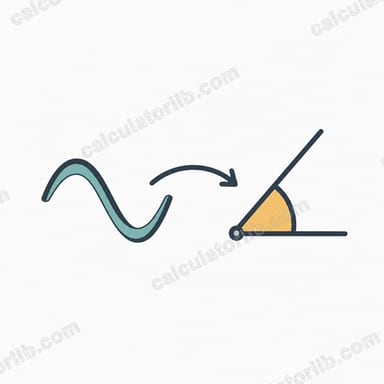
This tool evaluates the inverse (arc) trigonometric functions of a real number x and returns the principal-value result in radians. You can compute a single function (arcsine, arccosine, arctangent, arccosecant, arcsecant or arccotangent), or use the grouped options to get the three direct functions or the three reciprocal functions at once. If the input falls outside a function's real domain, the calculator reports that there is no real solution (a complex value would be required instead).
How to use it
Pick a Function from the dropdown, type your value of x, and choose how many significant digits to display. Press calculate. Note that ordinary double-precision arithmetic carries about 15 significant digits, so display options above 15 simply show every digit available. The math itself is unaffected by the display setting.
The formulas explained
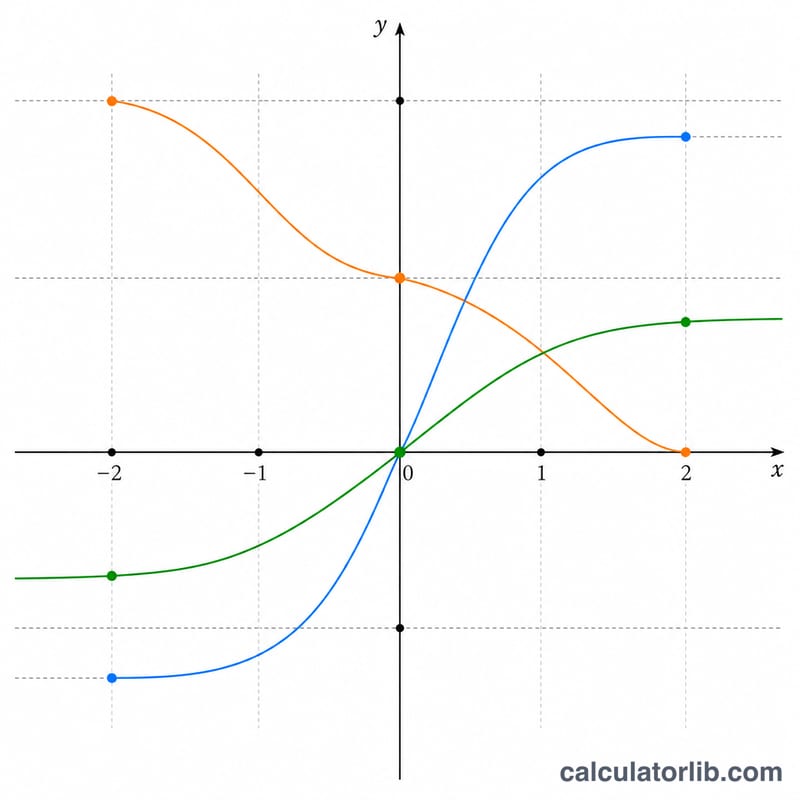
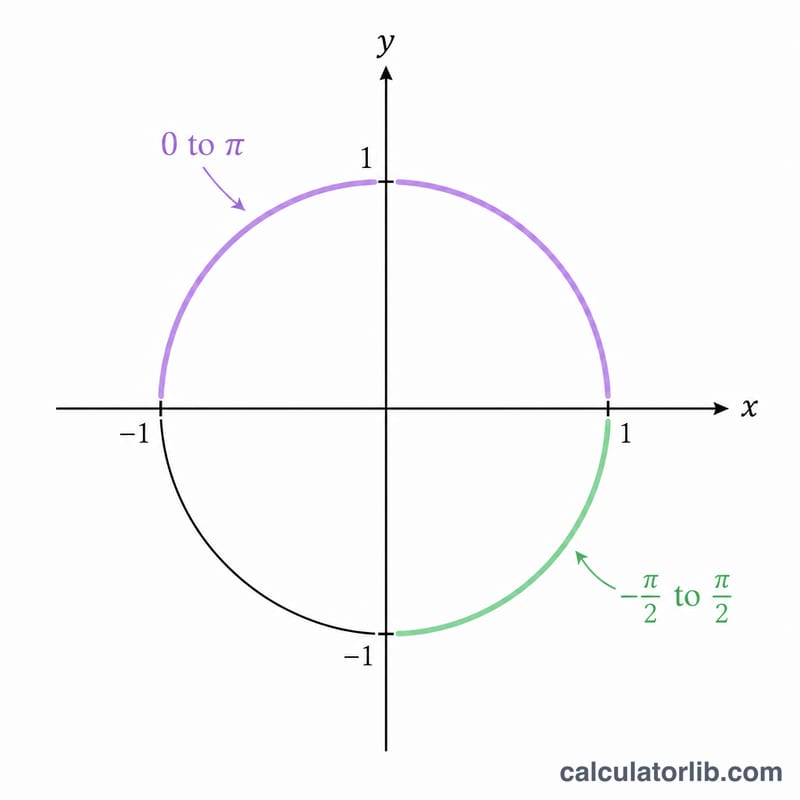
The direct functions use the standard principal ranges: arcsine returns a value in \([-\tfrac{\pi}{2}, \tfrac{\pi}{2}]\), arccosine in \([0, \pi]\), and arctangent in the open interval \((-\tfrac{\pi}{2}, \tfrac{\pi}{2})\). Arcsine and arccosine are only defined for \(-1 \le x \le 1\). The reciprocal functions are built from the direct ones:
$$\operatorname{arccsc} x=\arcsin\tfrac{1}{x},\quad \operatorname{arcsec} x=\arccos\tfrac{1}{x}$$both requiring \(|x| \ge 1\) (and \(x \ne 0\)). Arccotangent uses the common \((0, \pi)\) range convention,
$$\operatorname{arccot} x=\tfrac{\pi}{2}-\arctan x$$which keeps the function continuous and always positive, with \(\operatorname{arccot}(0) = \tfrac{\pi}{2}\).
Worked example
With Function = "asin, acos and atan" and \(x = 0.5\):
$$\arcsin(0.5) = 0.5235987755982988\ \text{rad}\ (\tfrac{\pi}{6})$$$$\arccos(0.5) = 1.0471975511965979\ \text{rad}\ (\tfrac{\pi}{3})$$$$\arctan(0.5) = 0.4636476090008061\ \text{rad}$$As a sanity check,
$$\arcsin(0.5) + \arccos(0.5) = \tfrac{\pi}{2} = 1.5707963267948966$$exactly as expected.
FAQ
Why does it say "no real solution"? Because asin/acos need an input between \(-1\) and \(1\), and acsc/asec need \(|x| \ge 1\). Outside those ranges the answer is complex, so no real principal value exists.
How do I convert to degrees? Multiply any radian result by \(180/\pi\) (about \(57.29578\)). The calculator keeps radians as the default output unit.
Which arccotangent convention is used? The \((0, \pi)\) branch, \(\operatorname{acot}(x) = \tfrac{\pi}{2} - \arctan x\). This is the most common convention in math references and gives \(\operatorname{acot}(0) = \tfrac{\pi}{2}\).