
What this calculator does
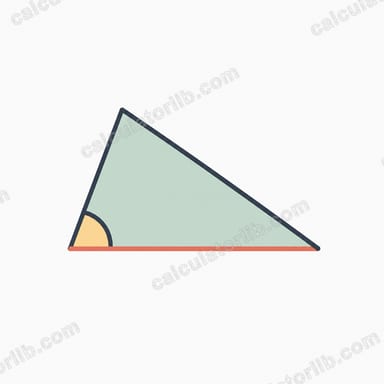
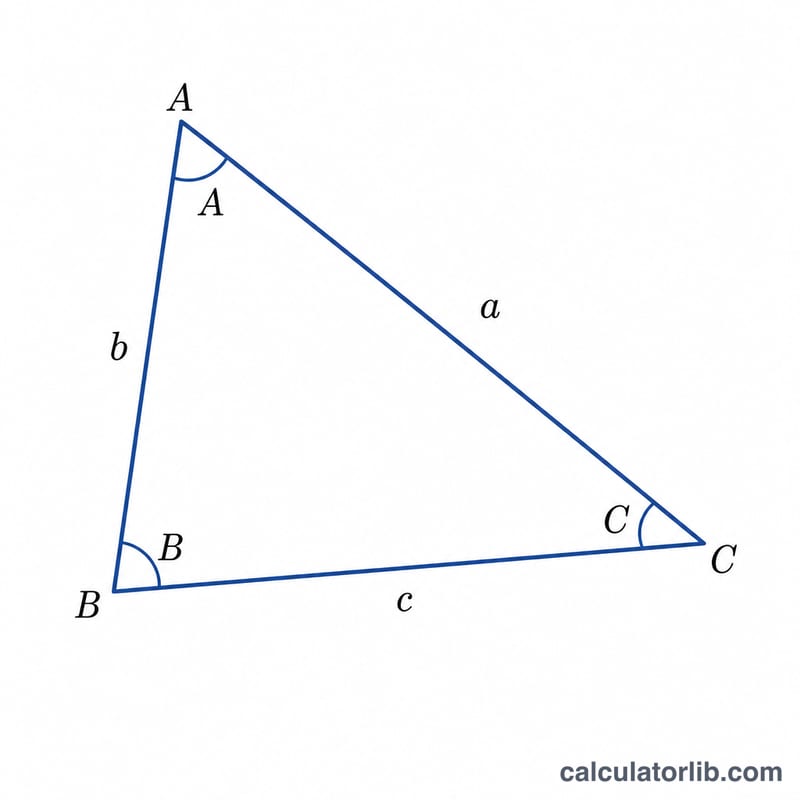
The Scalene Triangle Solver finds every element of a general triangle — the three sides a, b and c, the three interior angles A, B and C, the altitude h dropped onto base a, and the area S — from just three known quantities. Because a triangle is fully determined by three independent measurements, you can start from sides, angles, a height, an area, or a mix of these. Fourteen input modes cover the common combinations, including separate options for ambiguous cases where an angle could be acute or obtuse.
How to use it
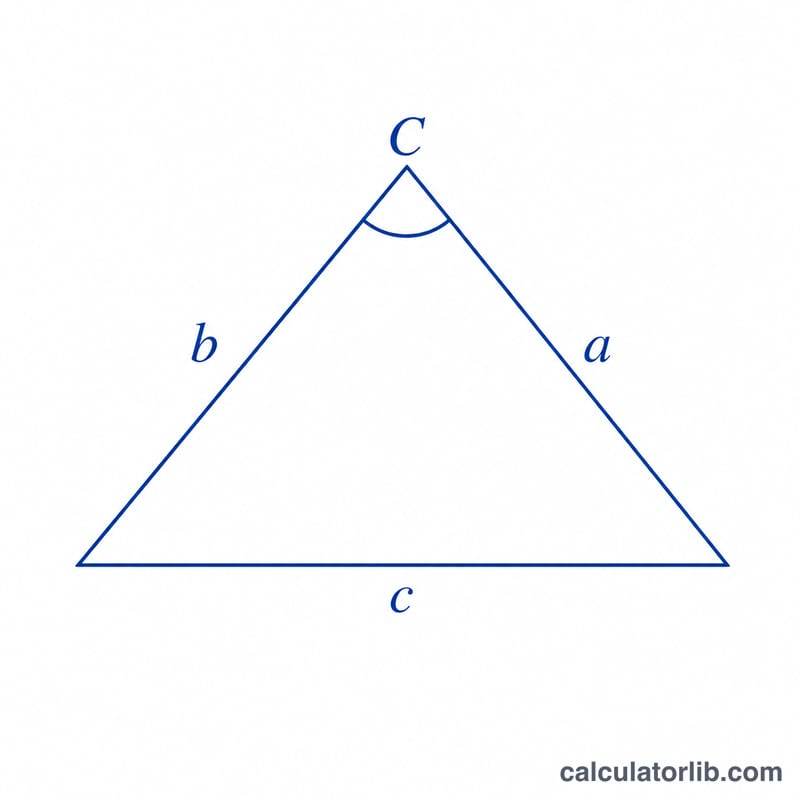
Pick an input specification from the dropdown, then enter the three values in the order shown for that mode (the helper line lists the meaning of each value). Lengths all use the same unit and results come back in that same unit; angles are entered and reported in degrees; area uses unit squared. For example mode 1 expects the three sides a, b and c, while mode 6 expects sides a and b plus the included angle C.
The formulas explained
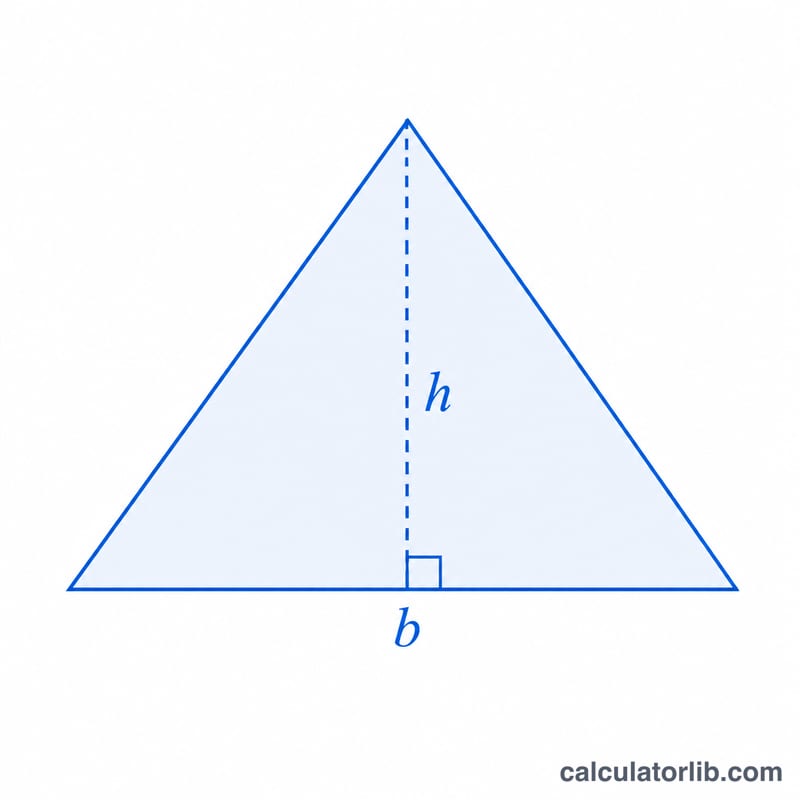
The solver leans on three classic relations. The law of cosines, \(c = \sqrt{a^2 + b^2 - 2ab\cos C}\), converts between sides and angles. The law of sines, \(\frac{a}{\sin A} = \frac{b}{\sin B} = \frac{c}{\sin C}\), scales the triangle once one side-angle pair is known. Heron's formula, \(S = \sqrt{s(s-a)(s-b)(s-c)}\) with \(s = \frac{a+b+c}{2}\), gives the area from three sides, and the altitude onto base a is \(h = \frac{2S}{a}\). The angle sum \(A + B + C = 180\degree\) closes the remaining angle.
Worked example
Mode 1 with a = 3, b = 4, c = 5: \(s = 6\), so $$S = \sqrt{6\cdot 3\cdot 2\cdot 1} = 6.$$ \(A = \arccos(0.8) = 36.8699\degree\), \(B = \arccos(0.6) = 53.1301\degree\), and \(C = 90\degree\). The altitude onto base a is \(h = \frac{2\cdot 6}{3} = 4\). This confirms the familiar right-angled 3-4-5 triangle.
FAQ
Why are there acute and obtuse versions of some modes? When you supply a side pair and a height or an area, the unknown angle can be either acute or its obtuse supplement. Choosing the matching mode removes the ambiguity.
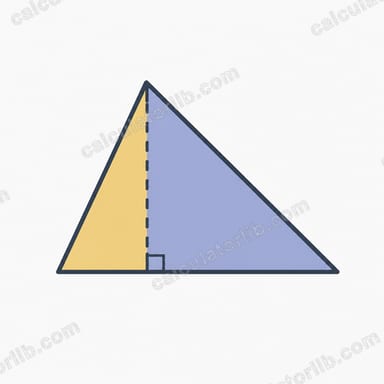
What is the height here? It is the altitude from vertex A perpendicular onto base a, equal to \(\frac{2S}{a}\).
Why did I get "no valid triangle"? The data may break the triangle inequality, require a height larger than a side, give angles summing to 180° or more, or imply an impossible area.