
What this calculator does
This tool evaluates the six inverse (or "arc") trigonometric functions for a single real input value x and returns the resulting angle in degrees. It covers arcsine (asin), arccosine (acos), arctangent (atan), arccosecant (acsc), arcsecant (asec) and arccotangent (acot). Alongside the decimal-degree value, every result is also broken down into degrees, minutes and seconds (D° M′ S″), with the seconds shown to two decimal places.
How to use it
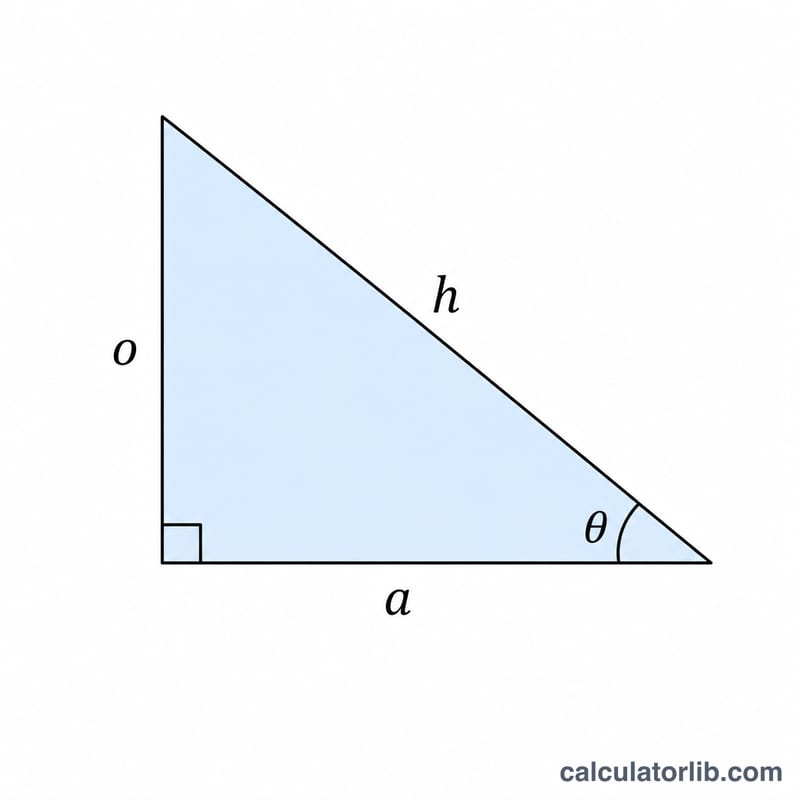
Pick which function you want from the dropdown. You can choose a single function, or one of the two combined options that compute the whole sine family (asin, acos, atan) or the whole reciprocal family (acsc, asec, acot) at once. Enter your value of x — a pure dimensionless number. For example, when finding an angle from a coordinate ratio such as opposite/adjacent, type that ratio (e.g. 0.2 or 0.3) and use arctangent. Choose the display precision and read the angle in degrees plus its DMS form.
The formula explained
Java/Groovy math functions return angles in radians, so each value is converted with the identity $$\theta_{\deg} = \theta_{\text{rad}} \cdot \frac{180}{\pi}$$ The reciprocal functions are defined via their partners: $$\operatorname{acsc}(x)=\arcsin\tfrac{1}{x},\;\operatorname{asec}(x)=\arccos\tfrac{1}{x},\;\operatorname{acot}(x)=\arctan\tfrac{1}{x}$$ adding 180° when x is negative so the answer stays in the (0°, 180°) range; acot(0) is defined as 90°.
Worked example
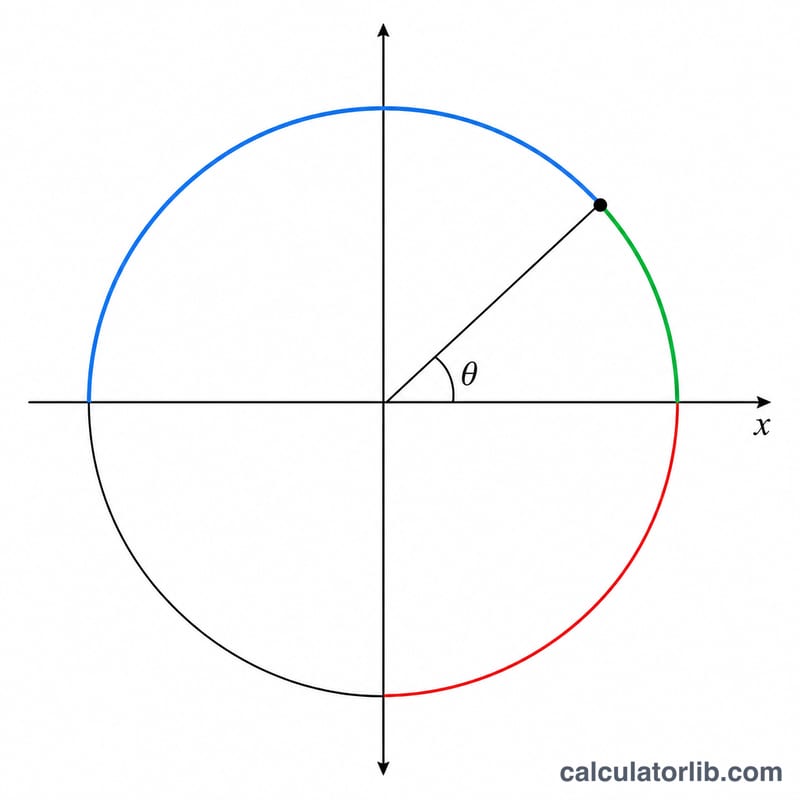
Take asin with x = 0.5. \(\text{Math.asin}(0.5) = 0.5235987756\) radians. Multiplying by \(180/\pi\) gives \(30.000000000°\). The fractional part is zero, so the DMS form is 30° 0′ 0.00″. Similarly, \(\arctan(1) = 45°\) and \(\operatorname{acot}(1) = 45°\).
FAQ
Why do some inputs say "Undefined"? Arcsine and arccosine only accept −1 ≤ x ≤ 1, while arccosecant and arcsecant require |x| ≥ 1. Values outside these domains have no real angle, so the calculator reports them as out of domain.
What convention does arccotangent use? This tool returns acot(x) in the range (0°, 180°), which is continuous across x = 0. Some textbooks use (−90°, 90°) instead.
How accurate are the seconds? The degrees-minutes-seconds breakdown shows seconds rounded to two decimal places, while the decimal-degree value is shown to your chosen precision.