
What this calculator does
This tool evaluates all six inverse hyperbolic functions of a single real number x at once: the inverse hyperbolic sine \(\sinh^{-1}(x)\), cosine \(\cosh^{-1}(x)\), tangent \(\tanh^{-1}(x)\), cosecant \(\operatorname{csch}^{-1}(x)\), secant \(\operatorname{sech}^{-1}(x)\) and cotangent \(\coth^{-1}(x)\). These functions are the inverses of the hyperbolic functions and appear constantly in calculus, integration tables, special relativity (rapidity), catenary curves and engineering.
How to use it
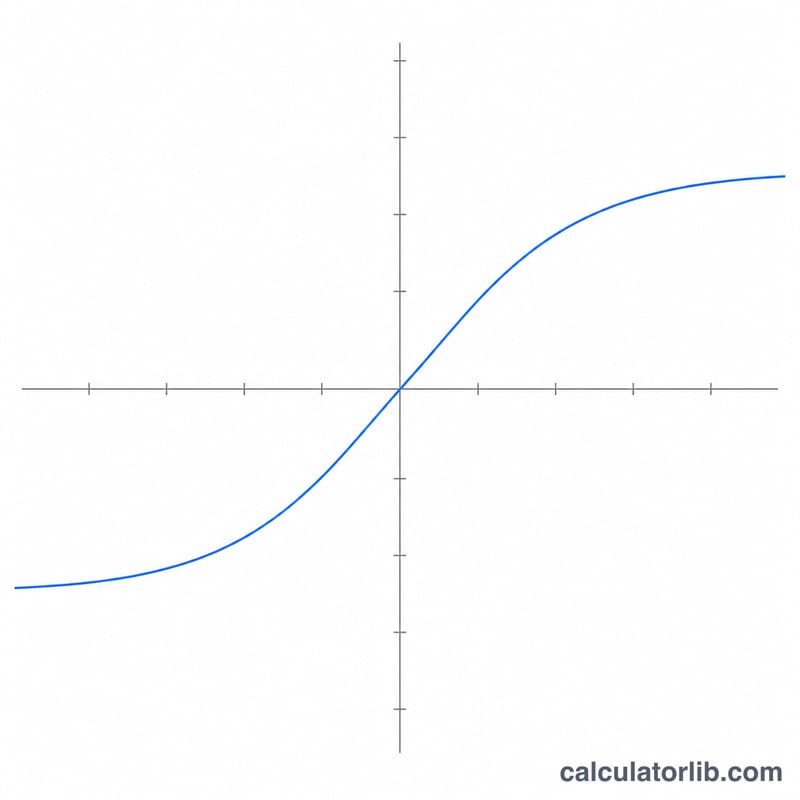
Enter any real number into the Variable x field and submit. The hero box shows the always-defined inverse hyperbolic sine, and the table lists all six results to high precision. Where x falls outside a function's real domain, the calculator reports "no real value" rather than a misleading number.
The formulas
Every inverse hyperbolic function reduces to natural logarithms and square roots on its principal real branch:
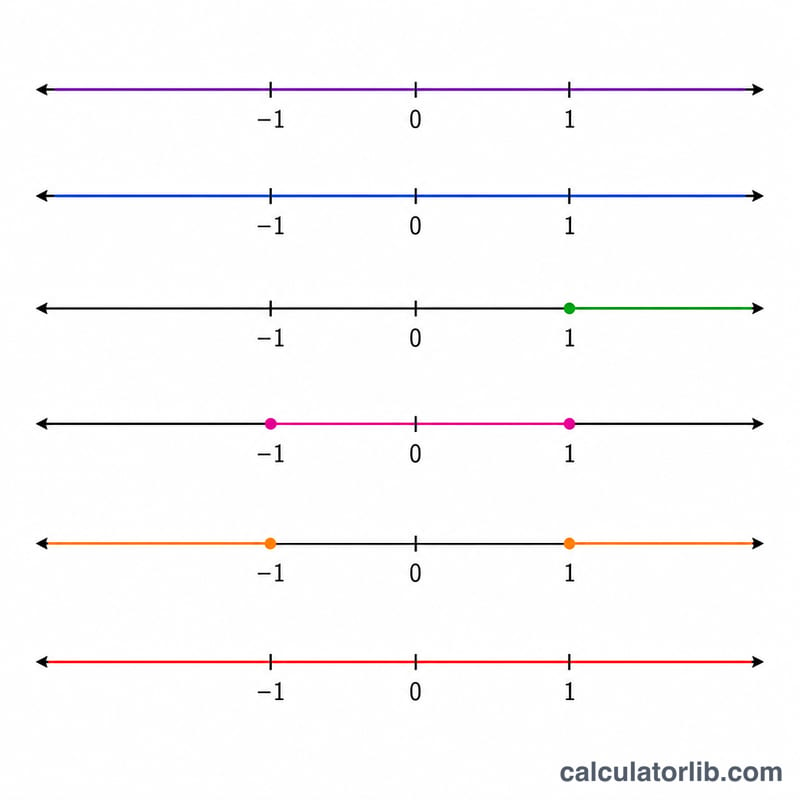
$$\sinh^{-1}(x) = \ln\!\left(x + \sqrt{x^2 + 1}\right)$$ for all real x. $$\cosh^{-1}(x) = \ln\!\left(x + \sqrt{x^2 - 1}\right)$$ for \(x \geq 1\). $$\tanh^{-1}(x) = \tfrac12\cdot\ln\frac{1+x}{1-x}$$ for \(|x| < 1\). The reciprocal functions feed \(1/x\) into the primary ones: \(\operatorname{csch}^{-1}(x) = \sinh^{-1}(1/x)\) for \(x \neq 0\); \(\operatorname{sech}^{-1}(x) = \cosh^{-1}(1/x)\) for \(0 < x \leq 1\); \(\coth^{-1}(x) = \tanh^{-1}(1/x)\) for \(|x| > 1\).
Worked example (x = 2)
$$\sinh^{-1}(2) = \ln(2 + \sqrt{5}) = \ln(4.2360679\ldots) \approx 1.44363548$$ $$\cosh^{-1}(2) = \ln(2 + \sqrt{3}) \approx 1.31695790$$ $$\operatorname{csch}^{-1}(2) = \sinh^{-1}(0.5) = \ln(0.5 + \sqrt{1.25}) \approx 0.48121183$$ $$\coth^{-1}(2) = \tanh^{-1}(0.5) = \tfrac12\cdot\ln(3) \approx 0.54930614$$ Because \(|2| > 1\), \(\tanh^{-1}(2)\) has no real value, and because \(2 > 1\), \(\operatorname{sech}^{-1}(2)\) has no real value either.
FAQ
Why do some outputs say "no real value"? Each function has a restricted real domain (for example \(\cosh^{-1}\) needs \(x \geq 1\)). Outside that range the true value is complex; this real-valued calculator simply flags it.
What happens at x = 0? The reciprocal functions \(\operatorname{csch}^{-1}\) and \(\coth^{-1}\) require \(1/x\), so \(x = 0\) is undefined for them.
Are these the same as the natural log identities? Yes — the calculator uses the exact logarithmic forms above, which are mathematically identical to the standard asinh/acosh/atanh built-ins.