
What this calculator does
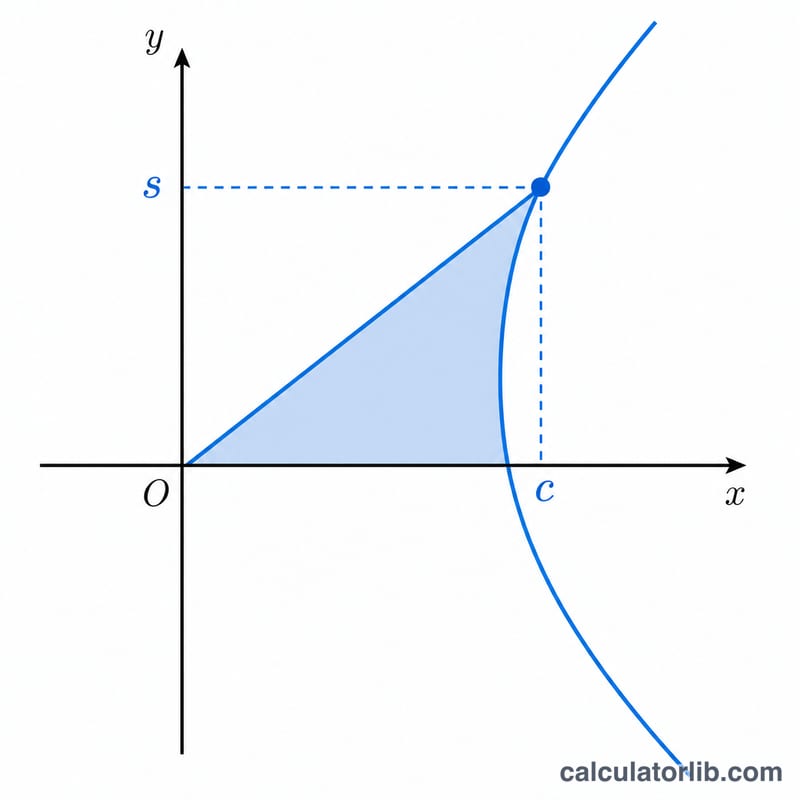
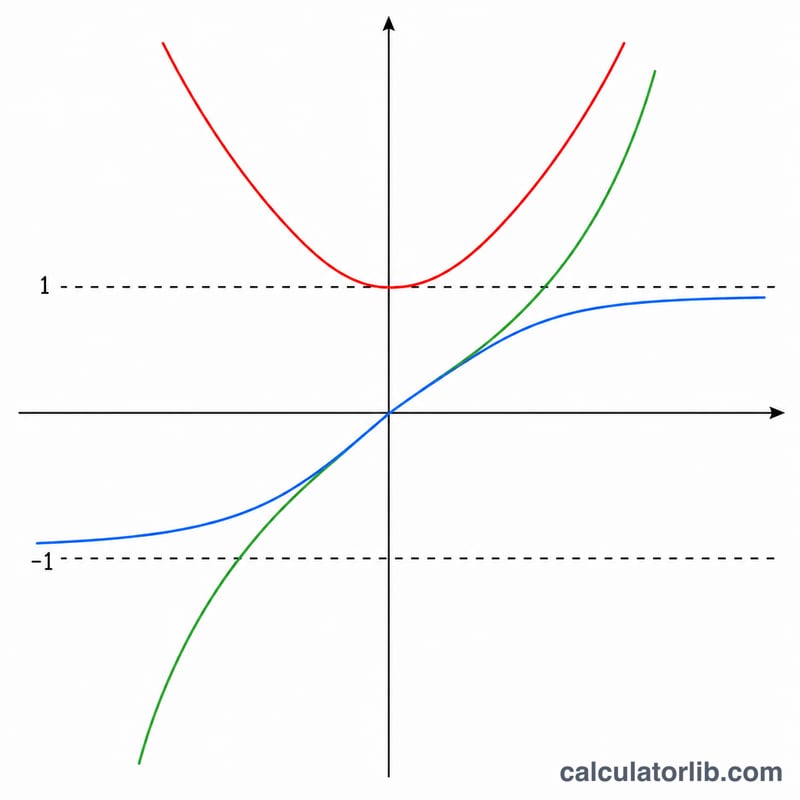
This tool evaluates the six hyperbolic functions of a real, dimensionless number x: the sine, cosine and tangent analogues sinh, cosh and tanh, together with their reciprocals csch (cosecant), sech (secant) and coth (cotangent). The argument x is a pure number — it is not an angle in degrees, so no degree-to-radian conversion is applied. Hyperbolic functions appear throughout physics and engineering: the shape of a hanging cable (catenary), special relativity, signal processing, heat transfer and the solutions of many differential equations.
How to use it
Enter any real value for x and choose how many significant digits to display. The calculator returns all six functions at once. Because cosh(x) is always at least 1, sech(x) is always defined. However \(\sinh(0) = 0\) and \(\tanh(0) = 0\), so csch(0) and coth(0) involve division by zero and are shown as "undefined".
The formula explained
Everything is built from the exponential function. With \(e_p = e^{x}\) and \(e_n = e^{-x}\):
$$\sinh x = \frac{e^{x} - e^{-x}}{2}, \quad \cosh x = \frac{e^{x} + e^{-x}}{2}, \quad \tanh x = \frac{\sinh x}{\cosh x}$$\(\sinh(x) = (e_p - e_n)/2\) measures the odd part of the exponential, \(\cosh(x) = (e_p + e_n)/2\) measures the even part, and \(\tanh(x) = \sinh(x)/\cosh(x)\). The reciprocals follow directly:
$$\operatorname{csch} x = \frac{1}{\sinh x}, \quad \operatorname{sech} x = \frac{1}{\cosh x}, \quad \coth x = \frac{1}{\tanh x}$$A useful identity that always holds is \(\cosh^2(x) - \sinh^2(x) = 1\), the hyperbolic analogue of the Pythagorean identity.
Worked example (x = 1)
With \(e = 2.718281828\ldots\) and \(e^{-1} = 0.367879441\ldots\):
$$\sinh(1) = \frac{2.718281828 - 0.367879441}{2} = 1.175201194$$$$\cosh(1) = \frac{2.718281828 + 0.367879441}{2} = 1.543080635$$$$\tanh(1) = \frac{1.175201194}{1.543080635} = 0.761594156$$The reciprocals give \(\operatorname{csch}(1) = 0.850918128\), \(\operatorname{sech}(1) = 0.648054274\) and \(\coth(1) = 1.313035285\).
FAQ
Is x an angle in degrees? No. Hyperbolic functions take a plain real number; there is no degree mode and no conversion.
Why are csch(0) and coth(0) undefined? Both divide by \(\sinh(0) = 0\), which is undefined. The calculator flags these instead of returning infinity.
Which functions are even or odd? sinh, tanh, csch and coth are odd (\(f(-x) = -f(x)\)); cosh and sech are even (\(f(-x) = f(x)\)).