
What is the Airy Function Table Calculator?
This tool evaluates the two Airy functions, \(\text{Ai}(x)\) and \(\text{Bi}(x)\), and optionally their derivatives \(\text{Ai}'(x)\) and \(\text{Bi}'(x)\), across a range of real values of \(x\). The Airy functions are the two linearly independent solutions of the Airy differential equation \(y'' - x\,y = 0\). They appear throughout physics: in quantum mechanics they describe the wavefunction near a classical turning point, and they also arise in optics, asymptotic analysis and the theory of rainbows.
How to use it
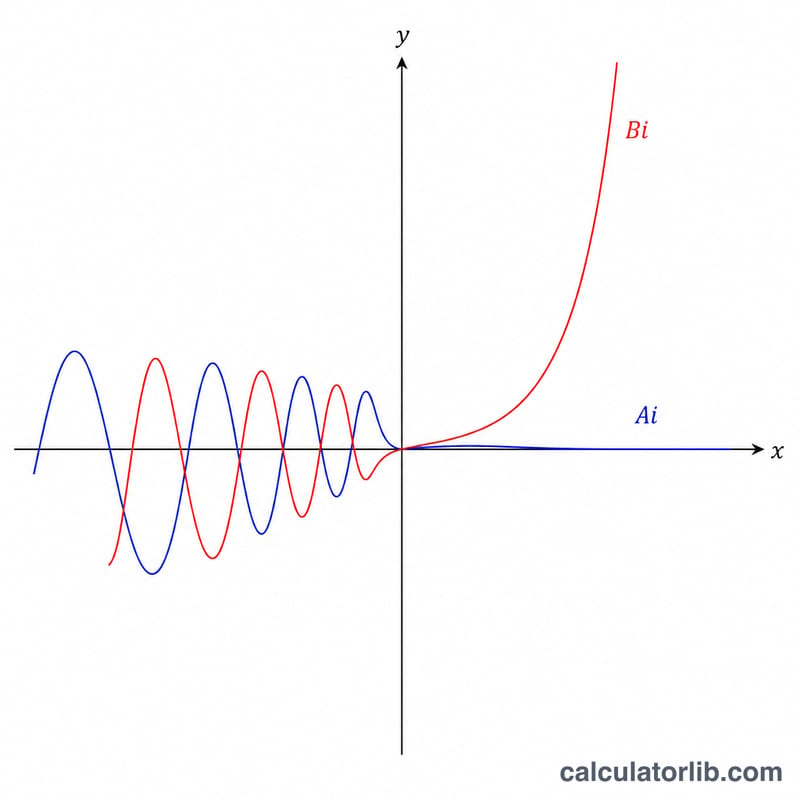
Enter a starting \(x\) value, an ending \(x\) value, and a step size. The calculator builds one row per \(x\) value from \(x\) start to \(x\) end inclusive. Tick the derivatives box to also list \(\text{Ai}'(x)\) and \(\text{Bi}'(x)\). The graph plots \(\text{Ai}(x)\) and \(\text{Bi}(x)\) against \(x\) so you can see Ai decay for positive \(x\) and both functions oscillate for negative \(x\).
The formula
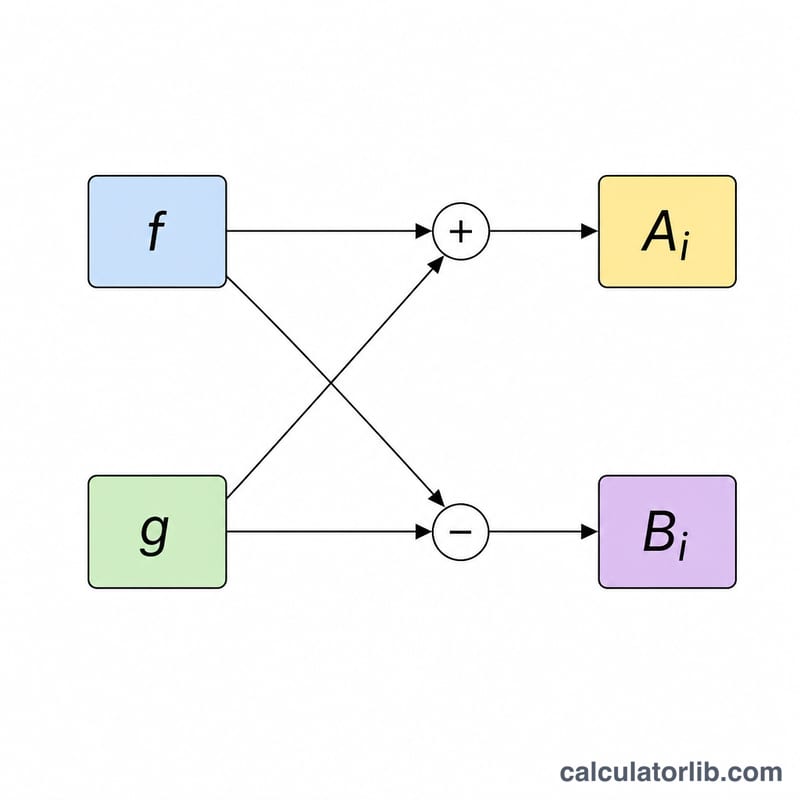
Using the series about the origin with \(\alpha = \text{Ai}(0) = 0.3550280539\) and \(\beta = -\text{Ai}'(0) = 0.2588194038\):
$$\text{Ai}(x) = \alpha\, f(x) - \beta\, g(x), \quad \text{Bi}(x) = \sqrt{3}\,\big(\alpha\, f(x) + \beta\, g(x)\big)$$ where \(f(x) = 1 + \frac{x^3}{6} + \frac{x^6}{180} + \cdots\) and \(g(x) = x + \frac{x^4}{12} + \frac{x^7}{504} + \cdots\) For \(|x|\) greater than about \(8\) the calculator switches to the asymptotic forms with \(\zeta = \frac{2}{3}|x|^{3/2}\) to avoid cancellation error.
Worked example
At \(x = 0\): \(f(0)=1\), \(g(0)=0\), so $$\text{Ai}(0) = \alpha = 0.3550281, \quad \text{Bi}(0) = \sqrt{3}\,\alpha = 0.6149266.$$ At \(x = 1\): \(f(1) \approx 1.1722535\) and \(g(1) \approx 1.0853407\), giving \(\text{Ai}(1) \approx 0.1352924\) and \(\text{Bi}(1) \approx 1.2074236\), matching tabulated values.
Definitions & Glossary
- Airy function of the first kind, \(\text{Ai}(x)\)
- The solution of the Airy equation that decays to zero as \(x \to +\infty\). For large positive \(x\) it falls off like \(\dfrac{e^{-\zeta}}{2\sqrt{\pi}\,x^{1/4}}\); for negative \(x\) it oscillates with slowly growing wavelength.
- Airy function of the second kind, \(\text{Bi}(x)\)
- The second, linearly independent solution. It grows like \(\dfrac{e^{\zeta}}{\sqrt{\pi}\,x^{1/4}}\) as \(x \to +\infty\) and, like Ai, oscillates for \(x<0\).
- Airy differential equation, \(y'' - xy = 0\)
- The simplest second-order linear ODE with a turning point at the origin. Its general solution is \(y(x) = c_1\,\text{Ai}(x) + c_2\,\text{Bi}(x)\). It arises in optics, quantum mechanics (a particle in a linear potential), and the WKB analysis of wave problems.
- \(\zeta = \tfrac{2}{3}|x|^{3/2}\)
- The natural phase/decay variable for the Airy functions. It governs the exponential growth and decay for \(x>0\) and the oscillation phase for \(x<0\), appearing throughout the asymptotic expansions.
- Turning point
- A value of \(x\) where the behavior of the equation changes character. For \(y'' - xy = 0\) the turning point is at \(x=0\): solutions are oscillatory for \(x<0\) (where the coefficient \(-x\) is positive) and exponential (growing or decaying) for \(x>0\).
- Asymptotic expansion
- A series in inverse powers of \(\zeta\) (or \(x^{3/2}\)) that approximates Ai and Bi accurately for large \(|x|\). It need not converge, yet a few terms give excellent precision far from the origin, where the power series of the formula tab converge slowly.
- Wronskian
- The determinant \(W = \text{Ai}(x)\,\text{Bi}'(x) - \text{Ai}'(x)\,\text{Bi}(x)\). A nonzero constant Wronskian (here \(1/\pi\)) confirms that Ai and Bi are linearly independent and therefore form a complete solution basis.
FAQ
Why does Bi(x) blow up? For large positive \(x\), \(\text{Bi}(x)\) grows like \(e^{\zeta}\) and overflows double precision near \(x\) above \(\sim 230\). Keep the upper bound modest.
Why do the functions wiggle for negative x? For \(x\) going to negative infinity both functions oscillate with amplitude decaying like \(|x|^{-1/4}\).
What units are used? None — \(x\) is a pure real number and the output values are dimensionless.