
What is the Spherical Hankel Function Table Calculator?
This universal mathematics tool tabulates the spherical Hankel functions of the first kind \(h_v^{(1)}(x)\) and second kind \(h_v^{(2)}(x)\), as well as their first derivatives, over a sequence of real arguments \(x\) for a chosen integer order \(v\). Because these functions are complex-valued, each entry is reported as a real part and an imaginary part, plus the magnitude.
How to use it
Pick which function to tabulate (first kind, second kind, or either derivative). Set the integer order \(v\), the initial value of \(x\), the step (increment) between successive \(x\) values, and the number of points to generate. The calculator builds a row for each \(k\) from 0 to \(N-1\) with \(x = \text{initialX} + k \cdot \text{stepX}\) and evaluates the selected function at every \(x\).
The formula explained
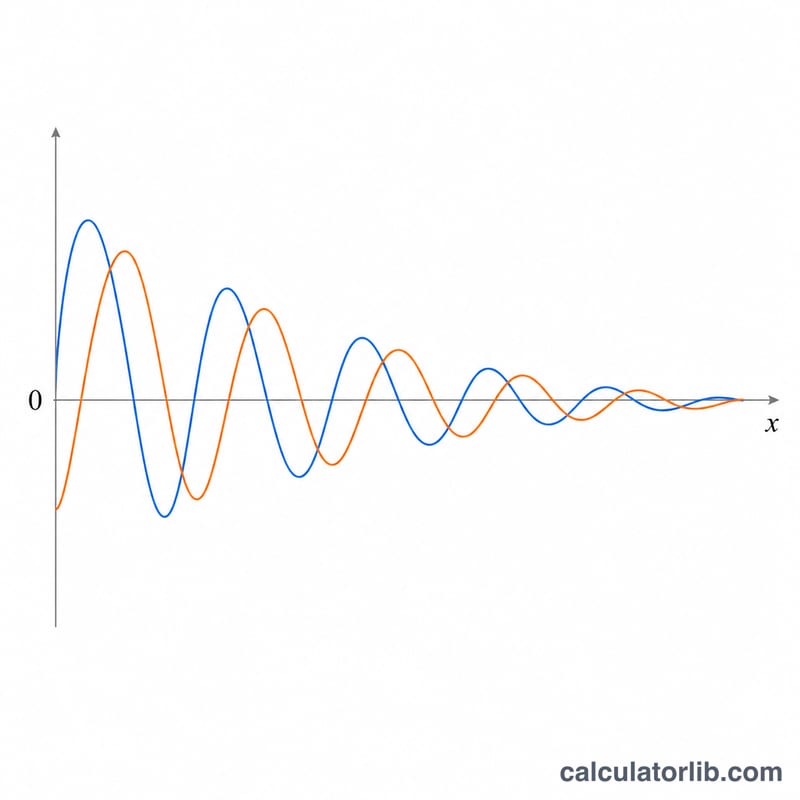
Spherical Bessel functions use closed forms: \(j_0(x) = \sin(x)/x\), \(j_1(x) = \sin(x)/x^2 - \cos(x)/x\), \(y_0(x) = -\cos(x)/x\), \(y_1(x) = -\cos(x)/x^2 - \sin(x)/x\). Higher orders follow the three-term recurrence $$f_{v+1} = \frac{2v+1}{x}\,f_v - f_{v-1}.$$ Then $$h_v^{(1)} = j_v + i\,y_v \quad\text{and}\quad h_v^{(2)} = j_v - i\,y_v$$ (the complex conjugate). Derivatives use $$f_v'(x) = f_{v-1}(x) - \frac{v+1}{x}\,f_v(x),$$ with \(f_0' = -f_1\).
Worked example
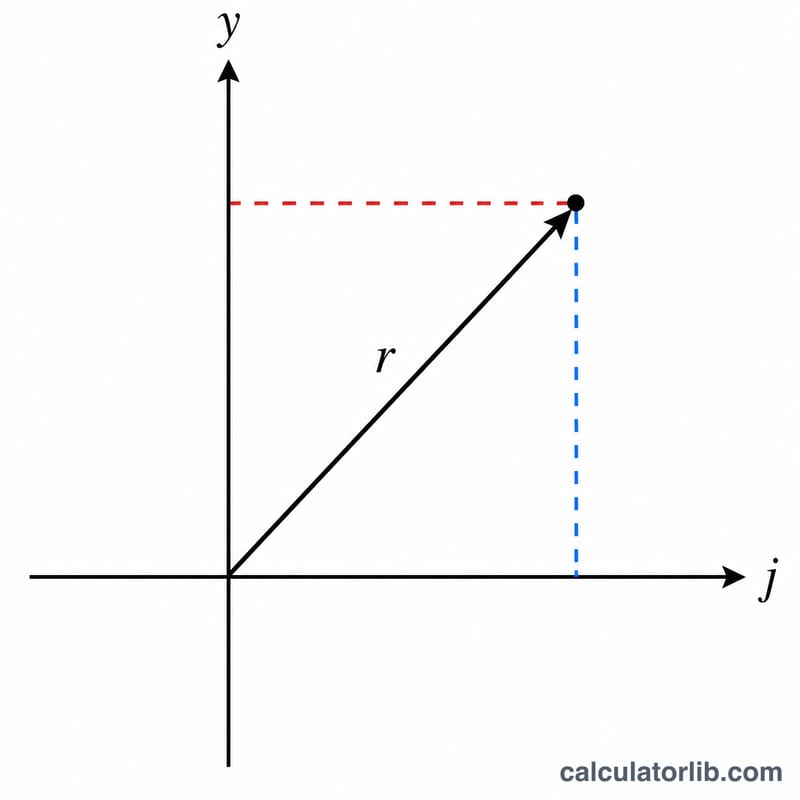
For \(h_v^{(1)}(x)\) with \(v = 0\), \(\text{initialX} = 2\): \(j_0(2) = \sin(2)/2 = 0.4546487\), \(y_0(2) = -\cos(2)/2 = 0.2080734\), so $$h_0^{(1)}(2) = 0.4546487 + 0.2080734\,i$$ with magnitude \(1/x = 0.5\). For the second kind \(h_0^{(2)}(2)\) the imaginary part flips sign to \(-0.2080734\).
FAQ
Why is \(x = 0\) not allowed? Every formula divides by \(x\), and \(y_v\) diverges as \(x\) approaches 0, so those rows are flagged as singular.
Why does \(|h_0^{(1)}(x)|\) equal \(1/x\)? Because \(j_0^2 + y_0^2 = (\sin^2 x + \cos^2 x)/x^2 = 1/x^2\).
Does it support non-integer orders? This build uses exact integer-order closed forms and recurrences; non-integer orders are not supported.