
What this calculator does
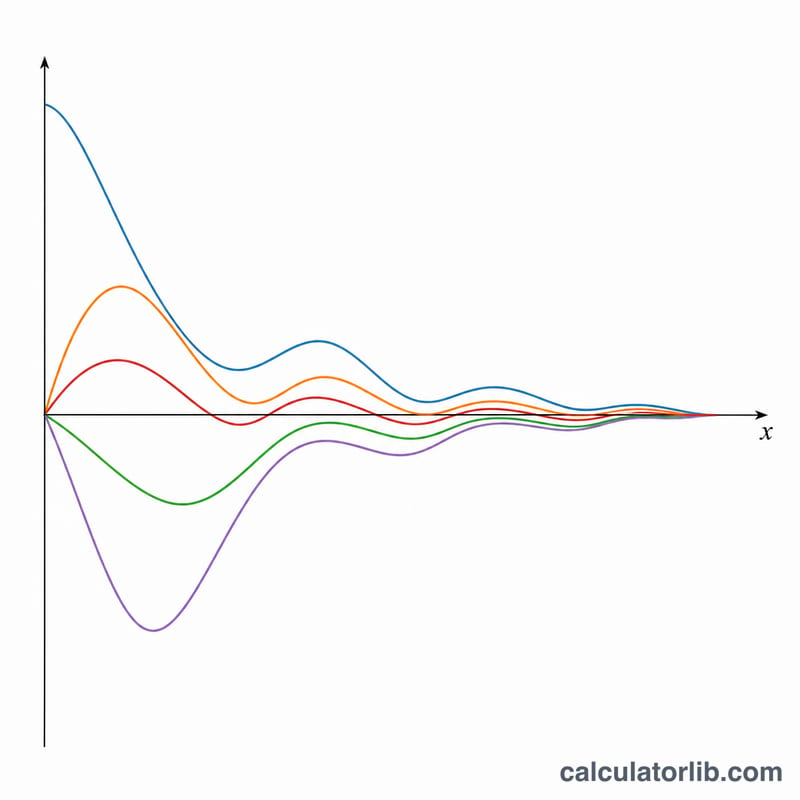
This tool evaluates the spherical Bessel function of the first kind \(j_v(x)\), the spherical Bessel function of the second kind \(y_v(x)\), and their first derivatives \(j'_v(x)\) and \(y'_v(x)\). These functions are the radial solutions of the wave and Helmholtz equations in spherical coordinates, and appear throughout physics: scattering theory, electromagnetic and acoustic radiation, and quantum mechanics (free-particle partial waves). This rebuilt version handles integer order \(v \ge 0\) and real argument \(x > 0\).
How to use it
Enter the order v (a non-negative integer such as 0, 1, 2) and the argument x (a positive real number). Press calculate to obtain all four quantities. Note that \(y_v(x)\) and \(y'_v(x)\) diverge as x approaches 0, so the tool reports them as infinite at \(x = 0\); \(j_0(0)\) equals 1 as a limit.
The formula explained
The functions satisfy $$x^2 w'' + 2x\,w' + (x^2 - v(v+1))w = 0.$$ Starting from the closed forms \(j_0 = \frac{\sin x}{x}\) and \(y_0 = -\frac{\cos x}{x}\), higher orders follow the three-term recurrence $$f_{n+1} = \frac{2n+1}{x}\,f_n - f_{n-1}.$$ Upward recurrence is stable for \(y_v\), but for \(j_v\) it is unstable when \(n > x\), so we use Miller's downward recurrence: start from a high order with f set to 0 and 1, recur downward, then rescale every value so that the order-0 term matches \(\frac{\sin x}{x}\). Derivatives use \(j'_v = j_{v-1} - \frac{v+1}{x}\,j_v\).
Worked example (v = 0, x = 2)
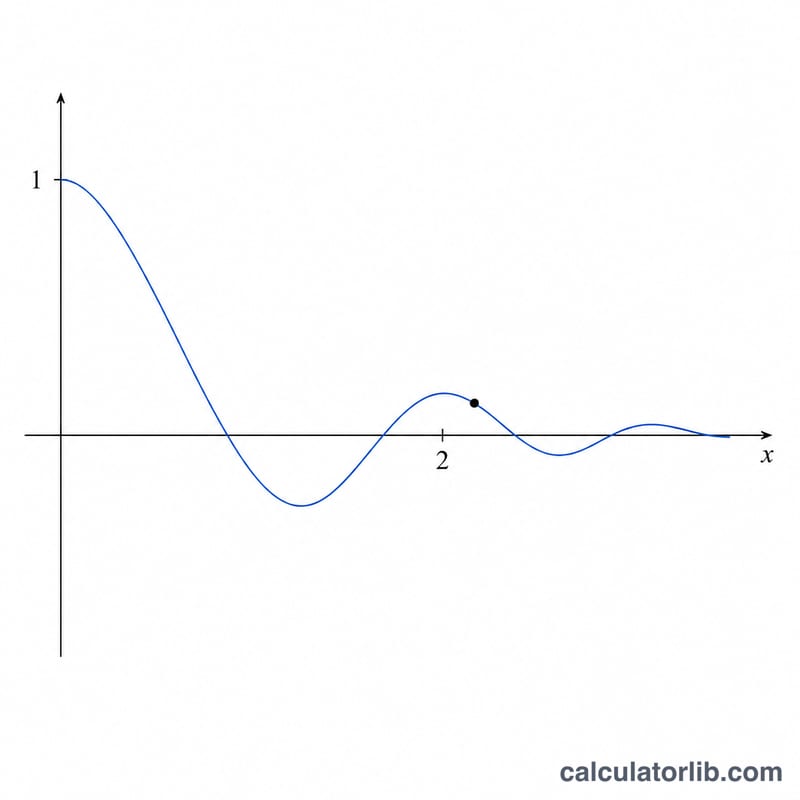
$$j_0(2) = \frac{\sin 2}{2} = 0.4546487134.$$ $$y_0(2) = -\frac{\cos 2}{2} = 0.2080734183.$$ Because \(j'_0 = -j_1\), we get \(j'_0(2) = -0.4353977750\), and \(y'_0 = -y_1\) gives \(0.3506120043\).
FAQ
Does it support complex x? No. The original page accepts complex arguments; this rebuild restricts to real \(x > 0\) for clarity and speed.
Why is \(y_v\) infinite at x = 0? The second-kind functions have a pole at the origin, so their values grow without bound as x approaches 0.
How accurate is it? Computations use double precision, giving roughly 15 significant figures, more than enough for typical engineering and physics work.