
What this calculator does
This tool evaluates the two linearly independent solutions of Bessel's differential equation, \(x^2 y'' + x y' + (x^2 - v^2)y = 0\): the Bessel function of the first kind \(J_v(x)\), the function of the second kind \(Y_v(x)\) (also called the Neumann function), and their first derivatives \(J'_v(x)\) and \(Y'_v(x)\). It accepts any real order \(v\) (integer, fractional or negative) and a real argument \(x\). Bessel functions appear throughout physics and engineering — vibrating circular membranes, heat conduction in cylinders, electromagnetic waves in waveguides, and signal processing.
How to use it
Enter the Order v (for example 0, 1, or 0.5), the Argument x, and choose how many display digits you want. Press calculate to see all four values. For non-integer order use \(x \geq 0\), because \((x/2)^v\) becomes complex for negative \(x\). At \(x = 0\) the second-kind functions are singular and are flagged as undefined.
The formula explained
\(J_v(x)\) is computed from its power series using the gamma function, summed term by term with a stable recurrence until terms fall below tolerance. $$J_{\nu}(x) = \sum_{k=0}^{\infty} \frac{(-1)^{k}}{k!\,\Gamma(\nu+k+1)} \left(\frac{x}{2}\right)^{2k+\nu}$$ \(Y_v(x)\) for non-integer order uses $$Y_{\nu}(x) = \frac{J_{\nu}(x)\cos(\nu\pi) - J_{-\nu}(x)}{\sin(\nu\pi)}$$ for integer order the calculator perturbs \(v\) slightly (by \(10^{-7}\)) to avoid division by \(\sin(v\pi)=0\). Derivatives use the recurrence $$C'_{\nu}(x) = \tfrac{1}{2}\bigl(C_{\nu-1}(x) - C_{\nu+1}(x)\bigr)$$ with the special case \(C'_0(x) = -C_1(x)\).
Worked example
For \(v = 0\) and \(x = 1\): the series for \(J_0(1)\) gives $$1 - 0.25 + 0.015625 - 0.000434 + \dots \approx 0.7651977$$ The known values are \(Y_0(1) \approx 0.0882570\), \(J'_0(1) = -J_1(1) \approx -0.4400506\), and \(Y'_0(1) = -Y_1(1) \approx 0.7812128\).
Key Terms and Variables
- Order \(\nu\)
- The parameter \(\nu\) in \(J_\nu(x)\) and \(Y_\nu(x)\) that sets the form of the differential equation \(x^2 y'' + x y' + (x^2-\nu^2)y = 0\). It may be any real number; integer orders (\(\nu = 0,1,2,\dots\)) arise from angular separation in cylindrical coordinates, while half-integer orders give spherical Bessel functions expressible in elementary functions.
- Argument \(x\)
- The independent variable at which the function is evaluated, typically a scaled radial distance \(x = kr\). For real \(x\), \(J_\nu\) is real-valued for integer \(\nu\), and \(Y_\nu\) is defined only for \(x>0\).
- Bessel function of the first kind \(J_\nu(x)\)
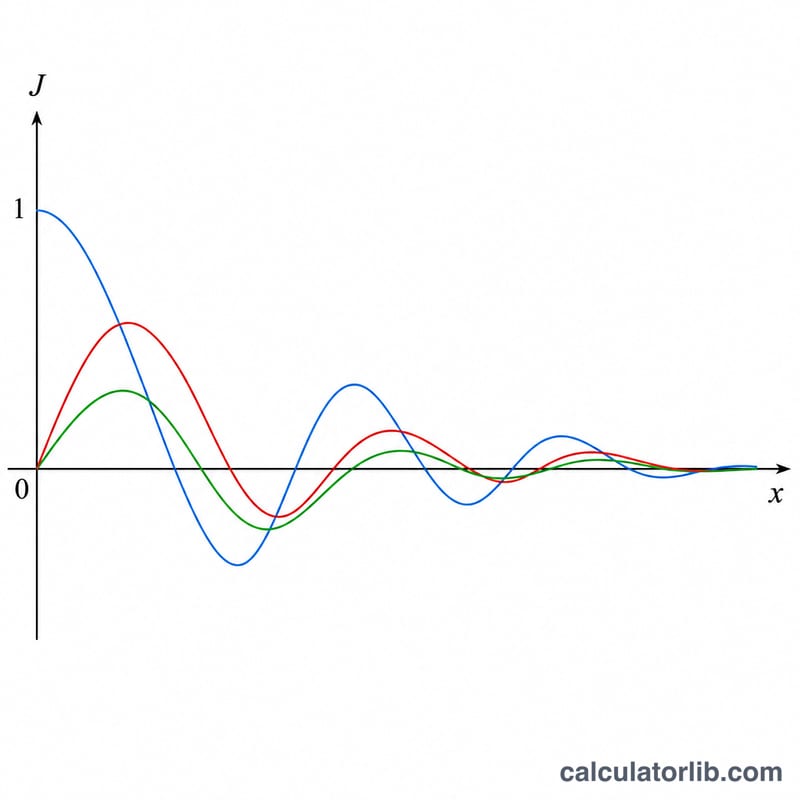
- The solution that is finite at the origin (for \(\nu\ge 0\)), defined by the series \(J_\nu(x)=\sum_{k=0}^{\infty}\frac{(-1)^k}{k!\,\Gamma(\nu+k+1)}\left(\tfrac{x}{2}\right)^{2k+\nu}\). It oscillates with slowly decaying amplitude as \(x\) increases.
- Bessel function of the second kind \(Y_\nu(x)\)
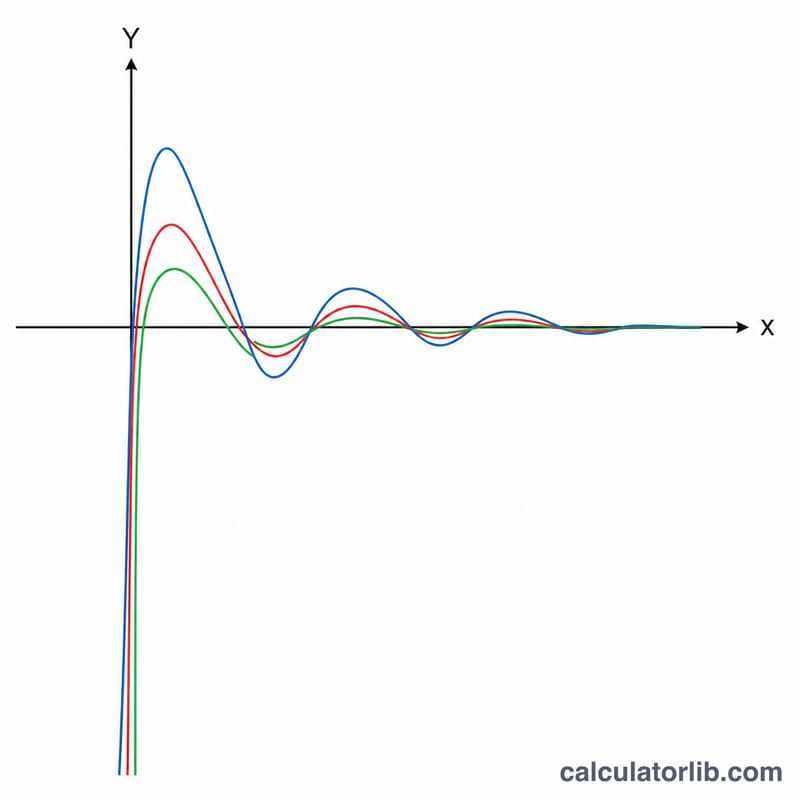
- Also called the Neumann (or Weber) function, this is the second linearly independent solution. It is defined via \(Y_\nu(x)=\dfrac{J_\nu(x)\cos(\nu\pi)-J_{-\nu}(x)}{\sin(\nu\pi)}\) (with a limiting form for integer \(\nu\)) and diverges logarithmically or as a power of \(x\) at the origin.
- Derivatives \(J'_\nu(x)\), \(Y'_\nu(x)\)
- The derivatives with respect to \(x\). They satisfy the recurrence \(C'_\nu(x)=\tfrac{1}{2}\bigl(C_{\nu-1}(x)-C_{\nu+1}(x)\bigr)\) and \(C'_\nu(x)=C_{\nu-1}(x)-\tfrac{\nu}{x}C_\nu(x)\), where \(C\) stands for either \(J\) or \(Y\). In particular \(J'_0(x)=-J_1(x)\).
- Gamma function \(\Gamma(z)\)
- The continuous extension of the factorial, with \(\Gamma(n+1)=n!\) for non-negative integers, appearing in the denominator of the \(J_\nu\) series to allow non-integer order. See the Gamma Function Calculator for individual values.
- Zeros (roots)
- The values \(j_{\nu,m}\) and \(y_{\nu,m}\) where \(J_\nu(x)=0\) or \(Y_\nu(x)=0\). These serve as eigenvalues in boundary-value problems; for example, fixed-edge circular membrane frequencies are proportional to the zeros \(j_{\nu,m}\).
FAQ
Can the order be negative or fractional? Yes. The series and gamma function handle any real \(v\). Just keep \(x \geq 0\) for non-integer \(v\).
Why is Y undefined at x = 0? All second-kind Bessel functions diverge to negative infinity as \(x \to 0\), so no finite value exists there.
How accurate is it? Calculations use double precision (about 15 significant digits). The display-digits option only controls formatting, not the underlying math.