
What this calculator does
This tool works in two directions. In Forward mode it takes an angle and returns all six trigonometric ratios at once: sine, cosine, tangent, cotangent, secant and cosecant. In Inverse mode it takes a ratio value and an inverse function (arcsin, arccos, arctan, arccot, arcsec or arccsc) and returns the angle that produces it. It is pure mathematics, so the results are identical everywhere in the world.
The six ratios on a right triangle
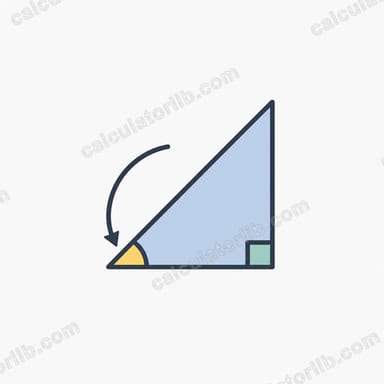
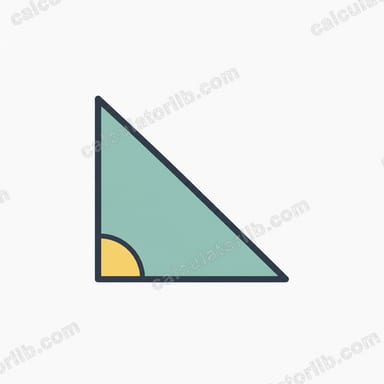
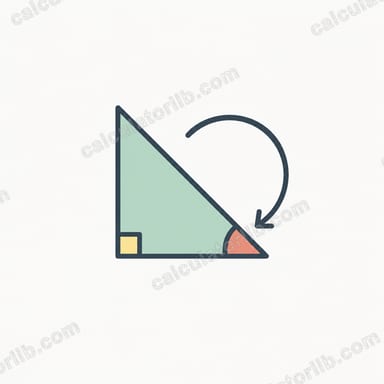
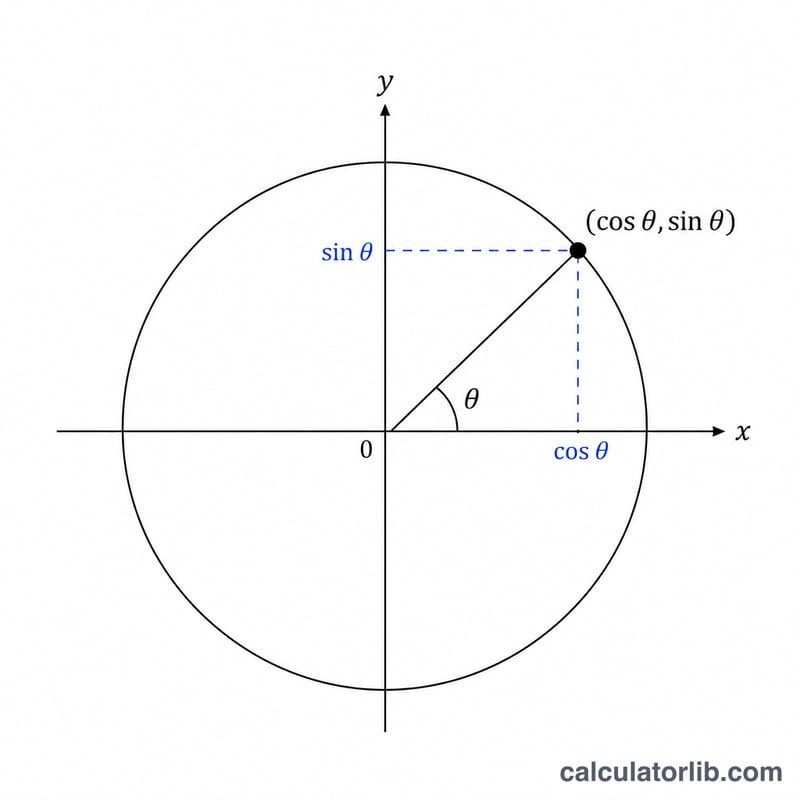
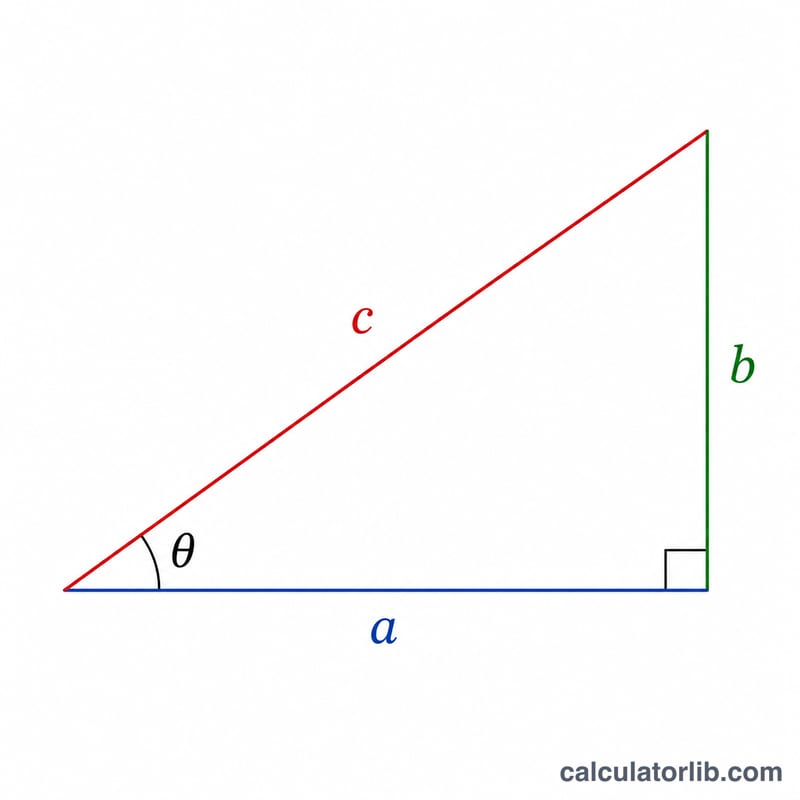
For an angle theta inside a right triangle, label the side across from theta as the opposite, the side next to it (not the hypotenuse) as the adjacent, and the longest side as the hypotenuse. Then $$\sin\theta=\frac{\text{opp}}{\text{hyp}},\quad \cos\theta=\frac{\text{adj}}{\text{hyp}},\quad \tan\theta=\frac{\text{opp}}{\text{adj}}$$ The remaining three are reciprocals: $$\cot\theta=\frac{1}{\tan\theta},\quad \sec\theta=\frac{1}{\cos\theta},\quad \csc\theta=\frac{1}{\sin\theta}$$
How to use it
Pick a mode. For Forward mode, type an angle and choose its unit (degrees, radians or gradians); the calculator converts to radians internally with the factors \(\pi/180\), \(1\), and \(\pi/200\) respectively. For Inverse mode, choose the inverse function, type the ratio value, and select the unit you want the answer in.
Worked example
Forward, angle = 30 degrees. Converting: $$30 \times \frac{\pi}{180} = 0.5235988 \text{ rad}$$ The ratios are \(\sin = 0.5\), \(\cos = 0.8660254\), \(\tan = 0.5773503\), \(\cot = 1.7320508\), \(\sec = 1.1547005\) and \(\csc = 2\). Inverse check: $$\arcsin(0.5) = 0.5235988 \text{ rad} = 30 \text{ degrees}$$
FAQ
Why does tan or sec sometimes say "undefined"? Tangent and secant both divide by \(\cos\theta\), which is zero at 90 degrees, 270 degrees, and so on. Cotangent and cosecant divide by \(\sin\theta\), zero at 0 and 180 degrees. The calculator detects these and reports "undefined" rather than a meaningless huge number.
Why does an inverse say "out of domain"? arcsin and arccos only accept values from \(-1\) to \(1\), while arcsec and arccsc only accept values with absolute value at least \(1\). Outside those ranges there is no real angle.
What angle range do inverses return? Each inverse returns its principal value: arcsin and arctan in \([-90, 90]\) degrees, arccos in \([0, 180]\), and arccot in \((0, 180)\).