
What it is
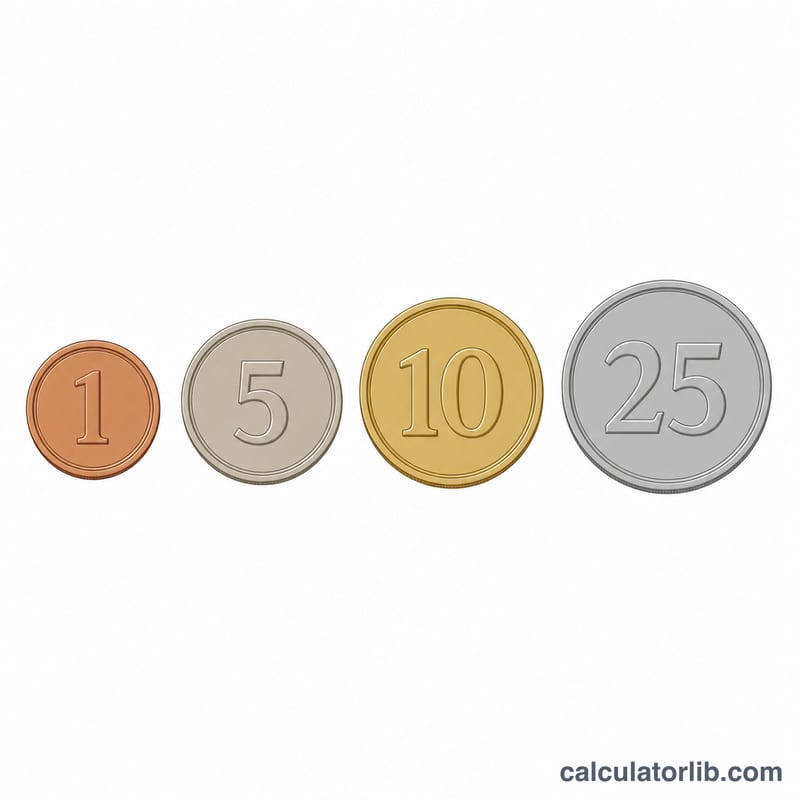
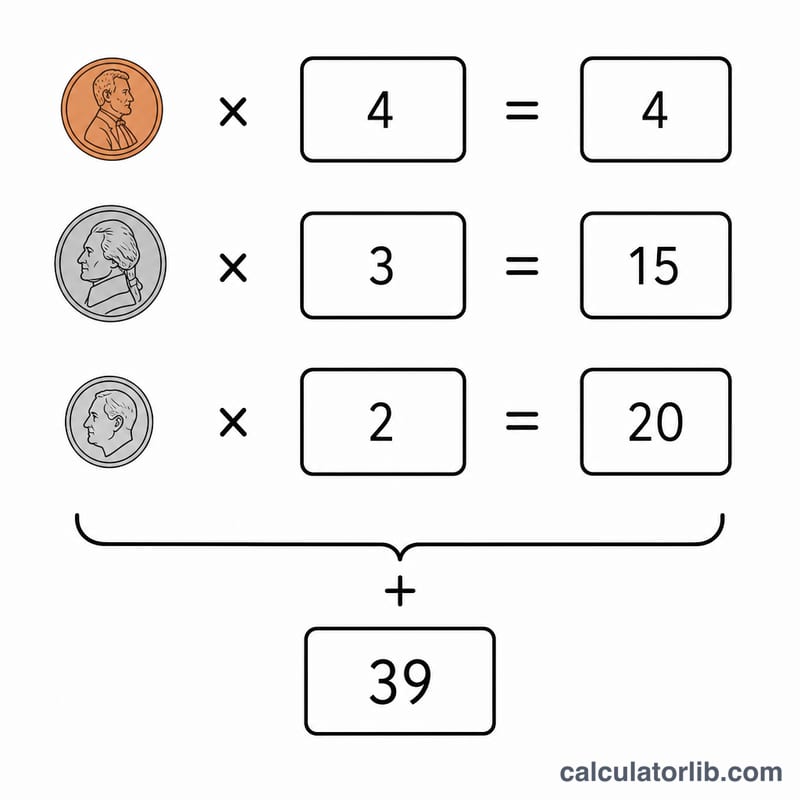
This tool is for the United States coin system. It builds a piggy-bank word problem from US coins (penny $0.01, nickel $0.05, dime $0.10, quarter $0.25, half dollar $0.50), lets you compute the total on paper, and then checks your answer while showing the full worked solution. Non-US users can still use it as a US-coin practice exercise.
How to use it
Pick a coin for each of the three lines and enter how many of that coin are in the bank. Work out the total value yourself, type it into the "Total = $" box, and submit. The calculator tells you whether your answer is right or wrong and displays the step-by-step solution so you can compare your reasoning.
The formula explained
For each coin line you multiply the count by the coin's dollar value, then add the lines together:
$$\text{Total} = (\text{count}_1 \times \text{value}_1) + (\text{count}_2 \times \text{value}_2) + (\text{count}_3 \times \text{value}_3)$$To stay exact, the calculator works in whole cents internally (penny = 1, nickel = 5, dime = 10, quarter = 25, half dollar = 50), sums them, then divides by 100. Your guess is compared after rounding both numbers to the nearest cent, so \(0.1 + 0.05\) style floating-point glitches never cause a false "incorrect".
Worked example
A bank holds 3 pennies, 1 dime, and 4 nickels. In cents: \(3 \times 1 = 3\), \(1 \times 10 = 10\), \(4 \times 5 = 20\).
$$\text{Sum} = 33 \text{ cents} = \$0.33$$Another: 7 dimes, 3 nickels, 10 half dollars gives
$$70 + 15 + 500 = 585 \text{ cents} = \$5.85$$FAQ
Why are my answers checked in cents? Computers store \(0.10\) and \(0.05\) imperfectly, so adding decimals can drift by a fraction of a cent. Comparing whole cents is exact.
What if a coin count is zero? A count of zero simply contributes nothing to the total.
Can I use the same coin twice? Yes. The math just adds the lines together, even if two lines use the same coin.