
What this solver does
This is a multi-mode calculator for the classic algebra and arithmetic word problems you meet in school: counting up the value of a pile of coins, splitting a length into equal pieces, working out how many of each of two coin types you have, finding three people's ages from how they relate, and computing percentage change. Choose a problem type, type the numbers, and you get the answer instantly. All money is shown in US dollars, but the underlying math is universal — swap dollars for any currency or any unit.
How to use it
Pick a Problem type from the dropdown. The form then shows only the inputs that matter for that mode. Enter whole-number coin counts, lengths, ages or money values, and the result appears with the answer plus supporting figures. If a problem has no valid solution (for example two coin types with equal face value, or division by zero), the calculator explains why instead of returning a misleading number.
The formulas explained
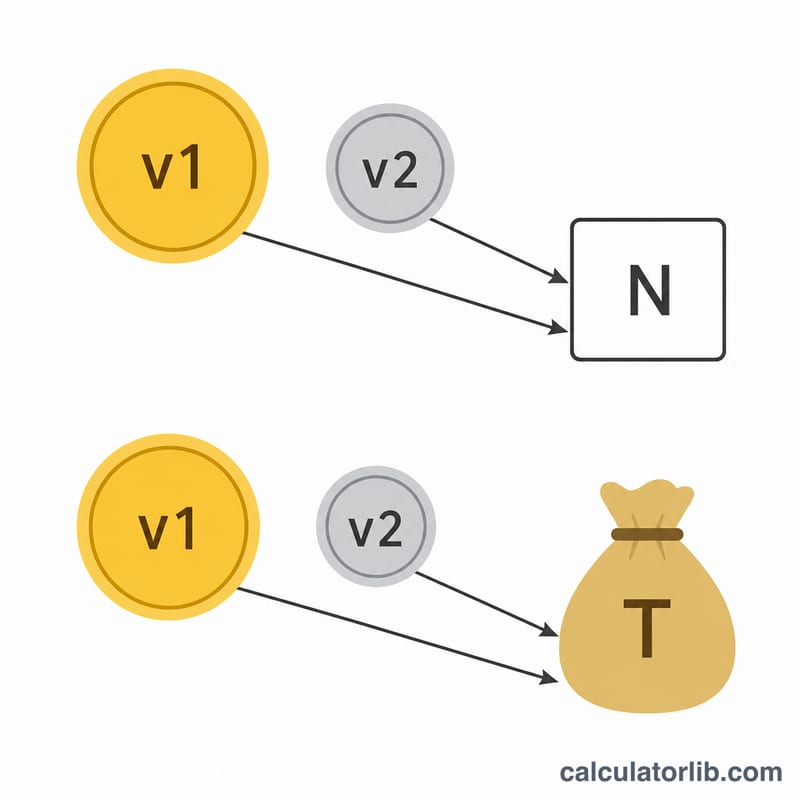
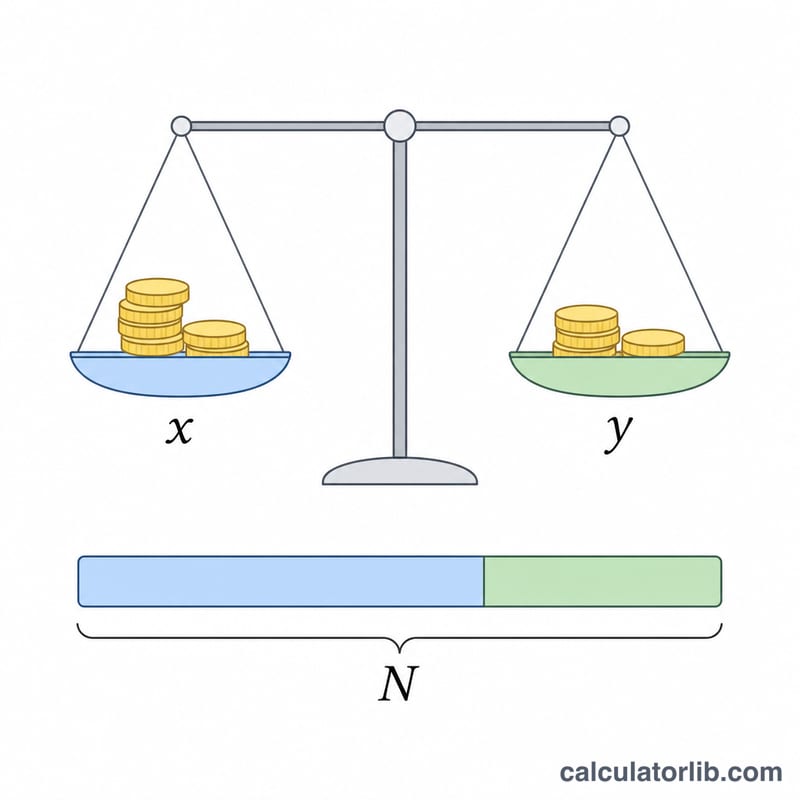
For total coin value, each count is multiplied by its face value in cents (1, 5, 10, 25, 50, 100) and summed; dividing by 100 gives dollars. The total in cents is $$V = 1p + 5n + 10d + 25q + 50h + 100D.$$ For two unknown coin counts, you have two equations: the counts add to the total number of coins \(x + y = N\) and their values add to the total money \(v_1 \cdot x + v_2 \cdot y = T\) cents. Subtracting gives $$y = \dfrac{T - v_1 N}{v_2 - v_1}, \quad x = N - y.$$ For three ages, if two people are younger than a reference by offsets \(o_1\) and \(o_2\) and all three ages sum to \(S\), then \(3a - o_1 - o_2 = S\), so $$a = \dfrac{S + o_1 + o_2}{3}.$$ Percentage change is $$\%\Delta = \dfrac{V_{new} - V_{old}}{|V_{old}|}\times 100.$$
Worked example
Suppose you have 8 coins made of dimes (10¢) and half dollars (50¢) worth $1.60 total. Then \(T = 160\) cents, \(N = 8\), \(v_1 = 10\), \(v_2 = 50\). $$y = \dfrac{160 - 10 \cdot 8}{50 - 10} = \dfrac{80}{40} = 2$$ half dollars, and \(x = 8 - 2 = 6\) dimes. Check: \(6 \cdot 10 + 2 \cdot 50 = 160\)¢ = $1.60. Correct.
US Coin Face Values
Every coin word problem depends on knowing the face value of each coin. Values are listed below in both cents and dollars. Working in cents keeps the arithmetic in whole numbers and avoids rounding errors; convert to dollars only at the end.
| Coin | Value (cents) | Value (dollars) |
|---|---|---|
| Penny | 1¢ | $0.01 |
| Nickel | 5¢ | $0.05 |
| Dime | 10¢ | $0.10 |
| Quarter | 25¢ | $0.25 |
| Half dollar | 50¢ | $0.50 |
| Dollar coin | 100¢ | $1.00 |
To total a mixed pile, multiply the count of each coin by its value and add the products: \(T = 1p + 5n + 10d + 25q + 50h + 100D\) (in cents), where \(p,n,d,q,h,D\) are the counts of pennies, nickels, dimes, quarters, half dollars and dollar coins.
More Worked Examples
1. Total value of a mixed pile
A jar holds 14 pennies, 8 nickels, 12 dimes, 6 quarters and 2 half dollars. Multiply each count by its face value (in cents) and add:
$$T = 1(14) + 5(8) + 10(12) + 25(6) + 50(2)$$ $$T = 14 + 40 + 120 + 150 + 100 = 424 \text{ cents} = \$4.24$$Check: The 6 quarters alone are $1.50 and the 2 half dollars are $1.00, totalling $2.50; the remaining small change ($0.14 + $0.40 + $1.20 = $1.74) brings the total to $4.24. ✓
2. Three related ages
Three siblings have ages that sum to \(S = 48\). The middle child is 4 years older than the youngest, and the oldest is 10 years older than the youngest. Let the youngest age be \(x\). Then the offsets are \(4\) and \(10\):
$$x + (x + 4) + (x + 10) = 48$$ $$3x + 14 = 48 \quad\Rightarrow\quad 3x = 34$$Here \(3x = 34\) is not divisible by 3, so this exact wording has no whole-number solution. Adjusting the sum to \(S = 49\) gives \(3x = 35\) — still not whole. With \(S = 50\): \(3x = 36\), so \(x = 12\). The ages are 12, 16 and 22.
Check: \(12 + 16 + 22 = 50\) ✓, the middle is \(12 + 4 = 16\) ✓, and the oldest is \(12 + 10 = 22\) ✓.
3. Percentage change
A collectible coin rose in value from an old price of $80 to a new price of $92. The percentage change is:
$$\text{change} = \frac{\text{new} - \text{old}}{\text{old}} \times 100\% = \frac{92 - 80}{80} \times 100\%$$ $$= \frac{12}{80} \times 100\% = 0.15 \times 100\% = \href{}{} 15\%$$So the value increased by 15%.
Check: 15% of $80 is \(0.15 \times 80 = \$12\), and \(80 + 12 = 92\), matching the new value. ✓
Key Terms in These Problems
- Total number of coins (N) — the count of all coins combined, regardless of type. In a two-coin problem, \(N = x + y\), where \(x\) and \(y\) are the counts of the two coin types.
- Total amount (T) — the combined monetary value of all the coins, usually expressed in cents during the calculation and converted to dollars at the end.
- Face value (v) — the official value of a single coin (e.g. a dime has \(v = 10\) cents). In the formula, \(v_1\) and \(v_2\) are the face values of the two coin types being solved for.
- Age offset — the fixed number of years one person's age differs from a reference person (typically the youngest). For example, "4 years older" is an offset of \(+4\).
- Age sum (S) — the total of all the ages added together. With a reference age \(x\) and offsets \(a\) and \(b\): \(x + (x+a) + (x+b) = S\), so \(x = (S - a - b)/3\).
- Old value / new value — the starting (original) quantity and the ending quantity in a percentage-change problem. The old value is the baseline against which change is measured.
- Percentage change — the relative difference between the new and old values, \(\dfrac{\text{new} - \text{old}}{\text{old}} \times 100\%\). A positive result is an increase; a negative result is a decrease.
FAQ
Why does it sometimes say "no valid solution"? A coin problem only has a meaningful answer when both counts come out as non-negative whole numbers; otherwise the totals you entered are inconsistent.
Can the ages come out as decimals? Yes — if the sum plus offsets is not divisible by 3 the ages will be fractional, which signals the problem data is not a clean whole-number scenario.
Is this only for US dollars? Money fields are labelled in dollars for convenience, but the arithmetic works for any currency or unit you choose to interpret them as.