
What is FFMI?
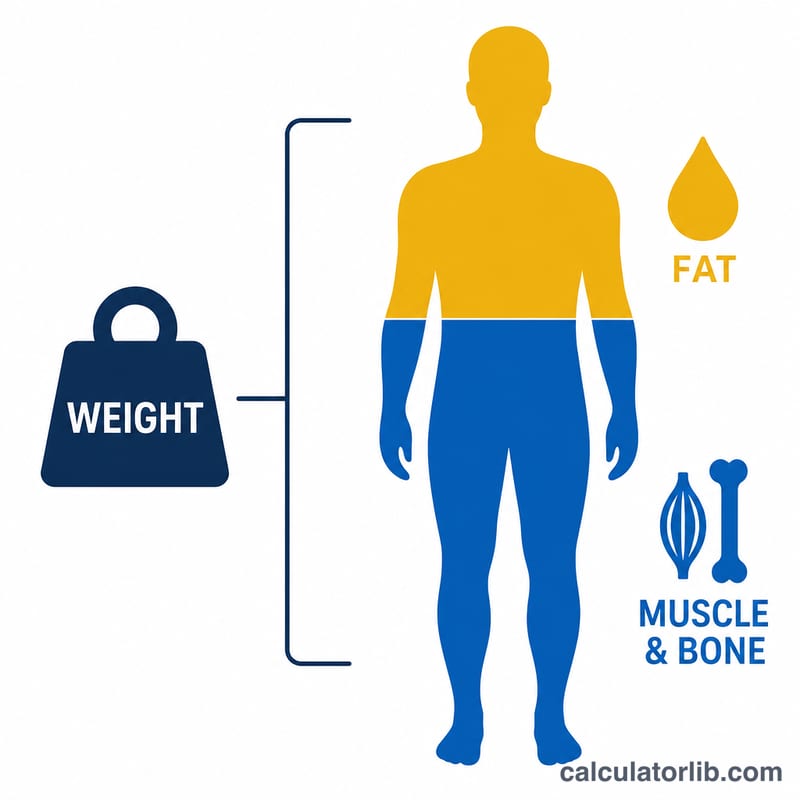
The Fat-Free Mass Index (FFMI) is a measure of how much lean (fat-free) muscle mass you carry relative to your height. It works much like BMI, but instead of using total body weight it uses only your fat-free mass, making it a far better indicator of muscularity. Bodybuilders and strength athletes use FFMI to track progress and to benchmark how developed their physique is.
How to use this calculator
Enter your weight in kilograms, your height in centimetres, and your estimated body fat percentage. The calculator first strips away your fat mass to find your fat-free mass, then divides by your height squared and applies a normalization factor so people of different heights can be compared fairly.
The formula explained
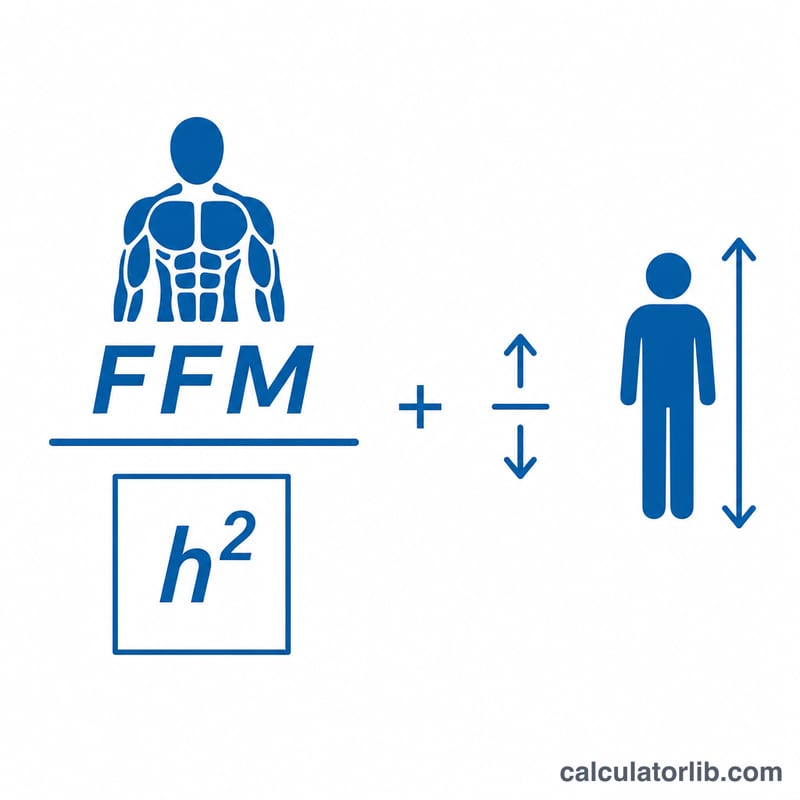
First, fat-free mass is calculated: $$\text{FFM} = \text{Weight} \times \left(1 - \frac{\text{BodyFat\%}}{100}\right)$$ Raw FFMI is then \(\text{FFM} / \text{height}^2\) (height in metres). Because taller people tend to score lower, an adjusted FFMI adds a correction: $$\text{FFMI}_{adj} = \text{FFMI} + 6.1 \times (1.8 - \text{height})$$ normalizing everyone to a 1.8 m reference.
Worked example
A person weighs 80 kg, is 180 cm tall, with 15% body fat. Fat-free mass = \(80 \times (1 - 0.15) = 68\) kg. Height = 1.8 m, so height² = \(3.24\). $$\text{Raw FFMI} = \frac{68}{3.24} \approx 20.99$$ $$\text{Adjusted FFMI} = 20.99 + 6.1 \times (1.8 - 1.8) = 20.99$$ (no adjustment at exactly 1.8 m).
FAQ
What is a good FFMI? For men, ~18–20 is average, 20–22 is fit, and 22–25 indicates an advanced, muscular build. Values above ~25 (drug-free) are rare.
Why use adjusted FFMI? The adjustment removes the height bias in raw FFMI so shorter and taller athletes can be compared on the same scale.
How accurate is it? FFMI is only as accurate as your body fat estimate. Use a reliable measurement method (DEXA, calipers, or BIA) for the best results.