
What is the Fat-Free Mass Index?
The Fat-Free Mass Index (FFMI) measures how much lean (fat-free) mass you carry relative to your height. Unlike BMI, which lumps muscle and fat together, FFMI isolates lean tissue, making it a far better indicator of muscularity. It is widely used in fitness and bodybuilding to assess how developed someone's physique is and is universal — it applies to anyone regardless of country.
How to use this calculator
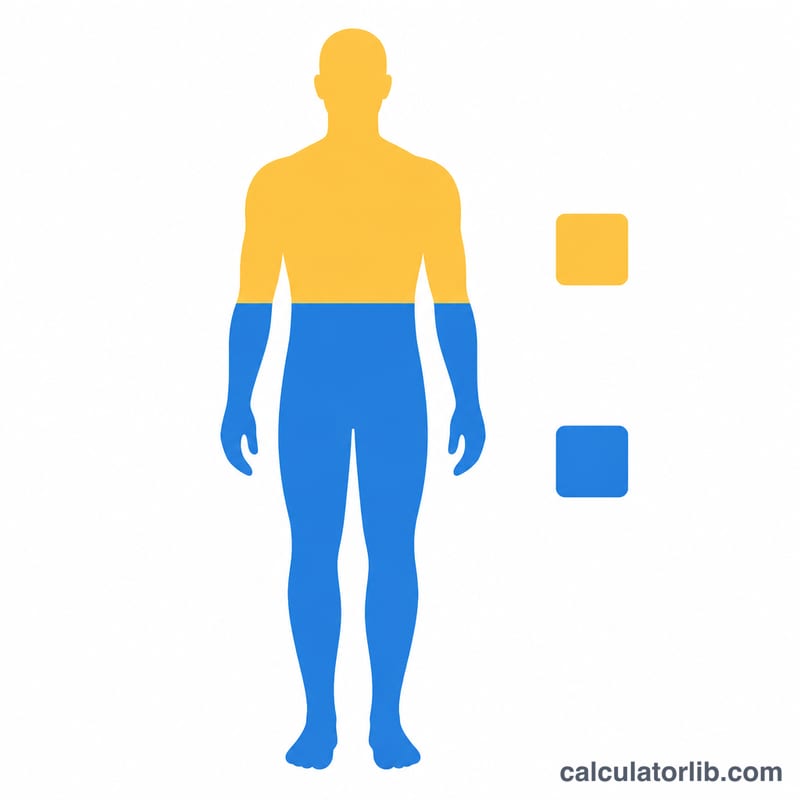
Enter your body weight in kilograms, your height in centimetres, and your estimated body fat percentage. The calculator first works out your lean body mass, then divides it by your height in metres squared to get FFMI. It also reports a normalized FFMI, which corrects the score to a reference height of 1.8 m so taller and shorter people can be compared fairly.
The formula explained
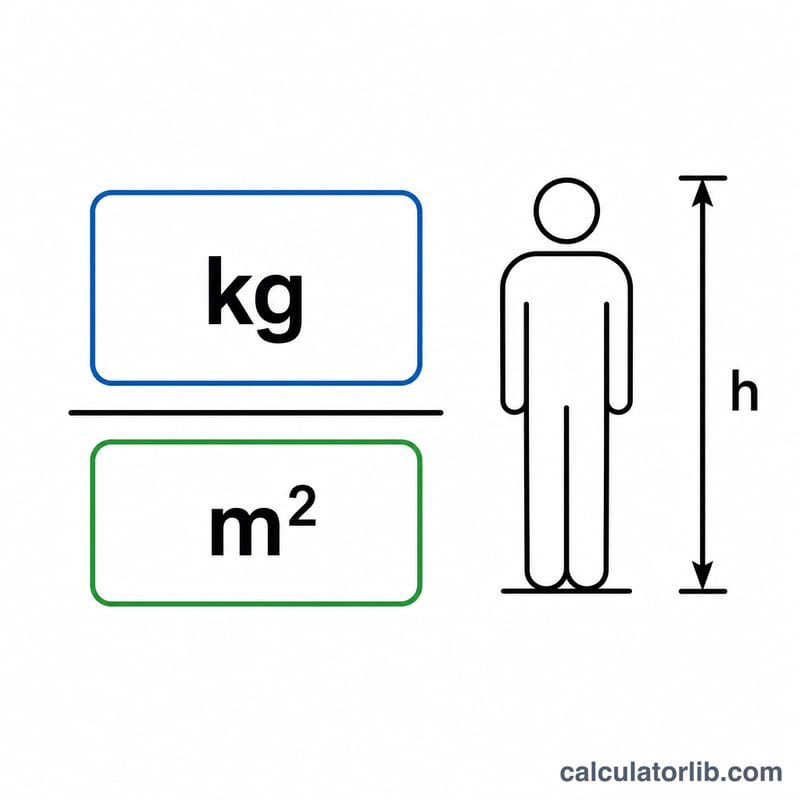
First, lean body mass (LBM) = weight \(\times (1 - \text{body fat\%} / 100)\). Then:
$$\text{FFMI} = \dfrac{\text{LBM}_{kg}}{\text{height}_m^2}$$The normalized version adds \(6.1 \times (1.8 - \text{height in metres})\) to account for height differences:
$$\text{nFFMI} = \text{FFMI} + 6.1\,(1.8 - \text{height}_m)$$A normalized FFMI of roughly 18–20 is average for men, 22–23 is very muscular, and values around 25 approach the natural ceiling.
Worked example
An 80 kg man at 180 cm (1.8 m) with 15% body fat has \(\text{LBM} = 80 \times 0.85 = 68\) kg.
$$\text{FFMI} = \dfrac{68}{1.8^2} = \dfrac{68}{3.24} = 20.99 \ \text{kg/m}^2$$Since height is exactly 1.8 m, the normalized FFMI is also 20.99.
FAQ
Is higher FFMI always better? Not necessarily — very high values can reflect either elite muscle development or measurement error in body fat estimates.
What FFMI is achievable naturally? Research suggests a normalized FFMI of about 25 is near the upper limit for drug-free trainees.
Does FFMI work for women? Yes, though typical values are lower; about 13–15 is average and 18+ is very muscular for women.