
What this calculator does
This tool estimates how many kilograms of pure fat you need to lose to reach a target body fat percentage. It assumes the ideal cutting scenario: you keep all of your lean body mass (muscle, bone, organs, water) and lose only fat. That gives you a concrete weight-loss target instead of a vague goal.
How to use it
Enter your current body weight in kilograms, your current body fat percentage (from a scale, calipers, or DEXA scan), and the body fat percentage you want to reach. The calculator returns the fat mass to lose, your projected goal weight, your unchanging lean mass, and your current fat mass.
The formula explained
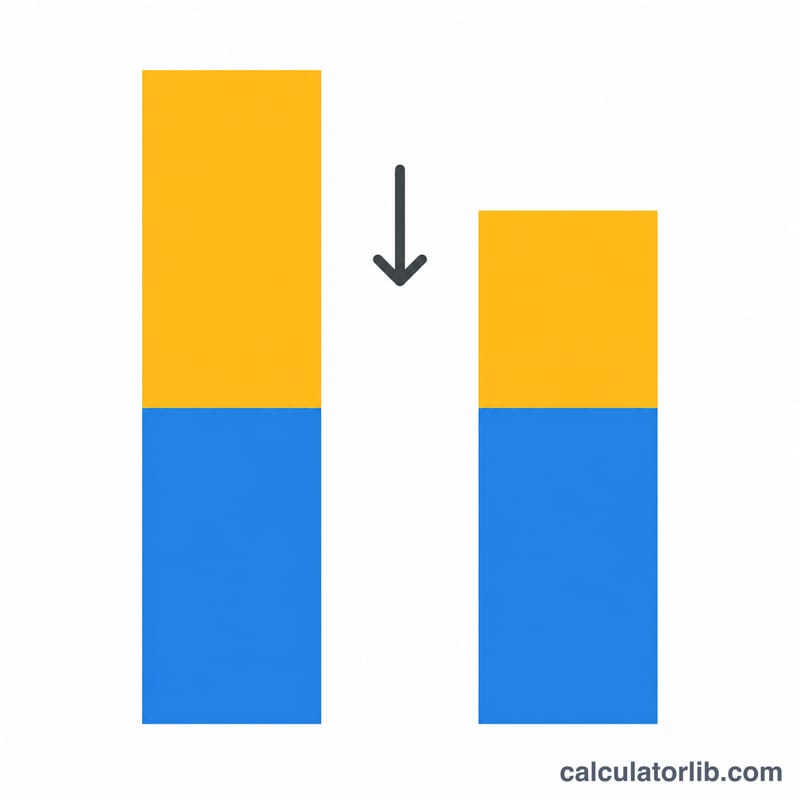
First we find lean mass: $$\text{Lean} = \text{Weight} \times \left(1 - \frac{\text{BF\%}}{100}\right)$$ Because lean mass stays fixed, your goal weight is the weight at which that same lean mass represents (100 − GoalBF%) of the total: $$\text{Goal Weight} = \frac{\text{Lean}}{1 - \frac{\text{GoalBF\%}}{100}}$$ The fat you must lose is simply \(\text{Weight} - \text{Goal Weight}\).
Worked example
Suppose you weigh 80 kg at 25% body fat and want to reach 15%. Lean mass = \(80 \times 0.75 = 60\) kg. Goal weight = \(60 \div 0.85 = 70.588\) kg. Fat to lose = \(80 - 70.588 =\) 9.41 kg. So you'd need to drop about 9.4 kg of fat while preserving all 60 kg of lean tissue.
Body Fat Percentage Categories
The table below shows commonly cited body fat percentage ranges by category and sex, based on the descriptive classifications popularized by the American Council on Exercise (ACE) and consistent with American College of Sports Medicine (ACSM) reference data. Women carry more essential fat than men because of sex-specific (reproductive and hormonal) fat deposits, so each category sits several points higher for women.
| Category | Women | Men |
|---|---|---|
| Essential fat | 10–13% | 2–5% |
| Athletes | 14–20% | 6–13% |
| Fitness | 21–24% | 14–17% |
| Average / acceptable | 25–31% | 18–24% |
| Obese | 32%+ | 25%+ |
Source: American Council on Exercise (ACE) body fat norms, aligned with American College of Sports Medicine (ACSM) reference values. These are descriptive population norms, not diagnostic thresholds — they help you choose a realistic goal body fat percentage for this calculator. Dropping to or below the essential fat range is not a healthy target for most people.
Interpreting Your Result
The number this calculator gives you is a best-case, fat-only target. It answers a clean math question: "If I removed pure fat and nothing else, how many kilograms would I drop to land on my goal body fat percentage?" That makes it an excellent planning figure, but reality is messier than the assumption.
- Real cuts include some lean loss. Even well-run diets shed a fraction of lean mass alongside fat — typically more when the deficit is aggressive, protein is low, or resistance training is absent. Because of this, your scale weight at the goal BF% will usually be a little higher than the goal weight shown here, and total weight lost may exceed the "fat to lose" figure.
- Pace it sensibly. A commonly cited safe rate of fat loss is roughly 0.5–1% of body weight per week, often expressed as about 0.5–1 kg per week. Leaner individuals usually need the slower end to protect muscle. You can translate a target into a timeline with a calorie-deficit weight-loss timeline calculator, since roughly 7,700 kcal corresponds to about 1 kg of body fat.
- Measurement method matters. Your starting body fat percentage is only as good as how it was measured. DXA, hydrostatic weighing, and air-displacement (Bod Pod) are more reliable; skinfold calipers and bioimpedance scales can vary by several points and drift with hydration and time of day. A formula-based estimate such as the Deurenberg BMI method is convenient but the least precise. Because the result scales directly with the inputs, a 3-point error in starting BF% can shift the fat-to-lose figure by a couple of kilograms.
- Re-measure as you go. Treat the output as a moving target — recompute every few weeks with updated weight and a fresh BF% reading rather than trusting a single day-one estimate all the way to the finish.
This is general educational information, not medical or nutritional advice. Goal body fat percentages, safe deficits, and training approaches vary by individual health status — consult a qualified physician or registered dietitian before starting a significant fat-loss plan.
FAQ
Does this account for muscle loss? No. It assumes lean mass is preserved, which is the goal of a well-managed cut with adequate protein and resistance training. Real-world loss usually includes some lean mass, so treat the result as a best-case target.
Can I use pounds? The math is unit-agnostic, so if you enter pounds the result will be in pounds — just be consistent.
Why is my goal weight not just a percentage of current weight? Because only fat is removed, lean mass becomes a larger share of a smaller body, so goal weight must be computed from lean mass, not scaled linearly.