
What is the BMI-method body fat calculator?
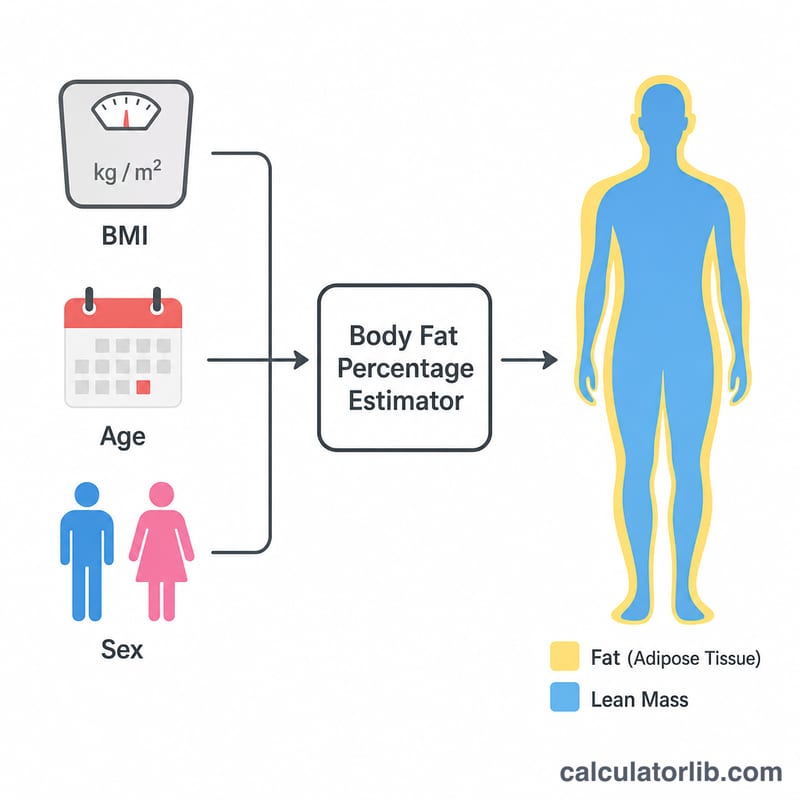
This calculator estimates your body fat percentage using the Deurenberg equation, a widely cited formula that predicts body fat from body mass index (BMI), age and sex. It is a quick, equipment-free alternative to skinfold calipers or body scans. Because it relies only on height, weight, age and sex, it is universally applicable and requires no special measurements.
How to use it
Select your sex, then enter your weight in kilograms, your height in centimetres and your age in years. The calculator first computes your BMI, then applies the Deurenberg formula to estimate body fat percentage. It also reports your estimated fat mass and lean (fat-free) mass in kilograms.
The formula explained
The equation is $$\text{BF\%} = 1.20 \times \text{BMI} + 0.23 \times \text{age} - 10.8 \times \text{sex} - 5.4$$ where sex equals 1 for males and 0 for females. BMI is calculated as weight in kilograms divided by height in metres squared. Fat mass equals weight \(\times\) BF% \(\div\) 100, and lean mass is the remaining weight.
Worked example
For a 30-year-old male weighing 70 kg at 175 cm: height = 1.75 m, so $$\text{BMI} = 70 \div (1.75 \times 1.75) = 22.857.$$ Then $$\text{BF\%} = 1.20 \times 22.857 + 0.23 \times 30 - 10.8 \times 1 - 5.4 = 27.428 + 6.9 - 10.8 - 5.4 = 18.13\%.$$ Fat mass \(\approx 12.7\) kg and lean mass \(\approx 57.3\) kg.
Body Fat Percentage Categories by Sex
Body fat needs vary by sex because women carry more essential fat for reproductive and hormonal function. The table below shows commonly cited classifications based on figures published by the American Council on Exercise (ACE). These are general population reference ranges, not diagnostic thresholds.
| Category | Women | Men |
|---|---|---|
| Essential fat | 10–13% | 2–5% |
| Athletes | 14–20% | 6–13% |
| Fitness | 21–24% | 14–17% |
| Average / Acceptable | 25–31% | 18–24% |
| Obese | 32% and higher | 25% and higher |
Essential fat is the minimum required for normal physiological function; falling below it is associated with health risks. The "fitness" and "average" bands cover most healthy adults, while the "obese" threshold corresponds roughly to the level at which body-fat-related health risk rises.
Interpreting Your Body Fat Result
The Deurenberg equation estimates the proportion of your total body mass that is fat. Comparing this percentage to the category ranges above tells you whether you fall in the essential, athletic, fitness, average, or obese band for your sex.
Two useful figures derive directly from the percentage:
- Fat mass = body weight × (body fat % ÷ 100). This is the absolute weight of stored fat.
- Lean (fat-free) mass = body weight − fat mass. This includes muscle, bone, organs, and water.
For example, a person weighing 80 kg with an estimated 25% body fat has 20 kg of fat mass and 60 kg of lean mass. Tracking lean mass alongside fat mass is helpful because two people at the same weight and BMI can have very different body compositions.
The Deurenberg formula is a population-level estimate built from BMI, age, and sex. Because it relies only on BMI, it cannot see where or how fat and muscle are distributed. As a result it can differ noticeably from a direct measurement such as DEXA, hydrostatic weighing, or skinfold calipers (e.g. the Jackson-Pollock method). Typical differences arise because:
- Muscular individuals and athletes have high BMI from lean tissue, so the equation tends to overestimate their body fat.
- Older adults often lose muscle and gain fat at the same BMI, which the age term partially accounts for but may still not match a scan.
- Very lean, frail, or very tall/short people sit outside the population the equation was fitted to, reducing accuracy.
Treat the result as a rough indicator for tracking trends over time rather than an exact clinical value. This is general educational information and not medical advice; consult a qualified professional for an individual assessment.
FAQ
How accurate is this method? The Deurenberg formula is a population estimate. It can be off by several percent for very muscular, very lean or elderly individuals, since BMI does not distinguish muscle from fat.
Why does sex matter? At the same BMI and age, women carry more essential body fat than men, so the formula subtracts 10.8 points for males.
What is a healthy body fat range? General guidelines suggest roughly 10–20% for men and 18–28% for women, but ranges vary by age and source. Consult a professional for personalised advice.