
What this calculator does
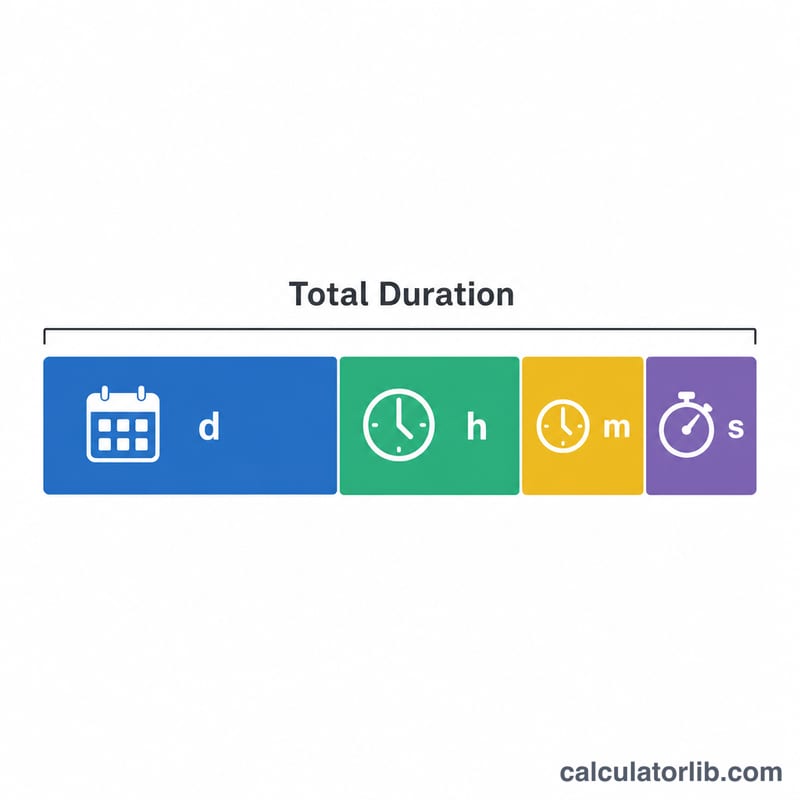
The Time Between Now and Future Date Calculator measures how far away a future moment is from the present. Enter any future date and time and it returns the total number of days, hours, minutes and seconds remaining, plus a friendly breakdown such as "1d 1h 1m 1s". It is handy for countdowns, deadlines, launch dates, exams, birthdays and project planning. The tool works in Coordinated Universal Time (UTC) internally so results are consistent regardless of your server or browser zone.
How to use it
Pick the future date and the time of day. Leave the optional "Reference now" field blank to use the current moment, or supply an epoch-millisecond timestamp to measure from a fixed reference point. The headline shows total days as a decimal; the table beneath shows the exact day/hour/minute/second breakdown and the totals in each single unit.
The formula explained
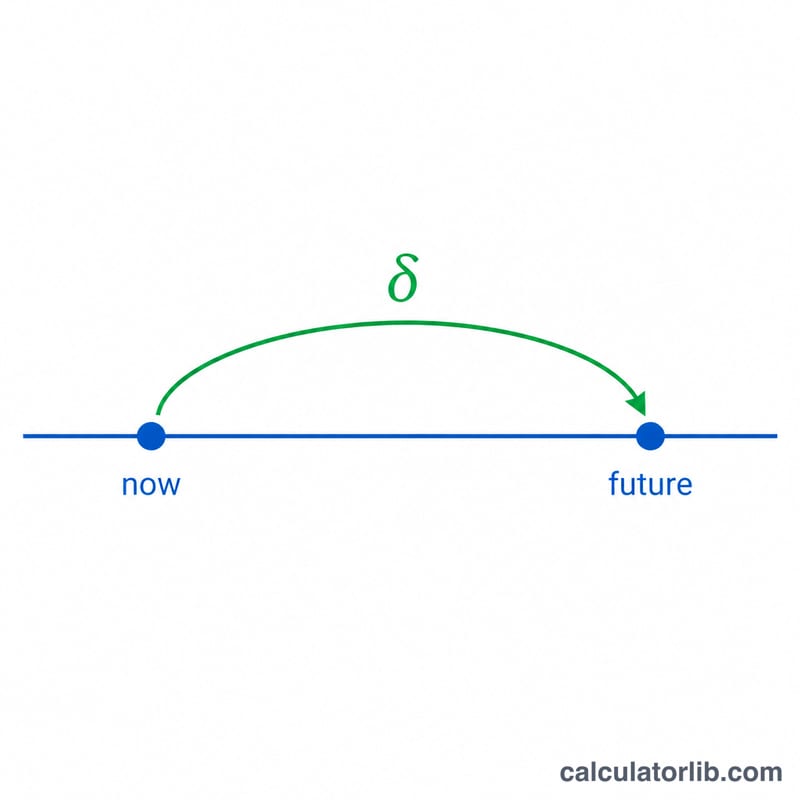
The calculator converts the future date-time to an epoch millisecond value and subtracts the reference now value: $$\text{diff} = \text{future} - \text{now}$$ Dividing the millisecond difference by 1000, 60000, 3,600,000 and 86,400,000 yields total seconds, minutes, hours and days respectively. For the breakdown it takes the absolute seconds, floors out whole days (\(\div 86400\)), then the remaining hours (\(\div 3600\)), minutes (\(\div 60\)) and leftover seconds.
Worked example
Suppose now is exactly midnight UTC on 1970-01-01 (epoch 0) and the future moment is 1970-01-02 01:01:01 UTC. That is 1 day + 1 hour + 1 minute + 1 second $$= 86400 + 3600 + 60 + 1 = 90{,}061 \text{ seconds}.$$ As days that is $$90061 / 86400 \approx 1.0424 \text{ days},$$ and the breakdown is 1d 1h 1m 1s.
FAQ
What if the date is in the past? The totals become negative, but the breakdown shows the absolute magnitude of the gap.
Does it account for leap years? Yes — the epoch conversion uses a calendar-correct day count, so leap days are handled automatically.
What about daylight saving time? Calculations run in UTC, which has no DST, so the elapsed duration is exact.